

Cube Sort: 3D Color Blocks - From Concept to Playable Prototype in Weeks
Genre: Casual Puzzle / 3D Block Sort | Platform: iOS & Android | Scope: Rapid Prototype (MVP) | Delivery: 3 Weeks
Cube sorting is one of the most reliably engaging casual puzzle formats on mobile. The mechanic is intuitive enough to learn in seconds, deep enough to sustain hundreds of levels, and emotionally sticky when paired with the right visual and narrative hooks. The category consistently ranks among the top-performing casual genres on both the App Store and Google Play.
The challenge for any development team is not understanding why it works. The challenge is building a production-quality prototype fast enough to validate the concept before the market window closes or the budget runs out.
That is exactly what this case study is about.
Cube Sort: 3D Color Blocks is a mobile puzzle game where players sort colorful 3D blocks, solve logic challenges, and help cute animals escape from trouble. Every level brings a new cube sorting challenge that tests attention, strategy, and puzzle-solving skills. The game was built by Galaxy4Games as a rapid MVP prototype, using our proprietary Game Application Template and modular solutions library to compress a development cycle that would normally take months into a matter of weeks.
This article breaks down how we did it, what the system looked like under the hood, and what the prototype delivered in terms of playable depth, analytics readiness, and monetization architecture.
The Brief: A Proven Genre, a Tight Timeline
The concept brief for Cube Sort: 3D Color Blocks combined two proven mobile casual formulas: the block-sorting puzzle mechanic and the animal rescue narrative layer that drives emotional engagement and session re-entry.

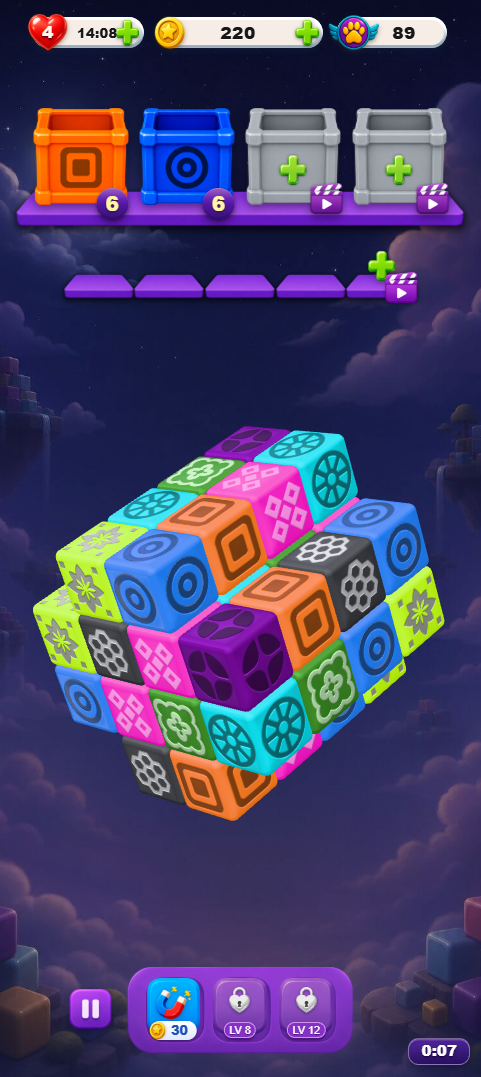

The core gameplay loop is straightforward: players are presented with a set of 3D colored blocks distributed across multiple slots or containers. The goal is to sort them by color, one move at a time, clearing the board and unlocking the next challenge. Each level adds a new constraint, a new configuration, or a new time pressure that keeps the experience from going stale.
Layered on top of that mechanic is a narrative hook: cute animals are trapped or in trouble, and completing each puzzle helps them escape. This is not decoration. Narrative wrapping is a proven retention mechanism in casual puzzle games, giving players an emotional reason to return beyond the puzzle itself.



What the Development Team Needed
The project requirements were defined around three priorities:
-
Speed to prototype: A fully playable build, across multiple levels, within weeks, not months
-
Production quality: Not a throwaway demo. A build that could be used for user testing, investor presentations, and soft-launch validation
-
Scalability: Architecture that could extend to hundreds of levels, LiveOps events, and monetization layers without a rebuild
This is a brief that rewards a team with pre-built infrastructure. Building Cube Sort from a blank slate, even with an experienced team, would realistically take three to four months to reach a production-quality prototype. With our rapid game prototyping system, the timeline compressed to three weeks.
The System Behind the Speed
The three-week delivery was not the result of cutting corners or shipping an incomplete product. It was the direct outcome of building on a foundation that already existed.
Galaxy4Games maintains two core infrastructure assets that every project benefits from: the Game Application Templateand the modular solutions library. Both were built and refined through our own live products, including our published titles on the App Store and Google Play. They are not theoretical frameworks. They are production-tested systems.
Game Application Template: The Starting Line
The Game Application Template is the structural foundation every Galaxy4Games project starts from. Instead of spending the first four to six weeks of a project on scaffolding, the team begins with:
-
Core game architecture, already structured for scalability
-
Platform integrations for iOS and Google Play, pre-configured and compliant
-
Analytics hooks connected and ready to fire from day one
-
Store submission requirements and compliance rules already baked in
-
UI framework with responsive layout and standard navigation patterns
For Cube Sort, this meant the team could focus immediately on the puzzle mechanic itself, the 3D block physics, the sorting logic, and the level design, rather than rebuilding infrastructure that had already been built and tested in previous projects.
The template is not a shortcut. It is a head start built from years of repetition.
Modular Solutions Library: Pre-Built Features, Battle-Tested
The modular solutions library is a collection of production-ready game features and mechanics that plug directly into any project using the template. For Cube Sort, the following modules were deployed:
|
Module |
Function in Cube Sort |
|---|---|
|
Sorting Mechanic |
Core block-sorting interaction, move validation logic, container state management |
|
Progression System |
Level unlocking, difficulty curve management, chapter structure |
|
UI / UX Module |
In-game HUD, pause menu, level complete screens, onboarding flow |
|
Monetization Module |
Rewarded video integration, IAP scaffolding, hint economy |
|
Analytics Module |
Session tracking, level completion rates, funnel events, retention triggers |
|
LiveOps Event Engine |
Infrastructure for future time-limited events and seasonal content |
|
Audio Manager |
Background music, SFX triggers, adaptive audio state management |
Each of these modules had already been deployed in live games before they were used in Cube Sort. The sorting mechanic itself was drawn directly from the library - the core interaction model, move validation logic, and container state management were pre-built and battle-tested. What the team built custom for this project was the 3D visual treatment of the blocks: the physics presentation, depth rendering, and the animation layer that gives the sorting interactions their tactile feel.
This is the structural advantage of mobile game development outsourcing with a studio that operates its own live products. The infrastructure is not borrowed from a template marketplace or assembled from open-source libraries. It was built by the same team that now uses it for client projects, refined by the experience of running real games in a live market.
What Was Built: Prototype Scope and Feature Depth
A prototype that cannot be used for real validation is not a prototype. It is a demo. The distinction matters, because demos get shelved and prototypes get funded.
The Cube Sort prototype was scoped and built to serve as a genuine validation instrument: something that could be put in front of real users, measured against real behavioral data, and presented to investors or publishers as evidence of a viable product.
Core Gameplay Mechanics
The central mechanic is a 3D block sorting puzzle. Players interact with stacks of colored blocks across multiple containers, moving blocks one at a time to sort them by color. The challenge escalates across levels through:
-
Increasing numbers of containers and color variants
-
Restricted move counts that require forward planning
-
Locked blocks that cannot be moved until conditions are met
-
Time-pressure variants that add urgency without breaking the core loop
The 3D visual treatment distinguishes the game from the flat 2D block sort genre. Blocks have physical weight and depth, and the sorting animations are designed to feel satisfying rather than purely functional. This is a deliberate design decision: in casual puzzle games, the feel of the interaction is as important as the logic of the puzzle.
Animal Narrative Layer
Each chapter of the game is anchored to a specific animal character in a predicament. Completing the puzzles within a chapter resolves the animal's situation and unlocks the next story beat. This structure serves two functions:
-
Emotional engagement: Players develop mild attachment to the animal characters, which increases session re-entry motivation
-
Natural pacing: Chapter breaks give the level progression a rhythm that prevents the experience from feeling like an endless grind
The narrative layer was designed to be lightweight, requiring minimal content overhead while delivering meaningful emotional impact.
Prototype Delivery Scope
|
Deliverable |
Status at Prototype Completion |
|---|---|
|
Playable levels |
20 fully designed and balanced levels |
|
Chapter structure |
2 complete chapters with narrative framing |
|
Onboarding flow |
First-time user experience with contextual tutorials |
|
Monetization hooks |
Hint system, rewarded video, IAP entry points |
|
Analytics integration |
Full session, level, and funnel event tracking |
|
Platform builds |
iOS and Android builds, store-ready |
|
LiveOps architecture |
Event engine integrated, ready for future content |
Twenty levels across two chapters is not a minimal slice. It is enough content to run a meaningful soft-launch test, collect statistically significant level completion data, and identify the exact difficulty curve adjustments needed before scaling to a full level library.
The prototype was built to be measured, not just played. Every feature decision was made with post-launch analytics in mind.
Analytics Architecture: Built to Validate, Not Just Track
Most prototypes treat analytics as an afterthought: something to be wired up after the product feels stable. This is a strategic mistake. The data you collect in the first days of a soft launch is the most valuable data you will ever have, because it captures real behavior from real users who have no prior exposure to the product.
The Cube Sort prototype was instrumented from day one, using the analytics module from the Galaxy4Games modular solutions library. The integration was not a custom build for this project. It was a pre-wired system, deployed and configured within the first days of development, leaving the team free to focus on level design and gameplay tuning.
What the Analytics Layer Tracks
The instrumentation was designed around the questions that matter most in a casual puzzle MVP validation:
-
Session behavior: How long are players staying? Where are they dropping off? What is the average session length at each level?
-
Level funnel: What percentage of players complete each level on the first attempt? Where does the difficulty curve break?
-
Hint economy: How often are players using hints? At which specific levels? What is the conversion rate from hint use to rewarded video view?
-
Retention signals: Day 1, Day 3, and Day 7 retention rates. Which levels correlate with early churn?
-
Monetization funnel: Rewarded video impression rate, completion rate, and IAP entry point engagement
Why This Matters for MVP Game Development
The analytics architecture built into Cube Sort is not decorative. It is the mechanism by which the prototype becomes a business decision tool.
A standard MVP game development approach delivers a playable product. The Galaxy4Games approach delivers a playable product with a measurement system already embedded, so that the first week of user data immediately answers the questions that determine whether to scale, pivot, or stop.
The difference between a prototype that gets funded and one that gets shelved is usually not the gameplay. It is the data.
For any startup or publisher evaluating MVP game development partners, the analytics readiness of the prototype is as important as the gameplay quality. Both need to be production-grade from day one.
Monetization Design: Casual-First, Conversion-Ready
Monetization in casual puzzle games follows a well-established hierarchy. Rewarded video is the primary revenue driver in the early stages of a game's lifecycle. In-app purchases become increasingly important as the player base matures and a segment of engaged players begins to self-select as paying users. The architecture needs to support both from the start, even if only one is active at launch.
The Cube Sort prototype was built with this hierarchy in mind.
The Hint Economy
The core monetization entry point in Cube Sort is the hint system. When a player is stuck on a level, they can request a hint that reveals the next optimal move. Hints are a limited resource, consumed from a pool that refills over time or can be replenished immediately through a rewarded video ad.
This design serves three purposes:
-
Reduces frustration-driven churn: Players who would otherwise quit a difficult level are given a path forward
-
Creates a natural ad inventory: Every hint request is a potential rewarded video impression, generated by genuine player need rather than forced placement
-
Establishes IAP value: Players who exhaust their hint pool and want more immediately can purchase a hint bundle, making the IAP proposition self-evident
Rewarded Video Integration
The rewarded video integration in Cube Sort was built using the monetization module from the modular solutions library. The integration handles:
-
Ad network SDK initialization and mediation configuration
-
Placement logic tied to hint economy depletion events
-
Completion tracking for analytics (which players watched, at which levels, and what they did next)
-
Fallback behavior when no ad is available
The placement logic is not arbitrary. It fires at the moment of maximum player motivation: when they are stuck, engaged with the puzzle, and actively looking for a way to continue. This is the highest-value ad placement in casual games, and it is built into the prototype from day one.
IAP Scaffolding
The IAP architecture in the Cube Sort prototype includes:
-
Hint bundle purchases (small, medium, large pack tiers)
-
Ad-free experience purchase
-
Starter pack with combined hint and currency value
None of these were active at prototype stage. The scaffolding was built so that enabling any of them for a soft launch or full release requires configuration, not engineering. This is the difference between a prototype built for speed and a prototype built for scale.
The 3-Week Timeline: How the Development Cycle Ran
Three weeks is a short development cycle for any mobile game. For a casual puzzle game with 3D visuals, a narrative layer, analytics integration, and dual-platform delivery, it is only achievable with a pre-built foundation and a team that has done this before.
Here is how the Cube Sort development cycle was structured:
Week 1: Foundation and Core Mechanic
The first week focused on two parallel tracks: deploying the Game Application Template for the Cube Sort project and building the core sorting mechanic from scratch.
The template deployment covered platform setup, build pipeline configuration, analytics hook activation, and UI framework initialization. This work, which would typically take three to four weeks on a greenfield project, was completed in two days.
The remaining time in week one was dedicated entirely to the 3D block sorting mechanic: the physics, the interaction model, the sorting validation logic, and the first pass of the visual language for the blocks and containers.
By the end of week one: A playable single-level prototype with functional sorting mechanics and the full technical foundation in place.
Week 2: Level Design, Narrative, and Module Integration
The second week expanded the prototype from a single mechanic into a structured experience. Level design began in earnest, with the team building and balancing the first ten levels across two difficulty tiers. The animal narrative layer was integrated, with character art, chapter framing, and the first story beats connected to level progression.
Module integration ran in parallel: the progression system, UI/UX module, hint economy, and audio manager were all deployed and configured during this week.
By the end of week two: Ten playable levels, two animal characters, a functioning hint system, and a complete UI shell.
Week 3: Completion, Polish, and Platform Builds
The final week completed the level library to twenty levels, tuned the difficulty curve based on internal playtesting, integrated rewarded video, and finalized the onboarding flow. Platform builds for iOS and Android were compiled, tested, and verified against store submission requirements.
Analytics event validation was completed in the final two days, confirming that every tracked event fired correctly and that the data pipeline was clean before any external testing began.
By the end of week three: A production-quality prototype, fully instrumented, dual-platform, with twenty levels and a complete monetization architecture.
The speed was not accidental. It was the result of a system designed specifically to eliminate the setup work that consumes the first weeks of every game development project.
What This Demonstrates About the Galaxy4Games Approach
Cube Sort: 3D Color Blocks is one data point in a larger pattern. It follows the same development model used for Pawdoku: Animal Logic Puzzle and for our own live products. The system does not change based on the genre or the client. It is the foundation every project starts from.
What Cube Sort specifically demonstrates is the range of the system. Pawdoku validated the approach for a 2D logic puzzle with a grid-based mechanic. Cube Sort applied the same infrastructure to a 3D physics-driven sorting mechanic with a different visual language, a different narrative structure, and a different monetization entry point. The result was the same: a production-quality prototype in three weeks.
What Clients Get That They Cannot Build Themselves
The honest answer to "why outsource to Galaxy4Games rather than build in-house or use a generalist studio" comes down to one thing: the infrastructure.
Building the Game Application Template, the modular solutions library, and the LiveOps-ready framework from scratch requires years of development and the operational experience of running live games. Most startups and publishers do not have that. They have a game idea, a budget, and a timeline.
What the Galaxy4Games system delivers is the equivalent of skipping the first six months of any game development project, because that work has already been done, tested in live products, and refined into a reusable foundation.
|
What a greenfield build requires |
What the Galaxy4Games system provides |
|---|---|
|
4-6 weeks of platform and architecture setup |
2 days of template deployment |
|
Custom analytics integration |
Pre-wired analytics module, ready to configure |
|
Custom UI framework build |
Production-tested UI module, deployed immediately |
|
Custom monetization integration |
Rewarded video and IAP module, pre-built |
|
LiveOps infrastructure (if ever built) |
Event engine included by default |
|
3-4 months to production prototype |
3 weeks to production prototype |
The Compounding Advantage
The speed advantage is real. The cost advantage is real. But the less obvious benefit is quality consistency.
When every project starts from the same tested foundation, the failure modes that plague greenfield builds, the platform compliance issues, the analytics gaps, the monetization integration bugs, do not appear. They were already encountered and solved in previous projects. The client gets the benefit of every lesson learned without paying for the learning curve.
This is what it means to partner with a studio that builds and operates its own live games. The knowledge is not theoretical. It is embedded in the infrastructure.
Is Rapid Prototyping Right for Your Game Idea?
Not every game idea needs a three-week prototype. But most benefit from one more than their creators initially expect.
The strongest candidates for rapid MVP game development are projects where the core mechanic is defined but unvalidated, the business case depends on real user data rather than assumptions, and the team needs to move faster than a conventional development timeline allows.
Cube Sort fits all three. The block-sorting mechanic is well-understood as a category, but the specific implementation, the 3D visual treatment, the animal narrative layer, the difficulty curve, these are variables that only user data can validate. Building a full game around unvalidated variables is an expensive way to learn that something needs to change.
When to Use Rapid Prototyping
Consider a rapid prototype when:
-
You have a mechanic concept but need data before committing to a full production budget
-
You are pitching to publishers or investors and need a playable build, not a slide deck
-
You are entering a genre with established competition and need to validate your differentiation
-
You want to test monetization assumptions before building a full level library
-
Your timeline requires a playable build within weeks, not months
When to Go Straight to Full Production
A rapid prototype is not always the right first step. If the mechanic is already validated by prior products, the audience is confirmed, and the business case is clear, a full production build may be more efficient than a phased approach.
The Galaxy4Games team can advise on which approach fits your specific situation. The answer depends on what is known, what is uncertain, and how much risk the project can absorb.
Ready to prototype your game idea? The Galaxy4Games team has built the infrastructure to take a concept from brief to production-quality prototype in weeks. Whether you are a startup validating your first mobile game, a publisher testing a new mechanic, or an entrepreneur who needs a credible build fast, the system is ready.
Talk to the Galaxy4Games team about your project. Bring the concept. We will bring the foundation.