





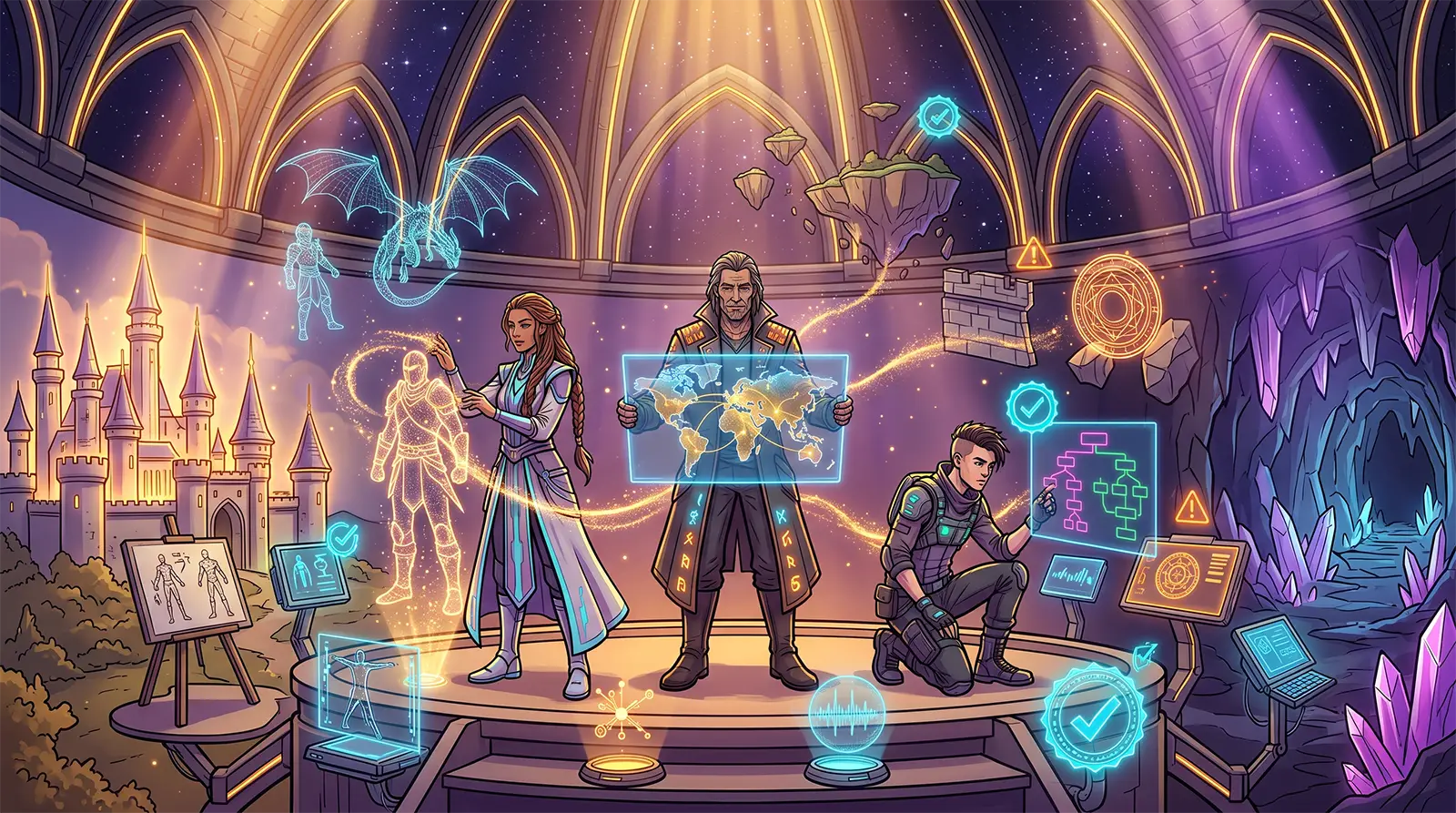
Full-Cycle Game Development Outsourcing for RPGs: What to Look for in a Studio
Quick answer: Full-cycle game development outsourcing for RPGs requires a studio that understands more than game engineering. RPGs demand narrative architecture, world-building systems, deep economy design, and LiveOps infrastructure capable of sustaining a player base over months or years. Most generalist studios underestimate this scope — and RPG projects pay for that underestimation in production overruns, shallow live phases, and commercial underperformance.
Quick navigation:
Why RPG Outsourcing Is a Different Problem
Outsourcing a mobile casual game and outsourcing an RPG are not versions of the same challenge. They are categorically different production problems.
A casual game can be built around a single well-executed mechanic. An RPG requires the simultaneous development and integration of multiple interlocking systems: narrative, combat, progression, economy, world-building, social features, and a LiveOps infrastructure capable of sustaining player investment over a timeline measured in months, not sessions.
Each of these systems influences the others. An economy that is mistuned breaks the progression. A progression system that moves too fast empties the LiveOps calendar. A narrative that doesn't connect to the economy removes the emotional stakes that make spending feel meaningful. RPG development is systems design at depth — and the studios that can execute it well at a full-cycle outsourcing level are significantly fewer than the general mobile development market might suggest.
The market reflects this complexity. Mobile RPGs made up 45% of global RPG revenue in 2023, with the global RPG market projected to reach $68.5 billion by 2027 according to industry tracking data. The genre's commercial scale is matched by its production demands — and the gap between studios that understand those demands and those that don't is where most RPG outsourcing projects run into trouble.
The Full Scope of Full-Cycle RPG Development
Understanding what full-cycle game development outsourcing for RPGs actually covers is essential before evaluating any studio. The scope is significantly broader than most initial briefs acknowledge.
Narrative Architecture
RPG narrative is not copywriting — it is system design. A narrative system for an RPG must account for branching logic, character relationship tracking, quest dependency chains, dialogue state management, and the integration of story beats with gameplay progression milestones.
A studio without narrative system experience will produce dialogue and story content. A studio with genuine RPG narrative capability will produce a narrative architecture that scales across the full game lifecycle — including the live phase, where new story content must integrate with existing character states and player history without breaking previously established narrative logic.
World-Building Systems
World-building in an RPG context goes beyond art direction and lore documentation. It includes the design of exploration systems, map architecture, environment pacing, discovery mechanics, and the spatial relationship between game world geography and gameplay systems.
For mobile RPGs specifically, world-building must be calibrated to the session design constraints of the platform — creating a sense of world depth and exploration that can be experienced in 10 to 20-minute sessions without requiring the player to hold the full world model in memory between sessions.
Combat System Design
Combat is the mechanical core of most RPGs, and one of the most technically intensive systems in production. Full-cycle RPG outsourcing requires a studio that can design, build, and balance a combat system that is deep enough to sustain long-term player engagement, accessible enough to onboard new players efficiently, and extensible enough to support LiveOps content additions without requiring rebuilds.
Studios that build combat systems without extensibility in mind consistently produce RPGs where adding new enemies, abilities, or game modes requires engineering work disproportionate to the content value delivered.
Progression and Economy Design
Progression and economy are the retention and monetization engines of an RPG. They are also the systems most commonly underbuilt by generalist studios that treat them as features rather than as the structural architecture of the game's commercial performance.
A well-designed RPG economy manages the relationship between resource acquisition rates, upgrade costs, content unlock pacing, and monetization touchpoints across a player lifecycle measured in months. Getting this wrong produces either a game that feels pay-to-win within the first week or a game whose players exhaust all available content before the LiveOps calendar can replace it.
LiveOps Infrastructure
RPG LiveOps is more complex than casual game LiveOps because the systems it must interact with are more complex. A LiveOps event in an RPG must integrate with the narrative state, respect the economy balance, interact with the progression system, and deliver content that feels meaningful to players at multiple different progression stages simultaneously.
Building an RPG without LiveOps infrastructure in mind from the start produces a game that is expensive to update, slow to iterate, and prone to breaking existing player states when new content is introduced.
What to Look for When Vetting an RPG Studio
The evaluation criteria for an RPG game development outsourcing partner are more specific than for general mobile development. The following criteria separate studios with genuine RPG capability from those with general mobile experience applying for an RPG brief.
Shipped RPG titles, not just RPG experience. The distinction matters. A studio that has contributed to an RPG as a subcontractor has different knowledge than one that has shipped and operated an RPG from concept to live phase as the primary developer. Ask specifically for titles the studio shipped as lead developer, and verify that those titles are still live and being updated.
Economy design methodology. Ask any prospective RPG studio for hire to walk through how they approach economy design: how they set resource acquisition rates, how they calibrate upgrade costs, how they position monetization touchpoints relative to the progression curve, and how they manage economy balance in the live phase. A studio with genuine economy design capability will have a methodology. A studio without it will describe economy design as a balancing exercise done late in production.
Narrative system architecture. Ask how they structure narrative systems technically: how branching logic is managed, how character state is tracked, how new story content integrates with existing player history. The answer reveals whether the studio thinks about narrative as content or as a system.
LiveOps track record for RPGs specifically. General LiveOps experience is not the same as RPG LiveOps experience. Ask for examples of RPG LiveOps operations the studio has run: what the event cadence looked like, how new content integrated with existing game systems, and what the retention impact of specific events was.
Platform-specific RPG experience. Mobile RPG and PC RPG are different products with different design constraints. A studio with deep PC RPG experience building a mobile RPG will consistently make session design decisions calibrated to a PC play session rather than a mobile one.
|
Vetting Criterion |
What a Strong Answer Looks Like |
Red Flag |
|
Shipped RPG titles |
Named titles, still live, lead developer credit |
"We've contributed to RPG projects" |
|
Economy design |
Specific methodology with progression curve documentation |
"We balance it during QA" |
|
Narrative systems |
Technical architecture description, not content examples |
Portfolio of dialogue without system context |
|
RPG LiveOps |
Named events with retention data |
"We support all genres post-launch" |
|
Mobile RPG specifically |
Session design calibrated to mobile constraints |
PC RPG portfolio only |
Economy Design as a Core RPG Competency
Economy design deserves its own treatment because it is the competency most frequently underestimated in RPG outsourcing briefs and most frequently responsible for RPG commercial underperformance post-launch.
An RPG economy is not a monetization layer applied on top of a game. It is the structural system that governs how players experience progression, how they make decisions about resource allocation, what motivates them to return, and when and why they choose to spend. A well-designed RPG economy is invisible to the player — they experience it as satisfying progression, meaningful choices, and rewarding gameplay. A poorly designed one is immediately visible as either a grind wall or a pay wall.
The specific design decisions that determine RPG economy quality include:
Resource acquisition rate calibration. How fast players earn soft currency, experience, crafting materials, and other progression resources relative to how fast those resources are consumed by the upgrade and content systems. Too fast and the economy deflates. Too slow and the game feels like a grind that can only be escaped through spending.
Monetization touchpoint positioning. The moments in the progression curve where players encounter the option to spend should be positioned at points of genuine player agency — moments where spending feels like an enhancement of an experience they are already enjoying, not a barrier to an experience they are being denied.
Economy extensibility for LiveOps. A live RPG requires the ability to introduce new resources, new upgrade paths, and new monetization mechanics without breaking the existing economy balance. Economy systems not designed for extensibility from the start require increasing engineering investment to update over time.
LiveOps for RPGs: What Sustaining a Live RPG Actually Requires
The live phase of an RPG is where the commercial trajectory of the title is ultimately determined — and it is the phase that most RPG outsourcing briefs underspecify.
Narrative-consistent event content. Events in a live RPG must be consistent with the established world, characters, and narrative logic of the game. An event that contradicts established lore or ignores the player's existing narrative history breaks immersion. This requires a LiveOps content production process integrated with the narrative system — not a generic event template applied to RPG-flavored content.
Progression-aware content design. New content added in the live phase must be designed for players at multiple different progression stages simultaneously. An endgame event inaccessible to Day 30 players, or a new story chapter that assumes progression milestones most players haven't reached, fails a significant portion of the active player base.
Economy-integrated rewards. LiveOps event rewards must be calibrated to the economy balance in the same way that core game content rewards are. An event that distributes resources at a rate inconsistent with the core economy inflates or deflates it in ways that affect the monetization performance of all subsequent content.
Social and guild event infrastructure. RPGs with guild or social features require LiveOps events that activate those social systems — guild challenges, alliance wars, cooperative content. According to the LiveOps Report 2025 by AppMagic, games with regular social or guild events show significantly stronger D60 and D90 retention than those relying exclusively on solo event content.
Why Most RPG Outsourcing Engagements Underperform
The gap between RPG game development outsourcing expectations and outcomes is wider than in most other game genres. The structural reasons are specific and recurring.
Scope underestimation at the brief stage. RPG projects almost universally start with scopes that underestimate the production complexity of the genre's interlocking systems. Economy design, narrative architecture, and LiveOps infrastructure are treated as secondary considerations rather than as the core production investments that determine commercial performance.
Generalist studios applying RPG-adjacent experience. Many studios bid on RPG projects with experience in genres that share some surface characteristics — action games with progression systems, strategy games with economies — but lack the specific RPG production knowledge the genre demands. According to market data, 60% of RPG developers outsource some form of production work, yet a significant portion of those engagements involve generalist partners who are not RPG specialists.
No LiveOps plan at production start. RPG LiveOps is expensive to retrofit. A game built without LiveOps infrastructure in mind requires significant engineering investment to add event management, content delivery, and economy update systems post-launch.
Economy treated as a balancing exercise. Studios that treat economy design as something to be calibrated during QA rather than designed from the start consistently deliver RPGs with economies structurally misaligned with the game's monetization objectives.
Galaxy4Games and RPG Development: Skies — The New World
Galaxy4Games' RPG capability is grounded in the development of Skies: The New World, a post-apocalyptic tactical RPG with a user-driven economy and tokenomy — one of Galaxy4Games' own in-house projects.
Set in the distant future on an Earth that has survived a catastrophe, Skies: The New World places players in a vast desert world divided into thousands of locations. The game combines mining, crafting, business management, and combat in a world governed by player-driven economic systems — a design that demands the full depth of RPG economy design, world-building, and LiveOps infrastructure that client RPG projects require.
The production results are concrete: an Alpha version was available to play within 12 months, and mobile platform availability was achieved within 4 months of Alpha launch thanks to the team's optimization approach.
This experience informs every RPG client engagement Galaxy4Games takes on. The economy design methodology, the world-building systems, the LiveOps framework — these are not approaches adapted from other genres. They are RPG-native systems refined through the real operational demands of building and running a live tactical RPG.
For publishers evaluating RPG outsourcing partners, this distinction is meaningful. A studio that has built and operated its own live RPG brings a category of knowledge that a client-only studio cannot replicate: they have faced the post-launch economy challenges, the narrative continuity demands, and the LiveOps production pressures as product owners, not as vendors.
Conclusion
Full-cycle RPG outsourcing is one of the most complex and highest-stakes outsourcing decisions in game development. The genre demands production depth across narrative, economy, combat, and LiveOps that most generalist studios cannot deliver at a commercial standard.
The studios that can genuinely execute full-cycle RPG outsourcing share specific characteristics: built and operated live RPG titles as lead developer, economy design methodology native to the genre, narrative system architecture built for the live phase, and LiveOps experience specific to RPG content and player bases.
Galaxy4Games is built to meet that standard — with the RPG game development production infrastructure, economy design depth, and LiveOps capability demonstrated through the development and ongoing operation of Skies: The New World, its own in-house Web3 tactical RPG.
Sources
-
Game Outsourcing Services Market Report 2025-2034 — Market.us
-
Mobile Game Development Outsourcing Market Report 2025-2032 — Future Market Report