





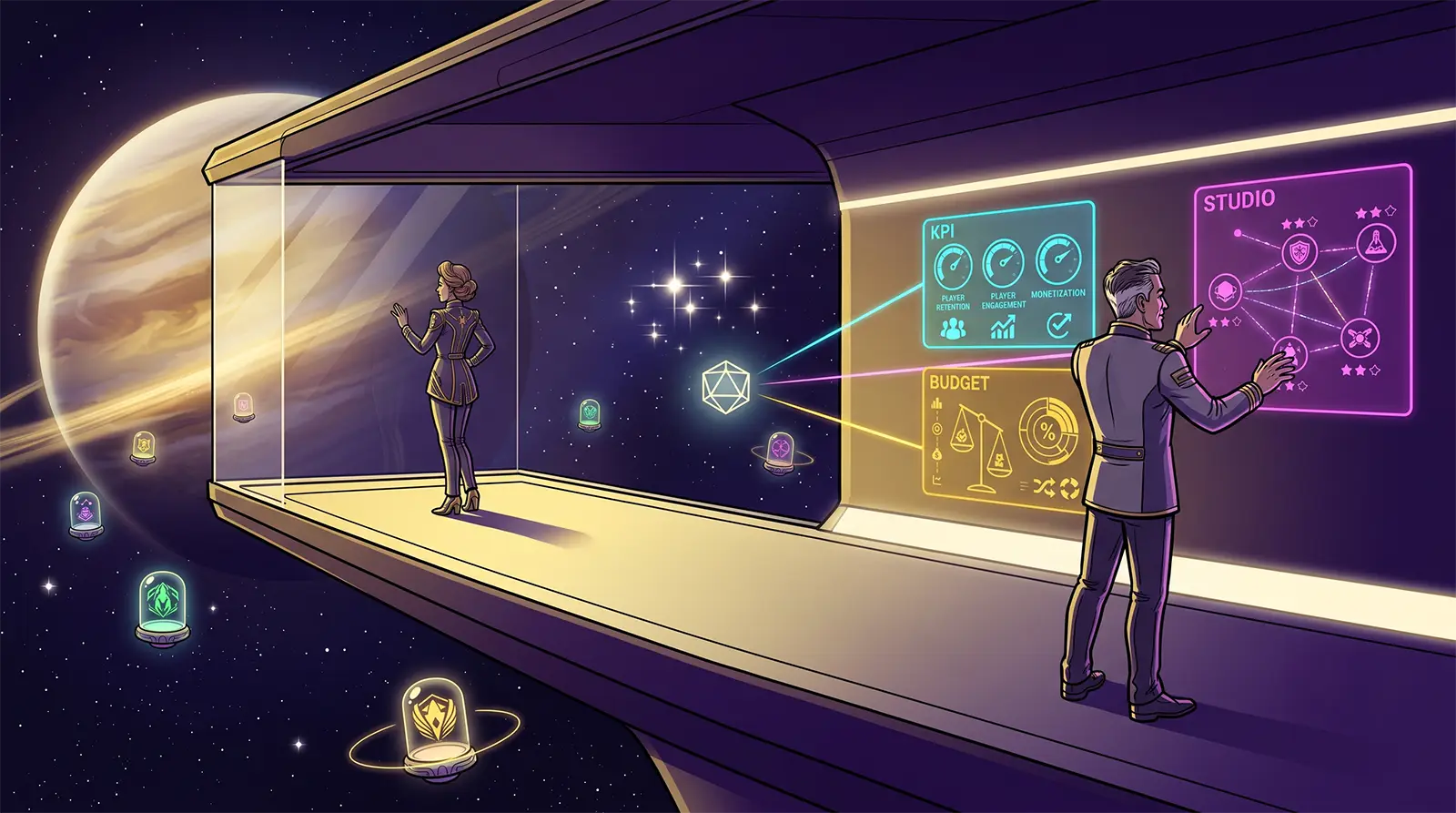
Game MVP Best Practices: KPIs, Budgets and Studios That Can Help
Quick answer: A game MVP is validated when it meets genre-specific KPI thresholds across Day 1 retention, Day 7 retention, and at least one monetization signal — not when it is feature-complete. The most common MVP mistakes are building too much before testing, under-instrumenting for data, and treating the MVP as a throwaway step rather than the architectural foundation of the full game. This guide covers the best practices, the benchmarks, and the studios equipped to execute.
Quick navigation:
What a Validated Game MVP Actually Looks Like
The word "validated" is doing significant work in any MVP discussion. A completed MVP is not a validated MVP. A playable build is not a validated MVP. An MVP is validated when it has been tested with a real audience and generated data that answers the core commercial questions the build was designed to test.
Those questions are specific: Does the core loop retain players past the first session? Does the progression system sustain engagement through the first week? Is there a monetization signal — even a soft one — that indicates players would spend given the right offer at the right moment?
A validated MVP is the evidence that the answer to each of those questions is yes. Everything else — the meta layer, the content library, the full economy, the social features — is built on top of that evidence. Studios and founders that skip the validation step and proceed directly to full production are not building faster. They are building on unvalidated assumptions at full production cost.
According to Zco's Mobile Game Development Guide 2026, most game concepts never make it past the prototype stage, and even those that launch often disappear within weeks. The games that survive made deliberate execution choices — and the MVP phase is where the most consequential of those choices are made.
Game MVP Best Practices
1. Define the Hypothesis Before Defining the Scope
The scope of an MVP is not a feature list. It is the minimum set of systems required to test a specific hypothesis about whether the game will retain and monetize.
Before a single feature is scoped, the team should be able to complete this statement: "We believe this game will retain players because [X mechanic creates Y behavior], and we will know it is working when [specific KPI] reaches [specific threshold]."
Every feature in the MVP is then evaluated against that hypothesis. Features that don't contribute to testing it are out of scope — not because they are unimportant, but because building them before the hypothesis is validated is spending budget on assumptions.
2. Scope the Core Loop First, Everything Else Second
The core loop is the single repeating unit of gameplay that defines the player experience. It is the first thing that should be playable in any MVP build, and the most important thing to get right before adding any surrounding systems.
A strong core loop can be experienced completely — start, play, resolution — within a single session. It should be understandable without explanation, generate intrinsic satisfaction on completion, and create a clear motivation to repeat. If the core loop requires onboarding instructions to initiate, it is not yet clear enough for the MVP.
Everything else — meta progression, economy, social features, content volume — is built around a validated core loop, not before it.
3. Build for Measurement from Day One
An MVP without analytics instrumentation is not an MVP — it is a demo. The data an MVP generates is its primary output. Without measurement, the build produces anecdotes, not evidence.
The minimum analytics requirement for a game MVP includes session length tracking, Day 1 and Day 7 return rate tracking, core loop completion rate, drop-off point mapping, and at least one monetization event — even a simulated or soft one.
According to GameAnalytics' 2026 data from 16,000+ live mobile games, the median D1 retention across all projects sits around 22%, meaning half of all games lose nearly four out of five players within 24 hours. Without instrumentation, a team cannot know whether they are above or below that median — or why.
4. Instrument for the Right Metrics, Not All Metrics
Building for measurement does not mean tracking everything. An MVP analytics setup that generates hundreds of events but cannot clearly answer "what is our Day 1 retention and where are players dropping off?" is more confusing than useful.
The MVP metrics that matter most are those that directly validate or invalidate the hypothesis: retention rates at Day 1, Day 3, and Day 7; session length and frequency; core loop completion rate; and the first monetization signal. Secondary metrics — social sharing, achievement unlocks, feature-level engagement — add context but should not distract from the primary validation signals.
5. Test with the Target Audience, Not Internal Teams
Internal playtesting produces feedback about whether the game is working as intended. Target-audience playtesting produces feedback about whether the game is working at all. These are different questions with different answers.
A casual game that is perfectly balanced for the team that built it — who understand the mechanic, have played through it hundreds of times, and are motivated to see it succeed — will feel very different to a cold player encountering it for the first time with no investment in its success.
MVP playtesting should involve a minimum of 10 to 15 players from the target demographic who have never seen the game before, observed without coaching, with session length, drop-off points, and verbal reactions all documented. The data from this testing should drive onboarding iteration before any UA spend begins.
6. Treat the MVP as the Architectural Foundation
The most expensive MVP mistake — more expensive than building too many features or skipping analytics — is treating the MVP as a throwaway build. Studios that build MVPs as disposable prototypes and then rebuild for full production pay twice: once for the MVP and once for the architectural work they avoided during it.
A properly built MVP is the foundation on which full production is built. The core loop architecture, the analytics instrumentation, the monetization scaffolding, and the LiveOps infrastructure established in the MVP phase should be the same systems that scale into the full game. The MVP is not a proof of concept — it is the beginning of the production codebase.
7. Resist Scope Creep During the MVP Phase
Scope creep is the single most consistent timeline and budget killer in MVP development. The features that get added during the MVP phase are almost always features that were correctly excluded from the original scope — and their inclusion during MVP production delays the point at which the core hypothesis is tested without meaningfully improving the test.
The discipline required to hold MVP scope against the pressure to add features is a founder and studio capability question, not just a process one. Studios that build MVPs well have established processes for evaluating scope addition requests against the core hypothesis rather than against feature desirability.
The KPI Benchmarks That Define MVP Validation
Understanding what "good" looks like for MVP KPIs is essential for interpreting the data an MVP generates. Without benchmarks, a Day 1 retention of 28% is just a number. With benchmarks, it is a signal that the core loop is below the casual genre threshold and the onboarding needs work before UA begins.
Retention Benchmarks
|
Metric |
Strong |
Average |
Needs Work |
|
D1 Retention (Casual) |
35%+ |
25–35% |
Below 25% |
|
D1 Retention (Hybrid Casual) |
35–40% |
30–35% |
Below 30% |
|
D1 Retention (Mid-Core) |
30–40% |
22–30% |
Below 22% |
|
D7 Retention (Casual) |
15%+ |
10–15% |
Below 10% |
|
D7 Retention (Hybrid Casual) |
18–22% |
12–18% |
Below 12% |
|
D7 Retention (Mid-Core) |
15–22% |
10–15% |
Below 10% |
According to GameAnalytics 2026 data, the top 25% of mobile games achieve 7 to 8% D7 retention across all genres — but genre-specific targets are meaningfully higher. A casual game at 8% D7 is in the industry-wide top quartile but below the casual genre benchmark, because casual games outperform the cross-genre average.
According to Adjust's Gaming App Insights Report 2026, global D1 retention for gaming sits at 27%. If your MVP is below that threshold, scaling UA will accelerate losses rather than growth.
Monetization Signal Benchmarks
A full economy is not required to generate a monetization signal in an MVP. What the MVP needs to produce is evidence that players would spend given the right offer at the right moment.
|
Signal |
What It Indicates |
|
Rewarded ad opt-in rate above 20% |
Players are motivated enough to trade attention for in-game value |
|
Soft currency spend at first offer above 15% |
Players are engaging with the economy and making allocation decisions |
|
IAP conversion above 1% in first cohort |
Early monetization architecture is correctly positioned |
|
Time-to-first-spend under 5 sessions |
Monetization is reaching players before they exhaust initial engagement |
UA Economics Validation
The MVP phase should also generate at least preliminary UA signal — enough to assess whether the game's CPI in soft launch markets is consistent with a positive LTV-to-CPI ratio at scale.
According to Adjust's Gaming App Insights Report 2026 Edition, global gaming CPI climbed 30% year-over-year, reaching a global blended average of $0.56. iOS CPI ranges from $2.00 to $5.00+ depending on genre; Android CPI ranges from $0.30 to $1.50. A casual MVP that cannot achieve a soft-launch CPI consistent with a 3:1 LTV-to-CPI ratio has a UA economics problem that more features will not fix.
Realistic Budget Ranges by Genre and Scope
The following ranges reflect 2026 market rates for game MVP development with vetted outsourcing partners at mid-market regional rates, assuming a detailed scope document and milestone-based payment structure.
|
MVP Type |
Budget Range |
Timeline |
What It Includes |
|
Hypercasual MVP |
$8,000–$25,000 |
6–10 weeks |
Core loop, minimal art, basic analytics |
|
Casual Mobile MVP |
$25,000–$80,000 |
8–14 weeks |
Core loop, onboarding, basic progression, monetization signal |
|
Hybrid Casual MVP |
$60,000–$150,000 |
12–18 weeks |
Core loop, meta layer, hybrid monetization architecture, LiveOps scaffold |
|
Mid-Core Mobile MVP |
$80,000–$200,000 |
14–22 weeks |
Core loop, progression systems, economy design, analytics |
|
Investor-Ready MVP |
$40,000–$120,000 |
10–16 weeks |
Core loop, analytics, monetization signal, pitch-ready build quality |
These ranges assume a vetted outsourcing partner with genre-specific experience, a milestone payment structure, and a detailed scope document. A quote significantly below these ranges for the same scope typically means one of three things: a smaller team than required, a delivery timeline with no iteration room, or scope assumptions the studio made without asking.
The budget that matters most in MVP development is not the build budget — it is the total cost through soft launch: build, iteration based on playtesting, analytics setup, and the UA spend required to generate a statistically meaningful cohort in the soft launch market. A $40,000 MVP build budget paired with a $5,000 soft launch UA budget will not generate the 1,000+ player cohort required for statistically reliable retention data.
Studios That Build Game MVPs Well
Not every development studio is well-suited to MVP work. The studios that execute MVPs effectively share a specific set of operational characteristics: fast iteration cycles, analytics-first production, architectural discipline that makes the MVP the foundation of full production rather than a throwaway build, and the LiveOps thinking that ensures the MVP is ready for the live phase before launch.
Galaxy4Games
Specialty: Full-cycle mobile game development, investor-ready and publisher-ready MVP development, hybrid casual and casual genres
Galaxy4Games approaches MVP development as a structured production phase, not a stripped-down version of full development. The Game Application Template and Modular Solutions Library provide the architectural foundation that makes the MVP the beginning of the production codebase — not a prototype that will be rebuilt.
The practical impact for MVP budgets: the analytics instrumentation, monetization scaffolding, and LiveOps infrastructure that would otherwise consume the first weeks of production are already built into the foundation. Development budget goes toward the core loop, the genre-specific systems, and the content that actually defines the game.
For founders building investor-ready or publisher-ready MVPs specifically, Galaxy4Games' production model is designed to produce builds that stand up to investor and publisher scrutiny — architecturally sound, analytics-instrumented, and positioned as the foundation of a full game rather than a standalone demo. A free initial consultation is available to define scope and establish the milestone structure before any budget is committed.
Best for: Founders and publishers building casual, hybrid casual, or mid-core MVPs who need the build to serve as the architectural foundation of the full game Engagement models: Full-cycle MVP development, MVP with soft launch support, investor-ready MVP preparation
Whimsy Games
Specialty: Mobile game development outsourcing, flexible production for iterative MVP builds
Whimsy Games is built around small, scalable teams that adapt well to projects where the design evolves during production — which is the defining characteristic of good MVP work. Their iterative approach and mobile-specific production capability make them a practical option for founders with clear creative direction who need a capable team to execute.
Best for: Founders with clear creative vision who need a reliable execution partner for a defined MVP scope Engagement models: Full MVP production, co-development, art and engineering outsourcing
Kevuru Games
Specialty: Full-cycle mobile game development, co-development, strong art and engineering pipeline
Kevuru Games brings a full production pipeline to MVP work — game design, art, animation, engineering, and QA — with a client roster that includes major publishers. For MVP projects that require high-fidelity art as part of the pitch (investor demos, IP-licensed builds), their art production capability is a meaningful differentiator.
Best for: MVP projects where visual fidelity is part of the investor or publisher pitch, or where co-development with an existing team is the right engagement model Engagement models: Full-cycle, co-development, art outsourcing, QA
Devoted Studios
Specialty: Staff augmentation and remote team placement for specific MVP disciplines
For founders who have strong internal capability in some disciplines but need to fill specific gaps — a senior systems designer, a Unity engineer, a mobile UX specialist — Devoted Studios' staff augmentation model places vetted specialists directly within the founder's workflow. This is a lower-overhead model for founders who can manage individual contributors but need specific expertise they don't have internally.
Best for: Founders with partial internal team capability who need targeted discipline coverage rather than full outsourcing Engagement models: Staff augmentation, individual specialist placement
How to Choose the Right MVP Partner
The criteria for choosing an MVP development partner are slightly different from the criteria for choosing a full-production partner, because the MVP phase has specific requirements that full-production engagements can compensate for but MVP engagements cannot.
Prioritize iteration speed over production polish. MVP development requires fast cycles: build a version, test it with players, incorporate what was learned, repeat. Studios optimized for high-fidelity production rather than fast iteration cycles will produce a beautiful MVP that took twice as long to build as the hypothesis required. Ask specifically how the studio handles mid-production design changes based on playtesting feedback.
Verify analytics capability before anything else. An MVP without analytics produces anecdotes. Ask any prospective MVP partner how they instrument builds for retention tracking and what their analytics setup looks like at the MVP stage. Studios that treat analytics as a post-launch consideration will not generate the data the MVP exists to produce.
Confirm that the MVP architecture is the full-game architecture. Ask explicitly whether the code produced in the MVP phase is the same codebase that full production will build on. Studios that treat MVPs as throwaway prototypes — to be rebuilt when full production begins — are adding a rebuild cost that most MVP budgets do not account for.
Check genre-specific MVP experience. A studio that has built casual game MVPs has different knowledge than one that has built mid-core MVPs. The core loop design principles, the retention mechanic structure, and the monetization signal design are meaningfully different across genre categories. Verify that the studio's MVP experience is specific to your genre.
Conclusion
Game MVP development is the phase where the most consequential commercial decisions are made — and the phase most consistently compressed, under-instrumented, and under-validated by the studios that fail commercially.
The best practices in this guide are not theoretical. They reflect the specific failure modes that separate games that find product-market fit in the MVP phase from those that discover their core hypothesis was wrong at full production cost. Define the hypothesis first. Build only what tests it. Instrument everything. Test with the right audience. Treat the build as the foundation, not the throwaway.
The KPI benchmarks and budget ranges give you the context to evaluate your MVP's results against what good looks like in your genre — and to assess whether a development quote is genuinely appropriate for the scope you are asking for.
Galaxy4Games is built to support founders and publishers through the full MVP process — from hypothesis definition to instrumented build to soft launch validation — with the production infrastructure that makes the MVP the beginning of the game rather than a step before it.
Sources
-
Mobile Game KPIs 2026: 20 Make-or-Break Benchmarks — Game Growth Advisor
-
2026 Mobile Game UA Cost Benchmarks: CPI by Genre and Region — FoxData
-
CPI Mobile Game 2026: Benchmarks and ROAS Optimization — Mega Digital