
The question we kept coming back to was straightforward: can AI build a game on its own? Models like Fable and Astra have shown the answer is closer to yes than most people expect. But that raised a harder question for us — not whether AI can build something, but whether what it builds is manageable, maintainable, and actually production-ready.
The honest answer is: not by default.
AI models work from the accumulated knowledge of everything that exists. Left to its own judgment, AI makes decisions that are locally reasonable and globally expensive. That is the core problem. AI can be a powerful production tool or it can make a project heavy, inconsistent, and impossible to maintain at scale. The difference is not the model — it is the system the model works within.
At Galaxy4Games, we built that system. The Proprietary AI Pipelines are a multi-agent architecture where every agent operates within our own company standards, department rules, Modular Solutions Library, and Game Application Template — not around them. AI is not a tool we reach for occasionally. It is a participant in the pipeline, sitting on top of a clean, solid, working system and extending what that system can do.
Part of the Galaxy4Games production foundation: The AI Pipelines are one of four core components in the Galaxy4Games In-House Technology stack, alongside the Game Application Template, Modular Solutions Library, and LiveOps Framework.
The Problem We Were Solving
Most studios that use AI in production run into the same issue: the output is functional in isolation, but it does not know what already exists in the project. It does not check your architecture. It makes locally reasonable decisions that create globally expensive problems — redundant implementations, integration conflicts, inconsistent assets, and a codebase that gets harder to extend with every AI-generated addition.
The damage does not show up immediately. It shows up when the team needs to ship a LiveOps event, integrate a new feature, or onboard the next module. By then, the technical debt is already embedded.
We have been building and operating games for 15+ years. We know what that debt costs. The AI Pipelines are the answer to that problem — built before it becomes one. future build
What We Built
We started by solving the most persistent bottleneck in our production: the bridge between UI and Technical Art. Once that was resolved, we built a multi-agent plugin that covers every department in our pipeline — from Game Design through Development — and connected those agents into a single coordinated system.
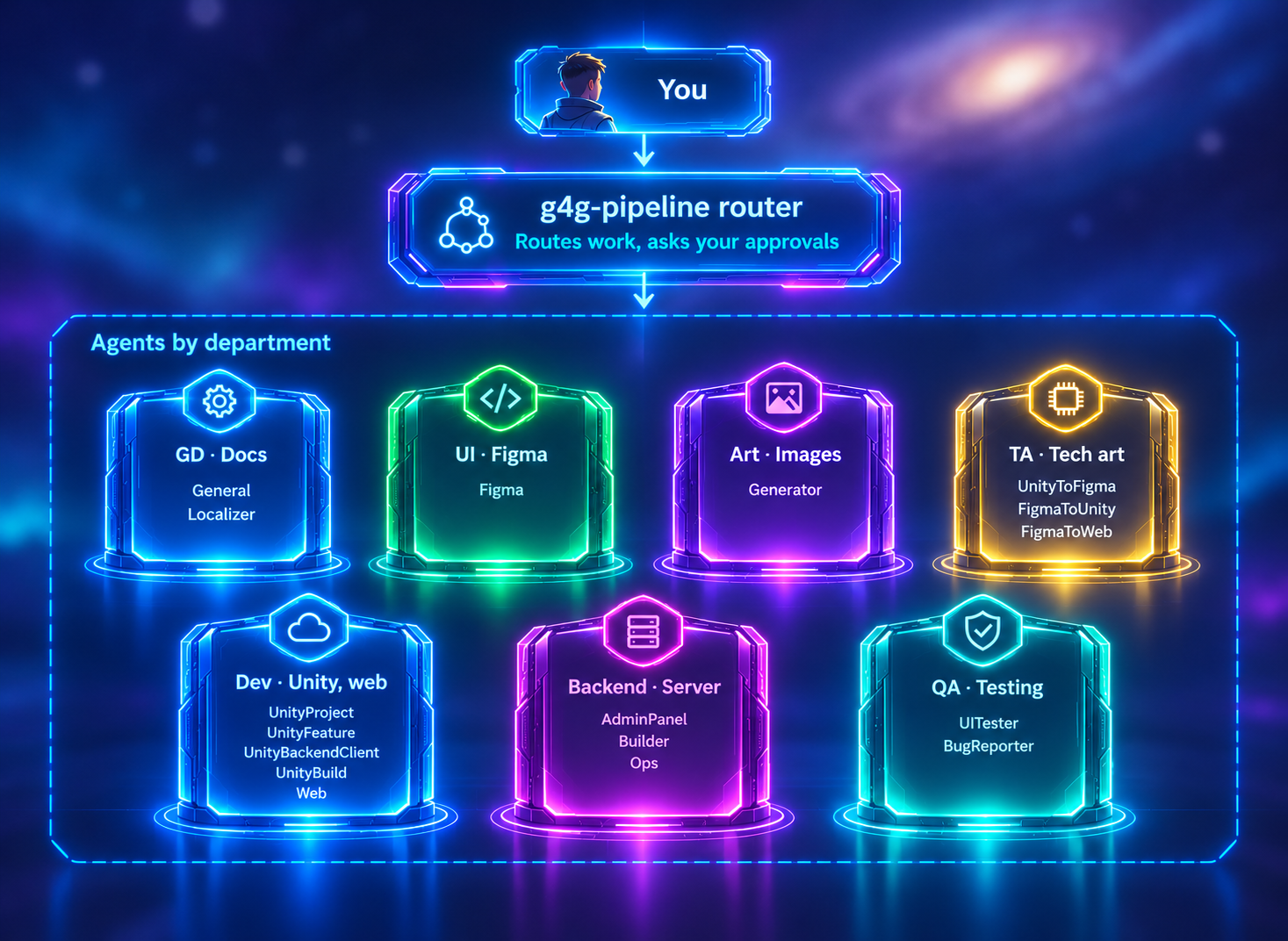
Each agent operates within the established standards, tools, and requirements of its department:
-
Art agents work directly in Figma, following the same visual standards the Art team uses
-
Technical Art agents share those standards and understand exactly how art is delivered — what anchors and constraints are required, how windows are prepared, what format everything needs to be in
-
Development agents know our Modular Solutions Library in full and work within it — not around it
Why the Development Agent Matters Most
When a Development agent needs to copy functionality from another project, it does not improvise. It follows a defined process:
-
Prepare documentation for the functionality being reused
-
Align UI and art requirements
-
Copy from the existing modular system
-
Adapt to the new project context
This is what prevents redundant builds. A feature that exists in one project can be brought into another cleanly, because the agent works within the library rather than around it. The same system that prevents an AI from writing redundant scripts also makes cross-project reuse fast, clean, and architecturally consistent.
Built on Top of Our Standardization Layer
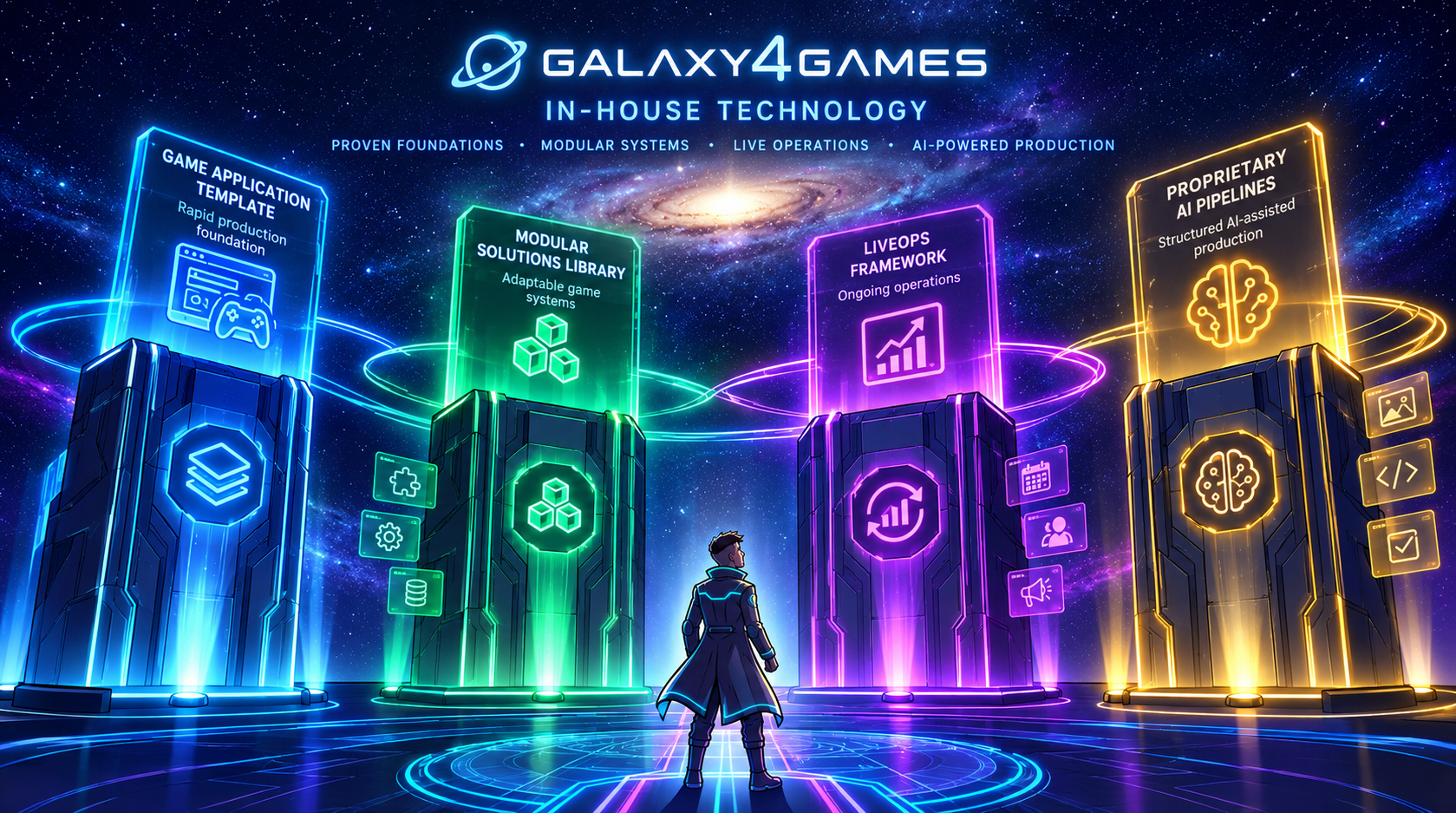
The AI Pipelines do not operate independently. They sit on top of the same standardization layer that governs every Galaxy4Games project.
The Modular Solutions Library is the repository of battle-tested game systems — match-3 engines, progression frameworks, monetization modules, event engines, UI systems — that Development agents work within. When a feature already exists in the library, the agent's task is integration and adaptation, not reinvention. When something genuinely new is required, the agent builds it to be architecturally consistent with everything that already exists.
The Game Application Template provides the project foundation — core architecture, platform integrations, analytics hooks — that every agent operates on top of. Because the starting point is standardized, AI-generated additions fit cleanly into the structure from day one.
This is the scalability advantage: the same governed system that builds one project can be applied to the next, with accumulated context and a library that grows more capable with each use.
Our position: AI working without a system produces output. AI working within a system produces product. The pipelines are proprietary not because of the models we use, but because of the operational architecture we built around them.built around them.
Where AI Pipelines Are Active in Production
The AI Pipelines are not reserved for specific tasks or project phases. They are active participants across the full production lifecycle, with different agents contributing most heavily at different stages.
|
Production Phase |
AI Pipeline Role |
|---|---|
|
Pre-production and design |
Game Design agents assist with documentation, balance frameworks, and design specifications |
|
Art production |
Art agents generate and iterate on assets within established visual standards in Figma |
|
Technical art and integration |
Technical Art agents handle the UI/art handoff, ensuring assets meet development requirements |
|
Feature development |
Development agents implement functionality using the Modular Solutions Library, avoiding redundant builds |
|
Content production |
AI accelerates level design, content population, and asset variation at scale |
|
QA and balance testing |
Agents support automated testing cycles and balance iteration |
|
LiveOps content cycles |
AI supports ongoing content production for events, offers, and seasonal updates post-launch |
AI Pipelines and the Modular Solutions Library
The relationship between the AI Pipelines and the Modular Solutions Library is central to how the system works. The Library is the repository of battle-tested, production-proven game systems: match-3 engines, progression frameworks, monetization modules, event engines, UI systems, and more.
Development agents do not work around this library. They work within it. When a project requires a feature that exists in the library, the agent's task is integration and adaptation, not reinvention. When a project requires something genuinely new, the agent builds it in a way that is architecturally consistent with the existing system.
This means the library itself becomes more valuable over time. Each project that uses an AI agent to integrate a module contributes to a clearer, more explicit specification of how that module works, which makes the next integration faster and more reliable.
AI Pipelines and LiveOps
One of the less obvious benefits of the AI Pipelines becomes visible post-launch. LiveOps game operation requires continuous content production: new events, seasonal variations, offer refreshes, balance adjustments. This content demand is ongoing and, in successful games, grows over time.
AI agents that are already embedded in the production pipeline and already understand the project's architecture can support this content cycle without the onboarding overhead of a new tool or a new team. The same agents that built content during development can extend it in operation, working within the same standards and the same library.
The practical result: the operational cost of keeping a live game active and growing is lower when AI has been a governed participant in production from the start, rather than a tool introduced after launch.
Why This Approach Works: The Governance Principle
The word "proprietary" in Proprietary AI Pipelines does not refer to the models. The models used inside the system are not unusual. What is proprietary is the operational architecture: the company standards, department rules, tool configurations, modular library integrations, and workflow structures that each agent operates within.
This distinction matters because it is the source of the system's value.
Governance Is What Makes AI Scalable
A single AI-generated feature, reviewed by an experienced developer, will usually be acceptable. The problem is not the individual output — it is what happens when AI is used at scale, across dozens of features, across multiple departments, without a governing system.
At scale, the absence of governance produces:
-
Inconsistency that compounds with every new AI-generated element
-
Increasing review burden as the team spends more time correcting AI output than benefiting from it
-
Architecture drift that makes the codebase progressively harder to work with
What we built is a system where every agent operates within a defined set of our own company standards, department rules, and production requirements — not as a constraint on AI's capability, but as the condition that makes that capability usable at production scale. The models inside the system are not unusual. What is proprietary is the operational layer we built around them.
The system also compounds. Each project adds to the agents' understanding of our library, our standards, and the edge cases we have already solved. The pipeline that runs project three is more capable than the one that ran project one.
For a broader look at how AI is reshaping game production, read: AI-Powered Game Development: Turning Ideas into Scalable Games
What This Means for Your Project
The AI Pipelines are not a separate service. They are part of how Galaxy4Games builds. Every project that goes through the studio benefits from them as part of the production foundation — alongside the Game Application Template, the Modular Solutions Library, and the LiveOps Framework.
In practical terms, this means:
Faster Production Without Accumulated Risk
AI accelerates content production, feature development, and asset iteration across the full project lifecycle. Because every agent works within the established architecture and library, that acceleration does not come with the technical debt that unstructured AI use typically introduces. The project moves faster and stays clean.
Budget Concentrated on What Makes Your Game Unique
When AI handles content population, asset variation, balance iteration, and cross-project feature reuse, the human engineering and creative budget is freed for the work that genuinely differentiates your game. The infrastructure cost goes down. The creative investment goes up.
A Production System, Not a Tool Dependency
The AI Pipelines are embedded in the production process. They do not create a post-launch dependency on a specific AI vendor or platform. The game that ships is your game, built on architecture you own. The AI that contributed to building it was a participant in your studio's production system, not a layer you need to maintain separately.
Scalable Content for Live Games
For games that launch and operate as live products, the AI Pipelines provide ongoing support for the content cycles that LiveOps requires. The same governed system that built the game can extend it — with the same architectural consistency, the same library awareness, and the same standards that governed production from day one.
Ready to talk through how this applies to your project? Contact Galaxy4Games to discuss your concept, timeline, and how our production foundation — including the AI Pipelines — can accelerate your path to launch.
Related Pages
-
Galaxy4Games In-House Technology — the full production foundation: all four core systems
-
Modular Solutions Library — the catalogue of battle-tested game systems the Development agents work within
-
Game Application Template — the production-ready starting point for casual and hyper-casual projects
-
LiveOps Game Development — how Galaxy4Games supports games in ongoing operation
-
Full-Cycle Game Development — end-to-end production from concept to live operation