
Why a Production Foundation Changes Everything
Every game project starts with a decision that most clients never see: build from scratch, or build from something proven. At Galaxy4Games, we made that decision once, years ago, and we have been refining the answer ever since.
What we built is a proprietary production foundation — a set of internal systems, tools, and structured workflows that every project we take on benefits from, whether it is a hyper-casual mobile prototype or a full-scale multiplayer title with LiveOps. This page is an overview of what that foundation looks like, how each component works, and why it matters for the speed, quality, and long-term scalability of the games we build together with our clients.
Important clarification: The systems described here are Galaxy4Games' internal production technologies. They are not off-the-shelf products we sell separately. When you work with us, you get the benefit of everything below built into your project from day one.
The foundation has four main components
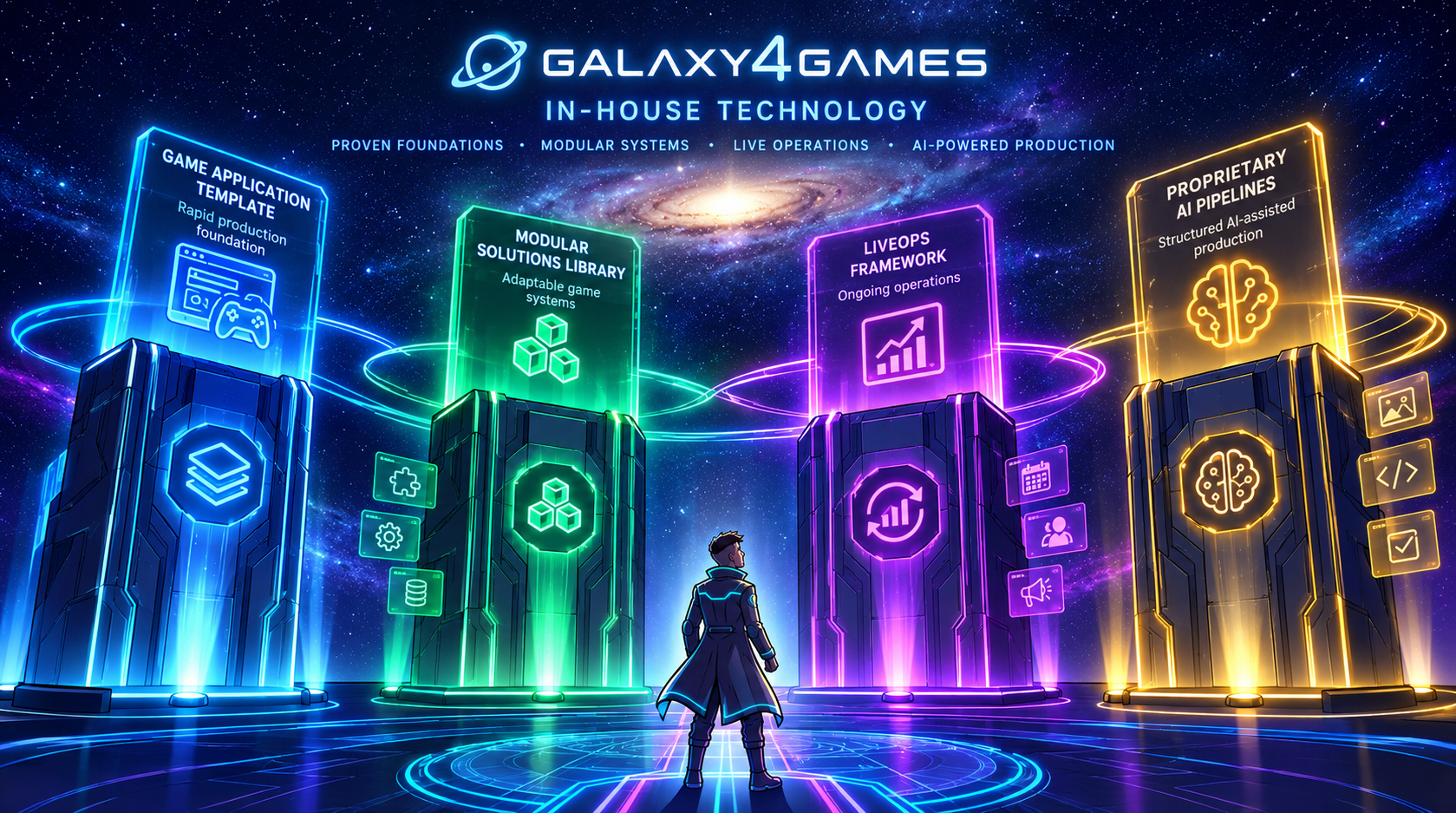
|
Component |
What It Is |
Primary Benefit |
|---|---|---|
|
A production-ready casual game application structure — architecture, platform integrations, analytics, monetization hooks, and UI framework already built and tested |
Eliminates 4–6 weeks of foundational setup; best fit for casual and hyper-casual projects |
|
|
A catalogue of battle-tested game systems — match-3 engines, progression, monetization, events, UI, backend structures, and more — each proven in live titles |
Replaces costly reinvention with proven components; applicable across all project types |
|
|
Internal architecture that embeds remote configuration, event infrastructure, analytics wiring, and scalability design from day one |
Games ship already capable of continuous updates, events, and content cycles without retrofitting |
|
|
Proprietary AI Pipelines |
A multi-agent system where Art, Technical Art, and Development agents operate within Galaxy4Games' own standards, tools, and modular library |
AI accelerates production without creating technical debt or architectural inconsistency |
Game Application Template
The Game Application Template is where every new project begins. It is a fully functional, production-ready casual game application that we have built, tested, and operated ourselves. Think of it as the architectural skeleton of a game — everything that is not specific to your concept is already there, already working, and already compliant.
What the Template Includes
When a new project kicks off at Galaxy4Games, the team does not start with a blank Unity project. The template provides:
-
Core application architecture — project structure, scene management, state machines, and initialization flows built to scale
-
Platform integrations — iOS and Android store compliance hooks, deep link handling, and platform-specific configurations
-
Analytics scaffolding — event tracking architecture wired up and ready for your chosen analytics provider
-
Monetization hooks — in-app purchase flow structure, ad network integration points, and offer system placeholders
-
Backend connectivity — server communication layers, authentication patterns, and data persistence structures
-
UI framework — a base window management system, popup handling, and responsive layout foundations
Why This Matters for Your Project
The first weeks of a typical game project are consumed by decisions and setup work that has nothing to do with your actual game. Platform compliance, folder structures, CI/CD pipelines, analytics wiring — this is necessary work, but it is not creative work, and it should not be billed at the same rate as building your core gameplay.
The template eliminates that phase. A project that would otherwise spend four to six weeks on foundational setup can move into actual game-specific development on day one. For clients working under budget constraints or tight market windows, this compression is significant.
The template is also a living system. Every project we complete feeds improvements back into it, which means the version your project starts from reflects everything we have learned across 15+ years of building and operating games.
Explore how this foundation applies to your specific project type: Mobile Game Development | Rapid Prototyping | Full-Cycle Game Development
Modular Solutions Library
If the Game Application Template is the skeleton, the Modular Solutions Library is the organ system. It is a growing catalogue of production-proven game features and mechanics that we have built, deployed in live titles, and refined into plug-and-play components that can be integrated into any compatible project.
The key distinction here is the word "live." Every module in this library has been deployed in a real game, with real players, and refined based on real performance data. We do not add a module to the catalogue until it has survived the operational environment.

What Is in the Library
The library spans the full range of systems a modern mobile game needs, organized into functional categories:
Core Gameplay Mechanics
-
Match-3 engine with configurable board logic, special tiles, and combo systems
-
PvP matchmaking and real-time battle infrastructure
-
Puzzle and level progression frameworks
Monetization and Commerce
-
In-app purchase flow with offer management and dynamic pricing hooks
-
Ad integration layer supporting rewarded, interstitial, and banner formats
-
Battle pass and subscription system structures
Progression and Retention
-
Player progression and XP systems
-
Daily challenge and quest frameworks
-
Achievement and reward engines
UI and UX Systems
-
Window and popup management system
-
Tutorial and FTUE (First-Time User Experience) flow controllers
-
Notification and push alert systems
-
Localization and audio management
LiveOps and Backend
-
Game events engine (dice, ladders, slots, progress bar, album events)
-
Offers and dynamic content delivery system
-
Analytics event pipeline
-
Player support integration layer
-
Backend data structures for leaderboards and player profiles
How Modules Are Used in Practice
Modules are not dropped into projects wholesale. Our team evaluates which systems are relevant to your game's design, adapts them to your visual language and gameplay context, and integrates them within the established architecture. The result is a feature that behaves like it was built specifically for your game — because the integration work is custom, even when the underlying system is proven.
This is how we avoid the reinvention problem. A leaderboard system, a popup manager, an analytics pipeline — these are solved problems. Building them from scratch on every project is expensive and introduces unnecessary risk. Our library means your budget goes toward what makes your game unique, not toward rebuilding infrastructure that already exists.
Browse the full catalogue: Modular Solutions Library
LiveOps Framework
Most development studios think about LiveOps as something you add after launch. We think about it as something you architect before a single line of game-specific code is written.
The Galaxy4Games LiveOps Framework is the internal foundation that makes this possible. It is a set of architectural decisions, backend structures, and operational tooling that we embed into every project from the start, ensuring that when a game ships, it is already capable of supporting the continuous updates, events, and content cycles that separate games that grow from games that plateau.
What the Framework Provides
Configuration and Remote Control Games built on our framework support remote configuration out of the box. Balancing values, event schedules, offer parameters, and content flags can be updated server-side without requiring a client update. This is the operational flexibility that LiveOps teams need to react to player data quickly.
Event Infrastructure The framework includes the foundational plumbing for in-game events: scheduling systems, reward delivery, player segmentation hooks, and content rotation logic. This connects directly to the Modular Solutions Library's event modules, which provide the specific event types (dice events, progress bars, slot events, etc.) that run on top of this infrastructure.
Analytics Integration Every game built on the framework ships with a structured analytics event schema. This is not an afterthought — the events are defined and wired during development, so the team has meaningful retention and monetization data from soft launch day one rather than spending weeks post-launch building the instrumentation they should have had from the start.
Scalability Architecture Backend structures are designed to handle player volume growth without requiring architectural rewrites. This matters most for games that succeed — the ones that need to scale quickly rarely have time for a technical overhaul.
Why This Matters Beyond Launch
We operate our own live games. Animal Sort! and our live Bingo title run on the same operational principles embedded in this framework. That means every decision we made about how to architect LiveOps readiness was informed by the real cost of getting it wrong — and the real benefit of getting it right.
A game built without LiveOps architecture in mind requires expensive retrofitting when the team wants to run its first event or update content without a full app release. We have seen this happen to studios that shipped fast and paid for it later. Our framework is the answer to that problem, built before it becomes one.
Learn more about our LiveOps Services for Games and how we support games in ongoing operation.
Proprietary AI Pipelines
The question we kept coming back to was straightforward: can AI build a game on its own? Models like Fable and Astra have shown the answer is closer to yes than most people expect. But that raised a harder question for us — not whether AI can build something, but whether what it builds is manageable, maintainable, and actually production-ready.
The honest answer is: not by default.
AI models work from the accumulated knowledge of everything that exists. Ask one to build a tower defense game and it will produce something functional — there is no shortage of code, examples, and reference implementations to draw from. But left to its own judgment, AI makes decisions that are locally reasonable and globally expensive. We asked an AI to add a tutorial step with an arrow pointing to a game cell. It wrote a new script. When we asked whether it had used the existing action system already in the project, the answer was no. It had not even looked for one.
That is the core problem. AI can be a powerful production tool or it can make a project heavy, inconsistent, and impossible to maintain at scale. The difference is not the model — it is the system the model works within.
What We Built
We started by solving the most persistent bottleneck in our production: the bridge between UI and Technical Art. Once that was resolved, we built a multi-agent plugin that covers every department in our pipeline — from Game Design through Development — and connected those agents into a single coordinated system.
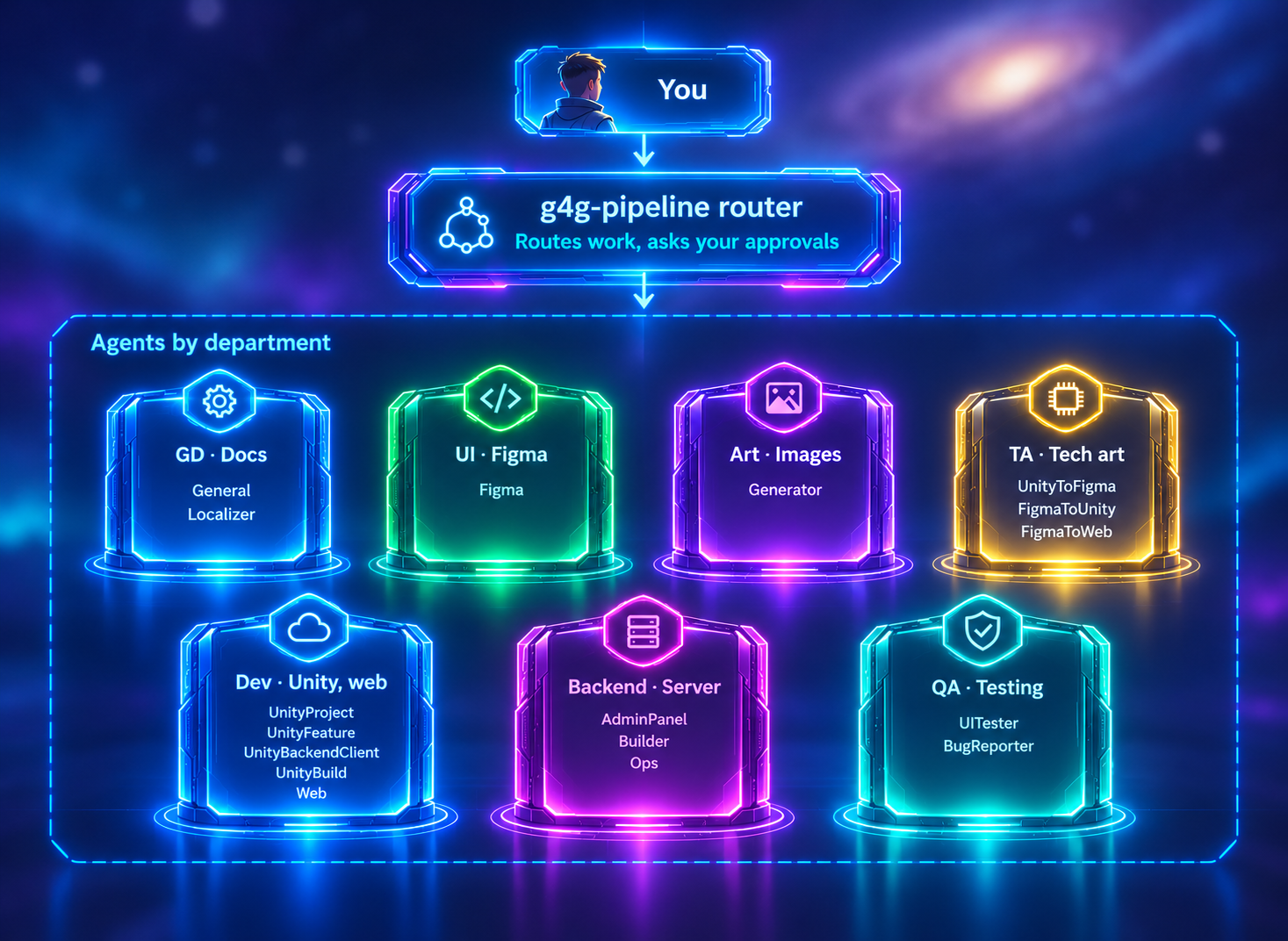
Each agent operates within the established standards, tools, and requirements of its department:
-
Art agents work directly in Figma, following the same visual standards the Art team uses
-
Technical Art agents share those standards and understand exactly how art is delivered — what anchors and constraints are required, how windows are prepared, what format everything needs to be in
-
Development agents know our Modular Solutions Library in full and work within it — not around it
This last point matters most. When a Development agent needs to copy functionality from another project, it does not improvise. It prepares the documentation, aligns the UI and art accordingly, copies the functionality using the existing modular system, and adapts it to the new project context. The same system that prevents an AI from writing redundant scripts also makes cross-project reuse fast, clean, and architecturally consistent.
Why This Approach Works
AI operates on context. The more structured and explicit that context is, the more useful and predictable the output becomes. What we have built is a system where every agent operates within a defined set of company standards, department rules, and production requirements — not as a constraint on AI's capability, but as the condition that makes that capability usable at production scale.
The result is that AI is not a tool we reach for occasionally. It is a participant in the pipeline, sitting on top of a clean, solid, working system and extending what that system can do.
Our position: AI working without a system produces output. AI working within a system produces product. The pipelines are proprietary not because of the models we use, but because of the operational architecture we built around them.
Read more: AI-Powered Game Development: Turning Ideas into Scalable Games
How the Components Work Together
Each component has value on its own. Together, they form a production system that changes the economics and risk profile of game development. How they combine depends entirely on the project.
One important thing to clarify upfront: every game we build is custom. There is no subscription to our systems, no licensing fee, and no ongoing dependency on Galaxy4Games infrastructure after delivery. When we use a module from our library to build a feature for your game, that feature is yours — as is the entire product. Our technology stack is how we build, not what we sell.
Starting Point: Template or Modular, Depending on the Project
The Game Application Template can be the right starting point for most casual and hyper-casual games. These projects share a large amount of common architecture — platform integrations, UI systems, monetization hooks, analytics scaffolding — and the template already has all of it built, tested, and compliant. A casual puzzle game, a match-3 title, or a hyper-casual prototype can be up and running in days rather than weeks.
For very unique or larger mid-core, multiplayer, or more structurally distinct projects, the starting point is different. The team works directly from the Modular Solutions Library, selecting the systems that are relevant to that game's design and building the architecture around them. The template is not a requirement — it is one option in a broader toolkit.
What does not change regardless of starting point: every project can be built from ready proven components, not from scratch - saving time and as a result costs.
Feature Integration and Custom Development
Once the foundation is established, the team identifies which modules can be additionally applied to this project. A match-3 title might pull in the match-3 engine, the progression system, the offer management module, and the events engine. A PvP title might pull in matchmaking infrastructure, leaderboard systems, and the battle pass structure. A more unique concept might use only a handful of modules and build the rest custom.
Custom development runs in parallel throughout — the mechanics, art, and content that are specific to this game and belong entirely to it. This is where the creative and engineering budget is concentrated, because the infrastructure cost has already been reduced by not rebuilding what already exists.
AI pipelines are active across this phase: accelerating content production, supporting level design, running balance testing, and expanding QA coverage.
LiveOps Readiness and Launch Preparation
Before launch, the LiveOps Framework is confirmed and tested. Remote configuration is validated, analytics events are verified, and the event scheduling infrastructure is ready. The game ships with the operational capability to run events, update content, and iterate on monetization without requiring a full client release cycle.
This is not a separate service layer added at the end. It is built into the architecture from the start, which is the only way it works reliably.
Ongoing Operation
Post-launch, the same infrastructure supports continuous operation. Events run on schedule. Analytics data flows cleanly. Balance updates and content drops can be pushed on a cadence that keeps players engaged without a full engineering sprint for each one.
The result: development time and costs are compressed by 30 to 50 percent compared to building from a blank slate — without reducing quality, creative ambition, or the client's full ownership of everything delivered.
Business Benefits: What This Means for Your Project
The technology story is interesting. The business story is what matters.
Here is what the Galaxy4Games production foundation translates to in practical terms for the projects we take on:
Faster Time to Market
Projects start from a proven base, not a blank slate. The setup work that typically consumes the first four to eight weeks of a project is already done. This means your game reaches playable prototype stage faster, reaches soft launch faster, and reaches the market faster — which matters enormously in a mobile landscape where timing is competitive.
More Efficient Production Budgets
When your budget is not being spent on rebuilding leaderboards, popup managers, and analytics pipelines that already exist, it goes toward the things that actually differentiate your game. Our clients consistently get more playable game for the same budget compared to studios that build from scratch on every project.
Reduced Technical Risk
Every system in our foundation has been tested in a live environment. We know what breaks under player load. We know what needs to be configurable for LiveOps teams. We know what the App Store and Google Play require for compliance. Starting from proven systems means fewer surprises during development and fewer emergencies post-launch.
Built for Scalability
Games that succeed need to scale — both technically and operationally. Our architecture is designed with that in mind. Backend structures handle volume growth. LiveOps tooling supports a growing event calendar. The AI pipelines that accelerate content production at launch scale with you as content demand increases.
Long-Term Operational Readiness
This is the benefit that most clients do not think about until they need it. A game built on our LiveOps Framework can run content updates, seasonal events, and monetization experiments without a full engineering sprint for each one. The operational cost of keeping a game alive and growing is dramatically lower than it would be with a game that was not architected for it.
Ready to discuss how this foundation applies to your project? Contact Galaxy4Games to talk through your concept, timeline, and how our technology stack can accelerate your path to launch.
Related Services
-
Mobile Game Development — iOS and Android development built on this foundation
-
Unity Game Development — Unity-specific expertise across all project types
-
Rapid Prototyping — validate your concept fast, starting from proven architecture
-
MVP Game Development — launch a focused, market-ready version without building everything at once
-
Full-Cycle Game Development — end-to-end production from concept to live operation
-
Co-Development — extend your existing team with our specialists and production infrastructure
-
LiveOps Services — ongoing game operation and growth support