
Casual, Hybrid Casual, and Hypercasual Games: The Complete Buyer's Guide to Finding the Right Development Partner (2026)
Search for "best casual game development companies" and you will find lists that mix publishers, product studios, and outsourcing partners side by side as if they were the same thing. They are not. Hiring a publisher when you need a dev studio is like hiring a distributor to manufacture your product. The confusion is costing founders real money and real time.
This guide fixes that. We define the three market segments clearly, explain how monetization works in each, and then break down the company landscape into three separate, honest lists: product companies that build and own games, outsourcing studios you can hire, and publishers who distribute them. By the end, you will know exactly which type of partner fits your goal and have a curated shortlist to start from.
What this guide covers:
-
The state of the casual mobile game market in 2026 and where growth is actually happening
-
Clear definitions of casual, hypercasual, and hybrid casual, including how the three differ in gameplay depth, development cost, and player behavior
-
The most popular genres in each segment right now
-
Why players shifted away from hypercasual and what hybrid casual fixes for both sides of the market
-
How monetization and publishing deals vary across the three segments
-
What to look for in a development partner depending on your specific goal
-
Curated lists of product companies, outsourcing studios, and publishers, separated so you can compare like-for-like
The State of the Casual Mobile Game Market in 2026
The casual mobile game market is not shrinking. It is restructuring, and the distinction matters enormously if you are making investment decisions right now.
The headline number: casual games remain the single largest category in mobile gaming, accounting for the majority of global downloads across iOS and Android. AppMagic's H1 2026 Casual Games Report describes the segment as showing "growth beneath the still surface," meaning that top-line download counts look flat while the underlying revenue story is dramatically more positive.
The real shift is happening at the monetization layer. Three forces are reshaping who wins and who gets left behind:
1. The Hypercasual Contraction
Pure hypercasual, the segment built on one-tap mechanics and 100% ad-revenue models, peaked around 2021 and declined sharply after Apple's App Tracking Transparency (ATT) changes gutted the targeting infrastructure that made mass user acquisition economical. Studios that built their entire business on $0.10 CPIs and interstitial ad stacks found that model no longer worked at scale.
The segment did not die. It evolved.
2. The Hybrid Casual Ascent
Hybrid casual is where the growth is concentrated in 2026. Publishers who led the hypercasual boom, including Voodoo, Homa, and Rollic, have systematically rebuilt their portfolios around hybrid casual titles: games that retain hypercasual's simple core loop but add meaningful progression systems, IAP economies, and LiveOps content layers. Voodoo's gross player spending rose approximately 137% year-over-year in the first eight months of 2026, reaching around $223 million, according to AppMagic estimates reported by Pocket Gamer. That is what a successful hypercasual-to-hybrid transition looks like in numbers.
3. Casual Puzzle and Match-3 Are Resilient
Traditional casual, led by puzzle, match-3, and word games, continues to generate strong revenue from an older, higher-spending demographic. Miniclip's $1.2 billion acquisition of Easybrain in late 2024 was a direct bet on the long-term value of casual puzzle players. The segment rewards studios that can build retention through content depth rather than novelty.
Key takeaway: If you are entering the market in 2026, pure hypercasual is the hardest bet. Hybrid casual offers the best combination of accessible development costs and scalable revenue. Traditional casual still performs but requires deeper content investment and a longer timeline to profitability.
Casual vs. Hypercasual vs. Hybrid Casual: Clear Definitions
Most articles use these three terms interchangeably or define them vaguely. That is exactly where the confusion starts. Here is a precise breakdown of what each segment actually means, covering gameplay, development scope, player behavior, and cost.
Casual Games
Definition: Games designed for broad, non-hardcore audiences with accessible mechanics, clear progression systems, and content depth that keeps players returning over weeks or months.
Casual games are not simple. They are intentionally approachable, but they carry significant production weight: level design at scale, meta-game progression (home decoration, character upgrades, story beats), visual polish, and ongoing LiveOps content to maintain retention. The player expects to invest time over a meaningful arc, not just a few sessions.
|
Attribute |
Casual |
|---|---|
|
Core mechanic complexity |
Medium (accessible but layered) |
|
Session length |
10-30 minutes |
|
Primary revenue |
IAP (in-app purchases) + ads |
|
Content depth |
High (hundreds of levels, meta layers) |
|
Development cost |
$80,000 to $250,000+ |
|
Time to launch |
4-9 months |
Popular casual genres in 2026: Match-3 (Royal Match, Candy Crush), puzzle (Sudoku, Blockudoku), idle/merge (Merge Mansion), word games, hidden object, and casual simulation (farming, restaurant management).
Hypercasual Games
Definition: Games with an ultra-simple, instantly understood core mechanic, designed for maximum download volume and short-session engagement, monetized almost entirely through advertising.
The hypercasual formula is one-tap or swipe mechanics, zero tutorial friction, and a loop that hooks in the first 10 seconds. The game does not need to retain players for months; it needs to reach millions of installs cheaply and serve enough ad impressions to generate revenue. Development is fast and cheap because depth is deliberately absent.
|
Attribute |
Hypercasual |
|---|---|
|
Core mechanic complexity |
Very low (one-tap, one-swipe) |
|
Session length |
2-5 minutes |
|
Primary revenue |
Interstitial and rewarded video ads (IAA) |
|
Content depth |
Low (minimal progression) |
|
Development cost |
$5,000 to $40,000 per prototype |
|
Time to launch |
2-8 weeks |
Popular hypercasual genres in 2026: Stack and sort (color sort, ball sort), runner and parkour, satisfying cutting/slicing mechanics, crowd-control games, and physics-based puzzles. The genre still works when CPI is low enough, but it demands a publishing partner with scale.
Hybrid Casual Games
Definition: Games that combine hypercasual's simple, instantly-understood core loop with meaningful progression systems, character/economy meta layers, and a monetization mix of both ads and IAP.
This is the fastest-growing segment in 2026 and the most strategically interesting. Hybrid casual games are built to survive the post-ATT advertising environment: they earn ad revenue during the early player lifecycle but convert higher-value players into IAP spenders through progression depth. Mob Control by Voodoo is the canonical example: its core mechanic (gate-based crowd multiplication) is as simple as any hypercasual game, but the upgrade economy and meta-progression layer drove approximately $95 million in IAP revenue in the first eight months of 2025 alone.
|
Attribute |
Hybrid Casual |
|---|---|
|
Core mechanic complexity |
Low-medium (simple loop, deeper meta) |
|
Session length |
5-20 minutes |
|
Primary revenue |
Mixed IAA + IAP |
|
Content depth |
Medium (progression, upgrades, events) |
|
Development cost |
$40,000 to $150,000 |
|
Time to launch |
6-16 weeks for prototype; 3-6 months for full launch |
Popular hybrid casual genres in 2026: Sort and merge with meta layers, tower defense with upgrade economies, idle runners with progression, battle games with character builds, and casual RPG-lite titles.
The critical distinction for buyers: Hypercasual is a volume game. Hybrid casual is a revenue-per-user game. Casual is a retention and content game. Your development partner needs to be built for the specific one you are targeting, not just experienced with "mobile games" in general.
Why Players Moved Away from Hypercasual and What Hybrid Casual Fixes
The shift from hypercasual to hybrid casual is not just a product decision. It reflects a deeper change in how people relate to mobile games, what they expect from them, and how much friction they are willing to tolerate in exchange for entertainment.
Understanding this shift helps you make smarter decisions about what to build and why.
The Psychology Behind the Hypercasual Boom
Hypercasual worked because it matched a specific moment in mobile gaming history. Smartphones had just become ubiquitous. App stores were new enough that novelty alone drove downloads. Players were curious, sessions were short, and the friction of installing a new game was low enough that a compelling thumbnail and a one-tap mechanic was all you needed to get someone in the door.
The model was built on volume, not depth. And for a while, volume was enough.
The hypercasual formula in its prime:
-
Instantly understood mechanic (no tutorial needed)
-
First session hook in under 10 seconds
-
Millions of installs at low CPI
-
Ad revenue spread across a massive player base
-
Churn was fine because the next install was cheap
The problem was structural from the start. Hypercasual games were not designed to be loved. They were designed to be tried. The moment a player finished the novelty loop, there was nothing to hold them. Retention curves fell off a cliff after Day 1. The entire business model depended on acquiring new players faster than existing ones churned, which made it completely dependent on cheap user acquisition.
When the Economics Broke
Apple's App Tracking Transparency (ATT) framework, introduced in 2021, did not kill hypercasual overnight. But it removed the targeting infrastructure that made mass user acquisition economical. CPIs that once sat at $0.10 to $0.30 climbed significantly as ad networks lost the ability to serve precise behavioral targeting. The margin compression was immediate and severe.
At the same time, the player base was maturing. Mobile gamers in 2024 and 2025 were no longer the novelty-seekers of 2017. They had played thousands of games. They had developed preferences. They knew what they liked, and they were increasingly impatient with experiences that felt disposable or exploitative.
The core tension: Hypercasual's monetization model required showing players a high volume of ads to generate revenue from a low-spending audience. But modern players, especially those who had been gaming on mobile for years, found heavy ad loads actively hostile. The experience that was supposed to generate revenue was damaging the product.
What Modern Players Actually Want
The psychology of today's mobile player is shaped by three forces that did not exist in the same way during hypercasual's peak:
1. The attention economy is more competitive than ever. Players are not just choosing between games. They are choosing between games, short-form video, social media, podcasts, and streaming. A game that does not offer a reason to return within the first few sessions is competing against an infinite feed of instantly gratifying content. Novelty alone is not a retention strategy.
2. Progression satisfies a deeper need than novelty. Psychological research on player motivation consistently points to mastery and autonomy as core drivers of sustained engagement. Hypercasual games offered neither. Hybrid casual games, with their upgrade trees, character progression, and meta-game economies, tap directly into the same motivational architecture that makes mid-core and RPG games sticky. They deliver that depth in a format accessible to non-hardcore players.
3. Players have become sensitive to monetization friction. Years of aggressive ad loads have conditioned players to recognize and resent exploitative monetization. A game that interrupts every 90 seconds with a full-screen interstitial is not just annoying; it signals to the player that the developer values impressions over experience. Hybrid casual's blended model, where ads are lighter and IAP is optional rather than coercive, reads as more respectful. That perception directly affects retention.
Hybrid Casual as the Market's Answer
Hybrid casual did not emerge from a design philosophy meeting. It emerged from publishers and developers observing what was actually happening to player behavior and adjusting their products accordingly.
The format solves both sides of the equation simultaneously:
|
Problem |
Hypercasual's failure |
Hybrid casual's solution |
|---|---|---|
|
Player retention |
No progression, D7 retention often below 10% |
Meta layer keeps players returning for upgrades and events |
|
Monetization depth |
Ad-only, low ARPU, CPI-dependent |
IAP layer captures high-value players; ads serve the broad base |
|
Ad tolerance |
Heavy interstitials caused active player resentment |
Lighter ad load, rewarded video preferred by players |
|
UA dependency |
Entirely dependent on cheap paid acquisition |
Better retention reduces UA pressure over time |
|
Developer sustainability |
Viable only at massive scale |
Positive unit economics achievable at smaller scale |
Voodoo's transformation is the clearest case study in the industry. The company that defined hypercasual rebuilt its entire portfolio around hybrid casual titles, and its gross player spending grew approximately 137% year-over-year in the first eight months of 2026, according to AppMagic data reported by Pocket Gamer. That is not a coincidence. It is the market confirming that the hybrid model better serves both players and developers.
What this means for your development brief: If you are building in 2026 and your instinct is to go pure hypercasual because it is cheaper and faster, the economics no longer support that instinct at small to medium scale. Hybrid casual costs more to build correctly, but it generates better retention, higher ARPU, and a more sustainable business. The additional investment in a meta layer and a proper IAP economy is not a luxury. It is the difference between a game that earns and a game that churns.
How Monetization and Publishing Work Across the Three Segments
The monetization model is not just a revenue decision. It shapes the entire development architecture, the type of publisher you need, and how your game is structured from day one. Getting this wrong at the design stage means expensive rework later.

Hypercasual Monetization
Pure hypercasual runs on in-app advertising (IAA). Interstitial ads appear between levels or sessions; rewarded video ads offer optional bonuses. The model works at scale because CPIs were historically very low, meaning publishers could acquire players cheaply and serve enough ad impressions to generate positive ROI.
The publishing deal structure for hypercasual:
-
Developer submits a prototype (playable build) to a publisher
-
Publisher runs a paid CPI test campaign to assess marketability
-
If CPI and Day 1 retention metrics hit thresholds, publisher funds full development
-
Revenue is split (typically 50/50 to 70/30 in the developer's favor)
-
Publisher owns UA, creative testing, and ad network relationships
The challenge: post-ATT, CPI floors have risen significantly, compressing margins. Most pure hypercasual deals now require a prototype that already demonstrates strong organic or soft-launch metrics before a publisher will invest.
Hybrid Casual Monetization
Hybrid casual uses a blended IAA + IAP model. Ads monetize the broad player base in the early game; IAP (cosmetics, progression accelerators, battle passes, limited-time offers) captures higher-value players who engage with the meta layer.
Why this matters architecturally: A hybrid casual game must be designed with an economy from the start. The meta-progression system, the in-game currency, the upgrade tree, and the LiveOps event calendar are not features you add after launch. They are the product. Studios that do not have experience building IAP economies in casual-depth games will deliver a game that looks hybrid casual but monetizes like hypercasual.
The publishing deal structure for hybrid casual:
-
More negotiation involved; publishers evaluate both CPI and D7/D30 retention
-
IAP revenue split is often separate from ad revenue share
-
Publisher may provide analytics tools, LiveOps support, and creative production
-
Some publishers (Voodoo, Homa) offer SDK integration as part of the deal
Casual Monetization
Traditional casual is primarily IAP-driven. Players purchase additional lives, level skips, cosmetic items, and seasonal content. Advertising exists but plays a secondary role. The revenue model rewards long-term retention: a player who stays 90 days is dramatically more valuable than one who churns after 7.
The publishing deal structure for casual:
-
More complex than hypercasual; publishers evaluate content depth, art quality, and retention metrics
-
Deals often include minimum guarantees or milestone-based funding
-
LiveOps support is a core expectation, not an add-on
-
Some casual publishers (Miniclip, Jam City, Scopely) acquire studios outright rather than signing publishing deals
|
Monetization Dimension |
Hypercasual |
Hybrid Casual |
Casual |
|---|---|---|---|
|
Primary revenue source |
IAA (ads) |
IAA + IAP |
IAP |
|
Revenue per user (ARPU) |
Low |
Medium |
High |
|
Publisher dependency |
Very high |
Medium-high |
Medium |
|
LiveOps requirement |
Low |
Medium |
High |
|
Economy design complexity |
None |
Medium |
High |
|
Time to positive ROI |
Fast (if UA works) |
Medium (3-6 months) |
Long (6-18 months) |
What this means for your development brief: Share your monetization model with any prospective studio before signing. A studio experienced in ad-only hypercasual prototypes will not automatically know how to architect a functioning IAP economy. Ask specifically about their IAP design experience and whether they have shipped hybrid or casual titles with active economies.
How to Choose the Right Development Partner for Your Goal
This is where most buyers go wrong. They search for "casual game development company," get a list that mixes product studios, outsourcing partners, and publishers, and try to evaluate them all on the same criteria. That is an impossible comparison because these three types of companies do fundamentally different things.
Before you evaluate any company, answer these two questions:
-
Do you need someone to build the game for you? You need a game development outsourcing studio.
-
Do you need someone to distribute and market the game? You need a publisher.
A product company does neither for you. They build and own their own games. They are not for hire. Including them in a "companies you can hire" list is the core error that most industry articles make.
If You Are Building a Hypercasual or Hybrid Casual Game
Your primary build partner needs to be fast. Prototype speed is the defining metric because most hypercasual games fail the publisher CPI test and you need to iterate quickly. Look for:
-
Prototype-to-playable speed: Can they deliver a testable build in 2-6 weeks?
-
Publisher familiarity: Do they understand how publisher CPI tests work? Have they shipped games that passed publisher marketability tests?
-
Modular development approach: Studios with reusable mechanics libraries can build hypercasual prototypes significantly faster than those building from scratch every time
-
Iteration culture: Are they comfortable scrapping a mechanic and rebuilding it based on test data?
For hybrid casual specifically, also evaluate:
-
IAP economy design experience
-
LiveOps architecture capability (can the game be updated post-launch without a full rebuild?)
-
Analytics integration (Firebase, Adjust, AppsFlyer)
If You Are Building a Casual Game
Casual requires more production depth and a longer partnership. The criteria shift:
-
Level design at scale: Can they design and produce 200+ levels with consistent quality? This is a different skill from building 10 polished levels.
-
Meta-game design experience: Have they shipped games with functioning progression economies, not just core loops?
-
Art production pipeline: Casual art standards are higher than hypercasual. Evaluate their portfolio specifically in the casual art style you are targeting.
-
LiveOps framework: Casual games live or die on ongoing content. A studio that delivers a game and walks away is not a casual game partner.
-
Publisher relationships: If you plan to publish through a third party, does the studio have experience preparing builds for publisher submission?
If You Are an IP Owner or Publisher Looking for a Build Partner
Your priorities are different from an indie founder. You need:
-
Proven delivery track record: Verified reviews from previous clients, not just portfolio screenshots
-
Scalable team structure: Can they staff up for a larger scope without quality degradation?
-
Standardized production systems: Studios with proprietary templates and modular libraries deliver more predictable timelines and costs
-
Post-launch support: Can they maintain and update the game after launch, or do they hand off and disappear?
The non-negotiable question to ask every studio: "Show me a game you shipped that is currently live on the App Store or Google Play with active players." A studio that has operated its own live game understands what post-launch actually demands. A studio that has only delivered client builds and never operated a live product is giving you theoretical knowledge, not operational experience.
Game Development Outsourcing Studios: Who to Hire to Build Your Game
These are studios you can hire to build your casual, hybrid casual, or hypercasual game. They are not publishers and they are not product companies. They build for clients. Entries are listed in no particular rank order. Strengths only, because this is a buyer's guide, not a review platform.
Galaxy4Games
Location: Tallinn, Estonia | Team size: 40 specialists | Engine: Unity
Galaxy4Games is a full-cycle casual and mobile game development studio with 15+ years of experience and over 25 shipped mobile and social games. What sets them apart from most outsourcing studios in this space is that they also build and operate their own live games on the App Store and Google Play (including Animal Sort! and a live Bingo title). That operational experience is not cosmetic. It means every architectural decision they make for your game is informed by what actually works in a live environment.
Key strengths for casual and hybrid casual development:
-
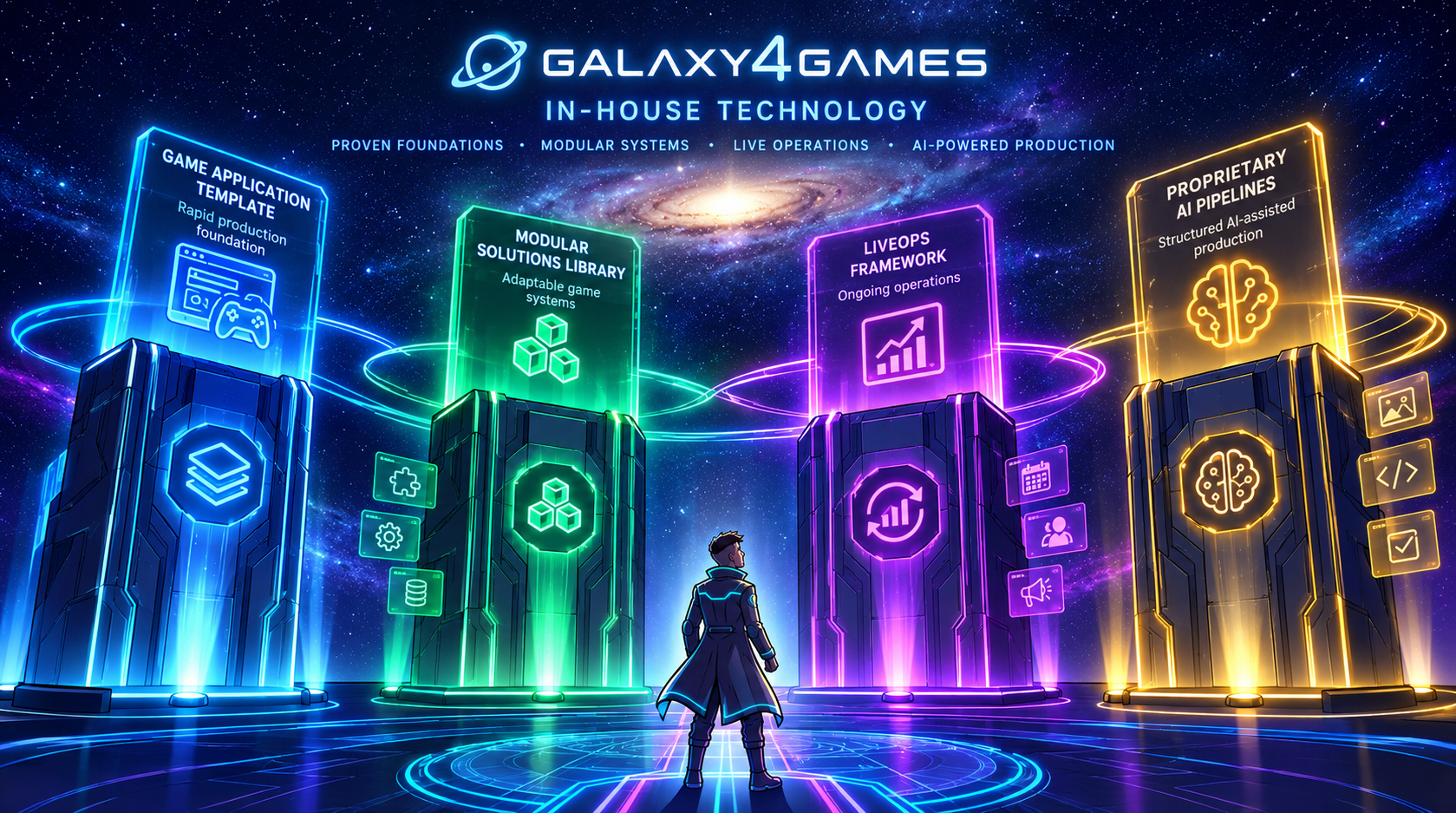
Modular solutions library: A production-ready library of battle-tested game features (UI systems, event engines, monetization modules, progression frameworks, LiveOps event tools) built and refined through their own live products. These modules are not proof-of-concept code. They are in production.
-
Game Application Template: A structured development foundation that eliminates the blank-slate startup cost. Core architecture, platform integrations, store compliance, and analytics hooks are already built. This directly compresses development time by 30-50% compared to conventional builds.
-
AI-accelerated pipelines: AI-integrated workflows speed up module assembly, asset generation, and iterative testing, which is particularly valuable for hypercasual and hybrid casual prototypes where iteration speed is the primary competitive advantage.
-
LiveOps-ready architecture: Every game is built from day one to support continuous content updates, in-game events, analytics integration, and long-term player retention. This is not a post-launch add-on. It is the foundation.
-
Publisher-friendly workflow: The team has direct experience working with publishers, preparing builds for CPI testing, and meeting the technical standards publishers require for SDK integration and store submission.
Best fit: Startups and publishers building casual, hybrid casual, or hypercasual games who need fast prototypes, production-ready architecture, and a partner that understands the full lifecycle from development through LiveOps.
Verified reviews: Clutch profile (5.0) | GoodFirms profile (5.0)
Kevuru Games
Location: Ukraine / USA / Poland | Team size: 200+ | Engine: Unity, Unreal
Kevuru Games is a full-cycle development and art production studio with a strong casual art specialization. Their Clutch and GoodFirms profiles both hold 5.0 ratings, with reviewers consistently noting quality and on-time delivery. One client noted the team "quickly grasped the style we were looking for" in casual art, which is a meaningful signal for studios where visual identity is core to the product.
Key strengths:
-
Extensive casual and casual-adjacent art production capability
-
Strong co-development model for studios that need art at scale alongside engineering
-
Verified 5.0 rating on both Clutch and GoodFirms across combined 20+ reviews
Best fit: Projects with significant art production requirements alongside development, or co-development arrangements where a primary studio needs art pipeline support.
Verified reviews: Clutch profile (5.0) | GoodFirms profile (5.0)
Game-Ace
Location: Kharkiv, Ukraine | Team size: 51-200 | Engine: Unity, Unreal
Game-Ace positions itself as a casual game studio offering full production from GDD through QA and post-launch support. Their published scope includes casual titles from focused mobile builds through full-featured LiveOps productions. The studio covers programming, 2D art, 3D art, and animation in-house.
Key strengths:
-
Explicit post-launch support commitment
-
Full-cycle capability from concept through QA
-
Covers both casual and hybrid casual scope
Best fit: Buyers who want a single studio to own the full production arc including post-launch, without managing multiple vendors.
Argentics
Location: Kyiv, Ukraine | Team size: 51-200 | Engine: Unity, Unreal
Argentics is a Unity and Unreal studio with a strong art and animation portfolio alongside development services. Founded in 2017, they cover casual and mid-core mobile development across iOS and Android.
Key strengths:
-
Strong visual production capability across 2D and 3D
-
Multi-platform coverage including PC alongside mobile
-
Flexible co-development and full-cycle engagement models
Best fit: Projects where high-quality art direction is a competitive differentiator and the buyer needs both art and engineering from one team.
Mobile Game Product Companies: Studios That Build and Own Their Games
These are companies that build and publish their own games. They are not outsourcing studios and they do not take client work. They are listed here for competitive reference and market context, not as potential partners for hire. If you want to understand what a successful casual or hybrid casual game looks like in practice, these are the companies to study.
Voodoo
HQ: Paris, France | Model: Product studio + publisher
Voodoo pioneered the hypercasual category and has since led the industry's transition to hybrid casual. Their portfolio includes Mob Control, Hole.io, and Paper.io 2. In 2026, Voodoo stands as a top 40 grossing mobile publisher globally by downloads and has seen IAP revenue grow 137% year-over-year. They also operate a publishing arm that accepts external game submissions.
Own games on store: App Store | Google Play
Homa
HQ: Paris, France | Model: Product studio + publisher
Homa surpassed 2 billion lifetime installs in 2025 and has continued scaling through hybrid casual titles. Their analytics-first approach and Homa Lab testing platform are central to their product development process. They also publish external games.
Own games on store: App Store | Google Play
Habby
HQ: Singapore | Model: Product studio
Habby has built one of the strongest reputations in hybrid casual with titles like Archero and Survivor.io. Their approach combines simple core mechanics with deep progression systems and aggressive LiveOps. They are widely cited as one of the best hybrid casual product companies in the world.
Own games on store: App Store | Google Play
Miniclip
HQ: Zurich, Switzerland | Model: Product studio + publisher (Miniclip group)
Miniclip reaches over 400 million players monthly. Their portfolio spans casual puzzle (via Easybrain acquisition), sports (8 Ball Pool, Golf Battle), and hybrid casual through the Lessmore acquisition. They are one of the most acquisitive operators in the casual space.
Own games on store: App Store | Google Play
Publishers and Distributors: Who Can Take Your Game to Market
Publishers fund user acquisition, run creative testing campaigns, and distribute games at scale. They are not development partners in the traditional sense. You bring them a prototype or a finished game; they bring the marketing infrastructure and UA budget. Most accept external submissions, though acceptance rates are competitive and KPI thresholds are real.
Voodoo Publishing
HQ: Paris, France | Segments: Hypercasual, Hybrid Casual | Submission: Self-serve via publisher platform
Voodoo's publishing arm is one of the most active in the industry. They fund a test campaign for each submitted game and provide coaching, LiveOps expertise, and their proprietary ad network. Their hybrid casual track record (Mob Control, Block Jam 3D) makes them a strong partner for games with a simple core loop and a planned meta layer.
Submit a game: voodoo.io/publishing
Kwalee
HQ: Leamington Spa, UK | Segments: Hypercasual, Hybrid Casual, PC/Console | Submission: Self-serve via Hitseeker platform
Kwalee has generated 144 million+ downloads across their mobile portfolio. Their Hitseeker platform provides structured testing and analytics for external developers. They also publish PC and console titles, giving them a broader distribution footprint than most mobile-only publishers.
Submit a game: kwalee.com
Homa
HQ: Paris, France | Segments: Hypercasual, Hybrid Casual | Submission: Self-serve via Homa Lab
Homa's publishing model is analytics-heavy. Their Homa Lab platform provides marketability and build testing tools, and their team provides feedback on game design before committing to a publishing deal. Developers who want a data-driven publishing partner with strong hybrid casual expertise will find Homa a natural fit.
Submit a game: homagames.com
SayGames
HQ: Minsk, Belarus | Segments: Hypercasual, Hybrid Casual | Submission: Pitch form
SayGames offers both publishing and funding, including upfront payments that can scale to investment-level deals depending on the game's potential. Their portfolio spans puzzle, runner, and sort mechanics. They are currently accepting submissions.
Lion Studios (AppLovin)
HQ: Palo Alto, USA | Segments: Hypercasual, Hybrid Casual | Submission: Self-serve via Lion portal
Lion Studios is backed by AppLovin's UA infrastructure, which gives them access to one of the largest mobile advertising networks in the world. For games where scale is the primary objective, Lion's distribution reach is a significant advantage.
TapNation
HQ: Paris, France | Segments: Hypercasual, Hybrid Casual | Submission: Pitch form
TapNation offers publishing, funding, and an acquisition/buy-out option for games that perform well. They respond within 7 business days of submission and accept both APK/IPA builds and store links for review.
Supersonic (Unity)
HQ: Tel Aviv, Israel | Segments: Hypercasual, Hybrid Casual | Submission: Pitch form
Supersonic is Unity's publishing division, which means games published through them benefit from tight integration with the Unity ecosystem, including the Wisdom SDK and access to Unity's ad network and analytics infrastructure.
|
Publisher |
Best for |
Submission type |
Funding offered |
|---|---|---|---|
|
Voodoo |
Hypercasual, hybrid casual |
Self-serve |
Publisher-funded test |
|
Kwalee |
Hypercasual, hybrid, PC/console |
Self-serve (Hitseeker) |
Analytics + publishing |
|
Homa |
Hybrid casual |
Self-serve (Homa Lab) |
Analytics + publishing |
|
SayGames |
Hypercasual, hybrid casual |
Pitch form |
Upfront + investment |
|
Lion Studios |
Hypercasual at scale |
Self-serve (Lion portal) |
Publishing |
|
TapNation |
Hypercasual, hybrid casual |
Pitch form |
Publishing + acquisition option |
|
Supersonic |
Unity-native games |
Pitch form |
Publishing |
The Bottom Line: Match Your Partner to Your Segment
The casual mobile game market is not one market. It is three distinct segments with different mechanics, different monetization models, different development timelines, and different types of partners. Treating them as interchangeable is the mistake that most listicles make, and it is the mistake that sends buyers to the wrong company.
Here is the decision framework in one place:
-
You need someone to build your game: Find a game development outsourcing studio. Verify their Clutch or GoodFirms profile. Ask to see a live game they have operated, not just shipped.
-
You need someone to distribute and market your game: Find a publisher. Prepare a prototype that already shows strong Day 1 retention before you submit.
-
You need to understand the competitive landscape: Study the product companies. They are not for hire, but their games are the benchmark.
If you are building a casual or hybrid casual game and need a development partner with a proven production foundation, publisher-ready workflows, and a team that has operated its own live games: Galaxy4Games is worth a conversation. Their modular solutions library, Game Application Template, and AI-accelerated pipelines mean your prototype moves faster and your architecture is built for the long game, not just the first launch.
The market rewards speed and operational depth in equal measure. The right partner brings both.
Further Reading
If this guide helped you get oriented in the casual mobile game market, these Galaxy4Games resources go deeper on the specific decisions you will face next.
Related Blog Articles
-
Hybrid Casual Game Development: The New Trend in Mobile Gaming - A detailed breakdown of hybrid casual systems, economy design, LiveOps architecture, and why the format is dominating 2026.
-
Mobile Game Monetization Strategies That Actually Work in 2026 - IAP, rewarded ads, hybrid models, subscriptions, and LiveOps systems that maximize lifetime value. Essential reading before you finalize your monetization design.
-
How Much Does It Cost to Develop a Mobile Game in 2026? - Real budget ranges, key cost drivers, and where modular development compresses spend without sacrificing quality.
-
The Real Cost of Launching a Mobile Game: Why ROI Thinking Must Start on Day One - Development cost is only one part of the equation. This piece covers UA, LiveOps, and the financial model that separates games that earn from games that burn through budget.
-
Game Development Approaches That Deliver the Highest ROI in 2026 - Modular architecture, LiveOps-driven design, and smart outsourcing models explained through an ROI lens.
-
Mobile Game Development Outsourcing 2026: Costs, Trends & Partner Guide - A broader look at the outsourcing landscape: regional rates, partner evaluation criteria, and how to structure the engagement.
-
Game LiveOps Integration: Expert Guide, Key Systems & Best Studios 2026 - How to integrate LiveOps from day one, which systems matter most, and what to look for in a partner that can support continuous operations.
-
AI-Powered Game Development: Turning Ideas into Scalable Games Faster - How AI pipelines are being used in production today, including Galaxy4Games' three-layer AI framework for faster prototyping and module assembly.
-
Why Mobile Games Become Hits: Candy Crush vs Gardenscapes Strategy - A breakdown of the design systems, monetization strategies, and player psychology behind two of the most successful casual games ever made.
-
Scalable Game Development Pipelines: Modular Game Design Guide 2026 - How modular architecture reduces costs, accelerates production, and makes LiveOps sustainable at scale.
Case Studies
-
Marble Ball Madness: From a Live Game Foundation to the First Store Build in 10 Days - A production record of how Galaxy4Games replaced a core gameplay mechanic, built 300 levels across 12 biomes, integrated LiveOps, localized into 5 languages, and submitted a Google Play build - all within a 10-day milestone. A concrete answer to the reskin vs. new game question.
-
Cube Sort: 3D Color Blocks - From Concept to Playable Prototype in Weeks - How a 3D casual puzzle with a full analytics layer, dual-platform builds, and a live monetization architecture was delivered in 3 weeks using the Game Application Template and modular solutions library. Includes a breakdown of exactly which modules were deployed and why.
-
Pawdoku: Animal Logic Puzzle - Prototype to Validated Retention in 3 Weeks - A logic deduction puzzle built, UA-tested, and validated for positive Day 1 retention in 3 weeks. Covers the go/no-go framework, what the retention data actually means, and how the results became a specific roadmap for the next development scope.
-
Royal Smash! Cannonball Fest: From Idea to Publisher Interest in 2 Weeks - A 3D physics destruction game prototyped, UA-tested, and taken to publisher interest in 2 weeks. Walks through the full Prototype, Analyze, Act cycle and what strong Day 1 retention at prototype stage actually signals to publishers.