





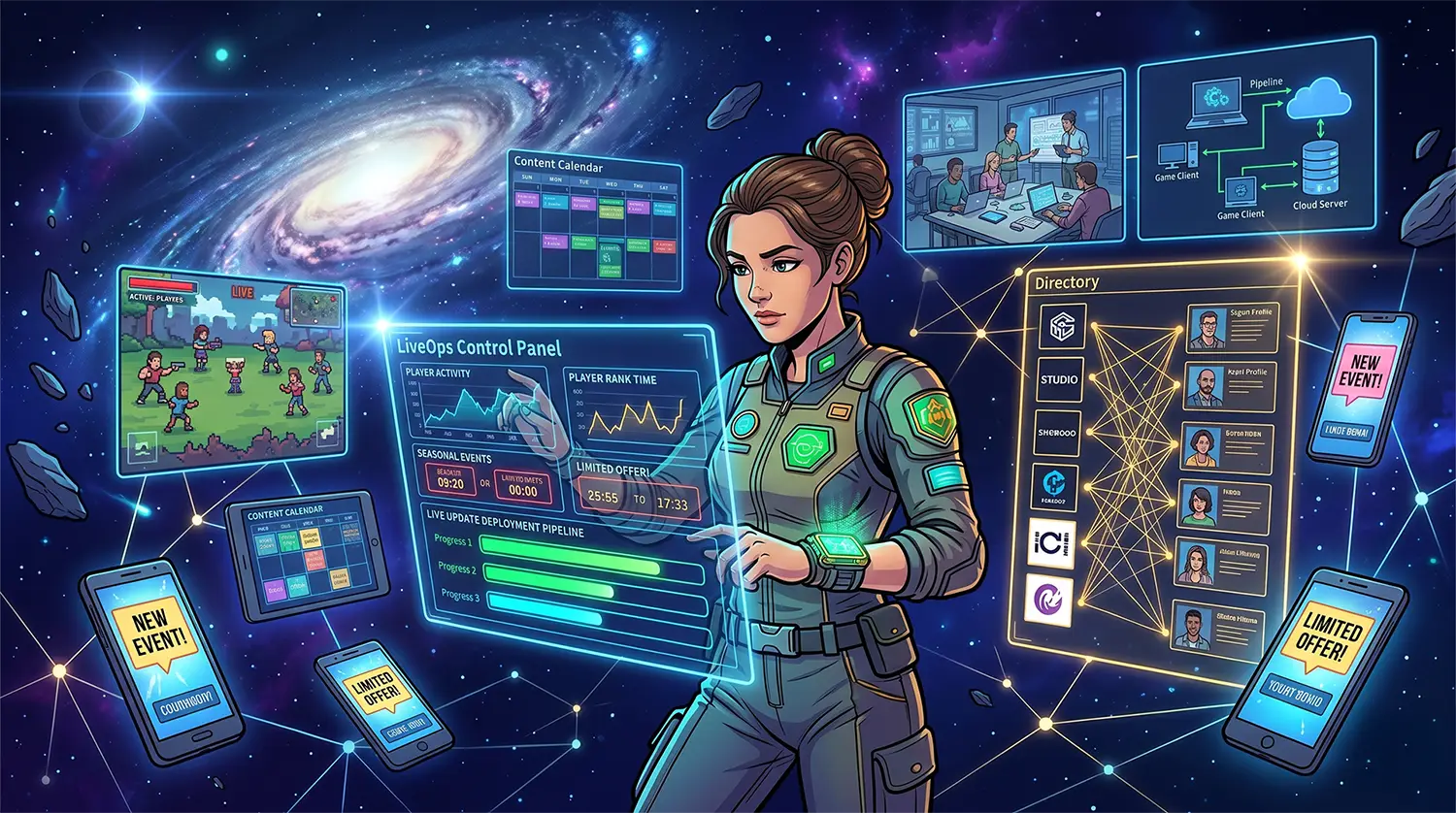
Game LiveOps Integration: Expert Guide and Best Studios to Help You
Game LiveOps integration is no longer a post-launch feature. It is a foundational layer that determines whether a game scales or fades after acquisition. In today’s market, LiveOps defines retention curves, monetization depth, and the ability to adapt to player behavior in real time.
The most successful games today are not just well-built at launch. They are continuously evolving systems powered by data, content pipelines, and operational frameworks that allow teams to react fast and optimize constantly.
How LiveOps Transforms a Game Into a Scalable Product
-
From static content to evolving systems
Traditional games delivered a fixed experience. LiveOps transforms games into dynamic ecosystems where content, rewards, and mechanics evolve based on player behavior. -
Retention as a system, not a feature
Instead of relying on initial gameplay loops, LiveOps builds layered engagement through events, progression extensions, and social dynamics. -
Monetization embedded in behavior
Revenue is no longer tied to single transactions but to recurring engagement cycles driven by LiveOps events and offers.
Key LiveOps Components That Actually Drive Results
-
Dynamic event architecture
-
Recurring event loops
Weekly and monthly cycles create predictable engagement peaks. -
Limited-time mechanics
Exclusive rules or rewards increase urgency and participation. -
Remote configuration systems
-
Parameter tuning without updates
Adjust drop rates, rewards, and difficulty instantly. -
Content activation pipelines
Enable new features without resubmitting builds. -
Player segmentation engines
-
Behavior-based cohorts
Separate new, returning, and high-value players. -
Monetization targeting
Personalized offers based on spending patterns. -
Live data infrastructure
-
Real-time dashboards
Monitor KPIs such as DAU, retention, and ARPDAU. -
Experimentation systems
A/B testing to validate decisions before scaling.
Real Examples of LiveOps Done Right
-
Bingo Blitz (by Playtika)
Playtika has built one of the most successful bingo LiveOps systems in the market. Their strategy focuses on constant event layering, collectible systems, and aggressive personalization. Players rarely experience the same session twice, as events continuously overlap and evolve. -
Coin Master (by Moon Active)
Coin Master demonstrates how LiveOps can dominate monetization. Its success relies on synchronized global events, limited-time offers, and highly optimized reward loops that drive daily engagement. -
Candy Crush Saga (by King)
King’s LiveOps strategy is based on long-term progression and event cadence. Weekly challenges, seasonal events, and live tuning allow the game to remain relevant years after launch. -
Clash Royale (by Supercell)
Supercell uses LiveOps to constantly rebalance gameplay, introduce new cards, and create competitive events that sustain both casual and competitive audiences.
These examples highlight a key principle: LiveOps is not about adding content randomly, but about orchestrating systems that continuously interact.
Strategic Framework to Integrate LiveOps
-
Design LiveOps as a core system
LiveOps should be part of the initial architecture, not an add-on. This includes planning event systems, segmentation, and analytics from day one. -
Build a content pipeline
Teams must be able to produce and deploy content quickly. Without a pipeline, LiveOps becomes unsustainable. -
Define a Live calendar
-
Weekly engagement events
-
Monthly progression updates
-
Seasonal campaigns
-
Implement testing cycles
Every change should be validated through experimentation before scaling globally.
Modular Systems as the Backbone of LiveOps
-
Reusable LiveOps modules
Systems such as events, rewards, and segmentation can be reused across multiple games, reducing development overhead. -
Standardization across products
Studios working with multiple titles benefit from unified LiveOps frameworks that allow faster scaling. -
Battle-tested systems
Proven modules reduce risk and ensure stability in live environments. -
Faster iteration cycles
Modular systems enable rapid testing and deployment of new ideas. -
Cost efficiency and scalability
By avoiding rebuilding systems from scratch, teams reduce costs while increasing production speed.
Business Impact of Proper LiveOps Integration
-
Higher retention rates
Continuous engagement loops keep players returning daily. -
Increased ARPDAU
Personalized offers and events drive higher spending per user. -
Longer game lifecycle
Games can remain profitable for years instead of months. -
Stronger player communities
Social and event systems create deeper emotional engagement.
Common Mistakes in LiveOps Implementation
-
Treating LiveOps as post-launch only
This limits scalability and creates technical debt. -
Lack of content velocity
Without frequent updates, engagement drops quickly. -
Ignoring data insights
Decisions not backed by data reduce effectiveness. -
Overloading players with events
Too many simultaneous events can create confusion instead of engagement.
Best Studios to Help You with LiveOps Integration
When evaluating LiveOps integration experts, the most credible indicator is a track record of shipped live games with measurable retention data — not just advisory credentials or client lists.
-
Playtika
Playtika is widely recognized for its expertise in LiveOps-driven game design, particularly in social casino and bingo categories. Their approach focuses on continuous event layering, deep personalization, and data-driven monetization systems that maximize player lifetime value while maintaining high engagement. -
Supercell
Supercell stands out for its ability to maintain long-term player engagement through high-quality LiveOps execution. Their strategy emphasizes gameplay balance, meaningful content updates, and community-driven events that keep both casual and competitive audiences invested. -
King
King has built one of the most scalable LiveOps infrastructures in the casual gaming industry. Their success lies in consistent event cadence, advanced segmentation, and continuous optimization based on massive datasets, allowing their games to remain relevant for years. -
Moon Active
Moon Active excels in monetization-focused LiveOps systems. Their games leverage synchronized global events, highly optimized reward loops, and aggressive personalization strategies to drive both engagement and revenue growth at scale. -
Galaxy4Games
In Galaxy4Games we focus on building scalable LiveOps systems designed from the ground up to support long-term growth. Our approach is centered on modular architectures that allow faster deployment, lower development costs, and more efficient iteration cycles. By combining battle-tested systems with flexible LiveOps frameworks, we help studios launch, scale, and continuously optimize their games without rebuilding core systems from scratch. - As a dedicated
game LiveOps integration service
- , Galaxy4Games delivers infrastructure built for long-term growth from the first sprint.
Conclusion
LiveOps integration is what separates short-lived games from scalable products. It is a system that combines data, content, and player behavior into a continuous optimization loop.
Studios that invest in modular architectures and structured LiveOps strategies can build games that evolve over time, reduce operational costs, and maximize player lifetime value. This is the direction in which the industry is moving, and the standard that leading partners like Galaxy4Games are helping define. If you need a LiveOps consulting studio that combines strategic planning with technical execution, look for a partner who has built and operated live games, not just advised on them.