





What Is a Game MVP and Why Every Studio Should Start There
The Concept Most Studios Understand Too Late
There is a version of game development where a studio spends 18 months building a fully featured product, launches it, and discovers within the first two weeks that the core loop doesn't hold. Players churn on day one. The monetization assumptions were wrong. The onboarding is too complex. The genre has more competition than anticipated.
This is not an unusual story. It is, in fact, one of the most common and most expensive patterns in the industry.
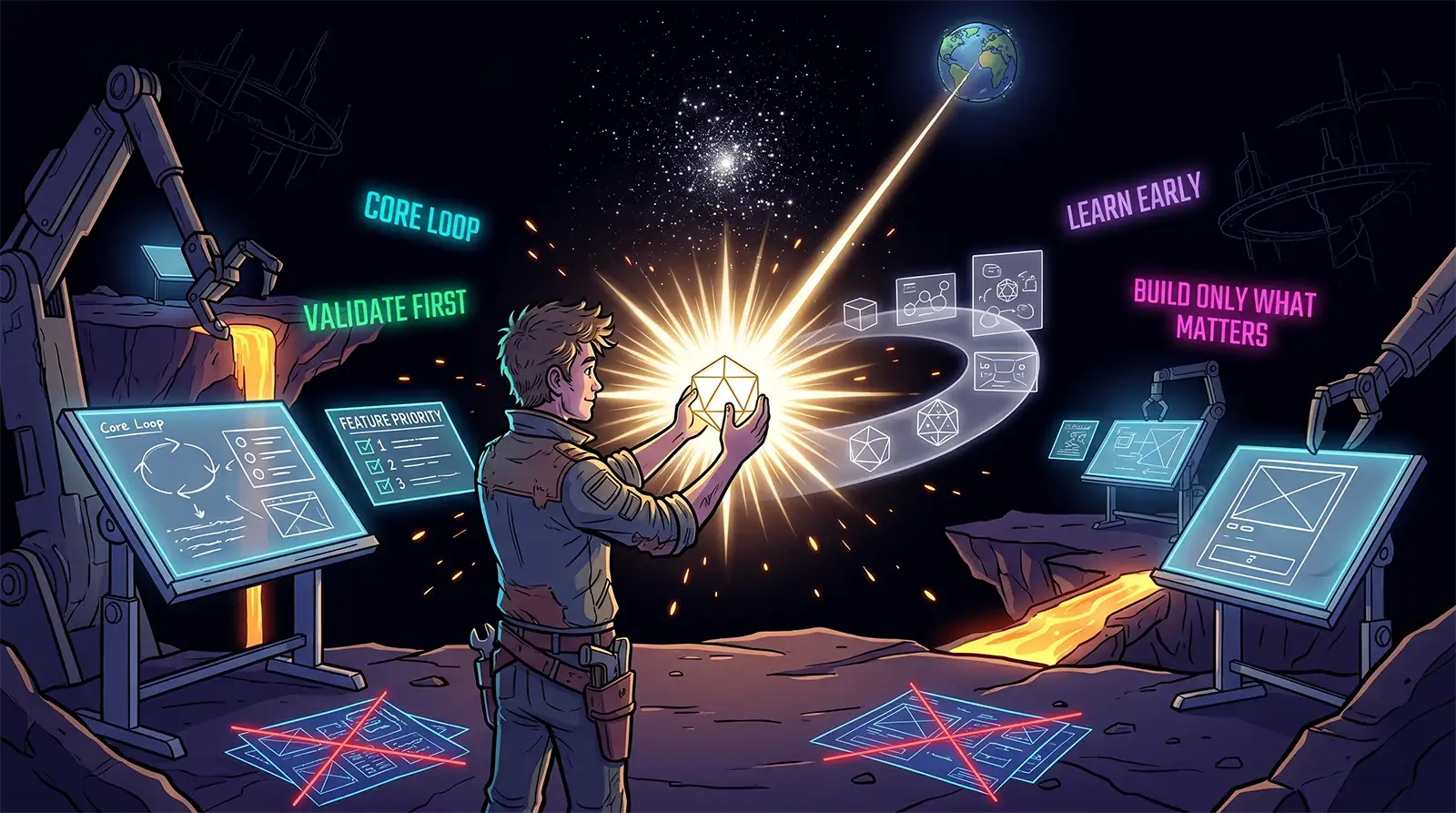
The game MVP — Minimum Viable Product — exists precisely to interrupt this pattern. Not as a shortcut, not as a way to ship something unfinished, but as a disciplined methodology for validating the most critical assumptions in a game's design before committing the full production budget to them.
In 2026, with UA costs rising, investor scrutiny tightening, and the mobile market more competitive than ever, the game MVP has become less of an option and more of an operational necessity.
What a Game MVP Actually Is
The term MVP comes from product development methodology, popularized by Eric Ries in The Lean Startup. In software, an MVP is the smallest version of a product that allows a team to test its core hypothesis with real users.
In game development, the definition requires some adaptation — because games are not software utilities. A game MVP is not a bug-ridden demo or an unfinished prototype. It is a playable, functional version of the game that isolates and tests the core experience: the core loop, the primary retention mechanic, and the fundamental feel of the product.
A well-built game MVP answers specific questions:
-
Does the core loop generate engagement on its own merit?
-
Is the onboarding intuitive enough for a cold audience?
-
Do players return voluntarily after the first session?
-
Is there a signal of monetization intent — even without a full economy in place?
-
Does the game feel distinct enough to compete in its target category?
What a game MVP deliberately excludes is everything that doesn't answer those questions: deep meta progression, full content libraries, polished UI, advanced social features, and extensive monetization systems. These come later — after the foundation is validated.
The Strategic Logic Behind Starting with an MVP
The argument for building an MVP is fundamentally an argument about where risk lives in game development.
Most production risk is front-loaded. The assumptions a studio makes at the start of a project — about genre fit, core mechanic appeal, target audience behavior, and monetization potential — are the assumptions with the highest uncertainty and the highest cost if wrong. Full production amplifies those assumptions. It doesn't test them.
An MVP inverts the risk curve. By building the smallest possible version of the core experience first, the studio creates an opportunity to test the most expensive assumptions before committing to them.
This has cascading effects on business outcomes:
Capital efficiency. An MVP typically costs a fraction of full production. If the core hypothesis fails validation, the studio has preserved the majority of its budget for a pivot or a new project. If it succeeds, the studio enters full production with validated assumptions and investor confidence.
Investor alignment. In 2026, most serious game investors — whether publishers, VCs, or strategic partners — expect to see some form of validated product before committing meaningful capital. A polished MVP with early retention data is a fundamentally stronger pitch than a concept deck.
Production clarity. Validated MVPs generate real data about what players respond to. That data shapes production priorities in full development, reducing the likelihood of building features that don't move retention or monetization metrics.
Team alignment. Building an MVP forces early alignment on what the game actually is — what's core, what's secondary, and what's speculative. This alignment is valuable. Many projects that fail in full production fail because the team never had a shared, tested definition of the product.
MVP vs. Prototype vs. Soft Launch
These three terms are often used interchangeably, but they represent distinct phases with different objectives.
|
Stage |
Primary Purpose |
Audience |
Output |
|
Prototype |
Test a mechanic or technical concept |
Internal team |
Proof of concept |
|
MVP |
Validate core loop and retention hypothesis |
Limited external audience |
Validated product foundation |
|
Soft Launch |
Test monetization, UA efficiency, and market fit |
Real market, limited geography |
Launch-ready data |
A prototype answers: can we build this?
An MVP answers: does this work as a game?
A soft launch answers: can this game succeed commercially?
The MVP sits between internal development and market exposure. It's the moment where the team stops talking about what the game will be and starts learning what it actually is.
What a Strong Game MVP Looks Like in Practice
The specific shape of an MVP varies by genre, platform, and target audience. But strong game MVPs share a set of operational characteristics regardless of the game type.
A single, complete core loop. The MVP must have a full play session — beginning, middle, and resolution — that can be experienced without explanation. If a player needs a tutorial to understand what they're supposed to do, the core loop is not yet clear enough.
Functional onboarding. The first three minutes of a game determine whether most players will stay or leave. The MVP must have onboarding that works on its own, without the team present to explain it.
Enough content to support multiple sessions. An MVP that exhausts its content in one sitting cannot measure retention. There must be enough variety or depth to bring players back at least two or three times.
Basic telemetry. Without data, the MVP produces anecdotes, not insights. Even simple analytics — session length, return rate, drop-off points — are essential to making decisions based on the MVP's results.
A testable monetization signal. The MVP doesn't need a full economy. But it should include at least one moment where a player might choose to spend — even if that spend is simulated or soft. This tests the emotional and motivational architecture of the monetization model before it's fully built.
Why Most Studios Skip the MVP — And Pay for It
The decision to skip the MVP phase is almost always driven by one of three pressures: timeline, confidence, or misunderstanding of what an MVP is.
Timeline pressure comes from investors, publishers, or internal stakeholders who want to see a complete product and view an MVP as a delay. In reality, a failed full production is a far longer delay than a two-month MVP cycle.
Overconfidence in the concept is endemic in game development. Studios that have deep genre expertise or a strong creative vision often believe that expertise substitutes for validation. It doesn't. Expertise informs the hypothesis — it doesn't confirm it.
Misunderstanding the MVP leads studios to either build too much (a full game marketed as an MVP) or too little (a prototype without enough fidelity to generate meaningful signal). Both approaches fail for different reasons: the former wastes capital, the latter produces inconclusive data.
The studios that consistently skip MVP validation and succeed are the exception. They tend to be operating in well-understood genres with proven mechanics and have significant prior data from previous titles. For most studios — especially those entering new genres, new platforms, or new markets — skipping the MVP is a bet with unfavorable odds.
The MVP as a Foundation for LiveOps
One dimension of the game MVP that is underappreciated is its relationship to LiveOps readiness.
A game built with an MVP methodology tends to have a cleaner system architecture. Because the team was forced to isolate and validate the core loop before building around it, the resulting codebase is more modular, the content systems are more defined, and the production logic is clearer.
This matters enormously at the live phase. Games that launch with tangled systems — where monetization, progression, and content are deeply coupled — are expensive to update, slow to iterate on, and prone to breaking when new content is added.
Games built from validated MVPs tend to launch with cleaner foundations, which translates directly into faster LiveOps cycles, lower update costs, and greater content scalability post-launch.
Galaxy4Games and MVP Development
Galaxy4Games approaches MVP development as a structured production phase, not a stripped-down version of full development. Using its proprietary Game Application Template and Modular Solutions Library, Galaxy4Games builds MVPs that are architecturally ready for scale from day one.
This means the MVP a client validates is not a throwaway build. It's the foundation the full game will be built on — with LiveOps systems, content pipelines, and monetization architecture already considered in the design. The result is a faster path from validated MVP to full production, with fewer structural rebuilds and a cleaner transition into the live phase.
For studios building investor pitches, evaluating new genres, or entering new markets, this approach transforms the MVP from a testing exercise into a strategic asset.
Conclusion
The game MVP is not a compromise. It's a discipline — one that separates studios that build games based on validated understanding from those that build based on untested assumptions.
In a market where production costs are rising, investor expectations are tightening, and player attention is increasingly scarce, the ability to validate fast and build smart is a genuine competitive advantage.
The studios that treat the MVP as a strategic phase — not a preliminary annoyance — are the ones that enter full production with confidence, clarity, and data. And they're the ones that tend to build games that actually survive the live phase.
Galaxy4Games is built to support that entire journey — from a disciplined MVP to a scalable, LiveOps-ready product.