




How to Optimize LiveOps Events for Better ROI: Expert Strategies
LiveOps game development services and events have become one of the most powerful growth drivers in modern game development. In leading mobile games, events are no longer occasional content drops—they are structured revenue systems designed to increase retention, monetization, and player lifetime value.
But running more events does not automatically generate better results.
Many studios fall into the trap of measuring success through short-term spikes in engagement or revenue without evaluating long-term ROI. Poorly structured events can inflate operational costs, overwhelm players, and even damage retention.
The studios that consistently outperform in LiveOps treat events as part of a scalable operating system. They optimize timing, segmentation, rewards, economy balance, and content cadence with the same level of precision used in core game systems.
Why LiveOps ROI Matters More Than Ever
The economics of mobile gaming have shifted significantly over the last few years.
According to recent market analysis from Sensor Tower and broader industry reporting, mobile studios are facing a more expensive acquisition environment while player growth slows across multiple genres. As a result, profitability increasingly depends on maximizing engagement and monetization from existing players rather than continuously scaling user acquisition.
This changes the role of LiveOps.
Instead of functioning as a retention support layer mostly, LiveOps operates as a core profitability engine now more than ever.
A successful event does not simply increase activity for a few days. It improves:
-
Session frequency
-
Retention curves
-
Conversion timing
-
Average revenue per paying user
-
Long-term player engagement
The key metric is no longer “did the event perform?” but:
Did the event improve player lifetime value relative to operational cost?
New Market Trend: Progression Events Are Replacing Short-Term Monetization Loops
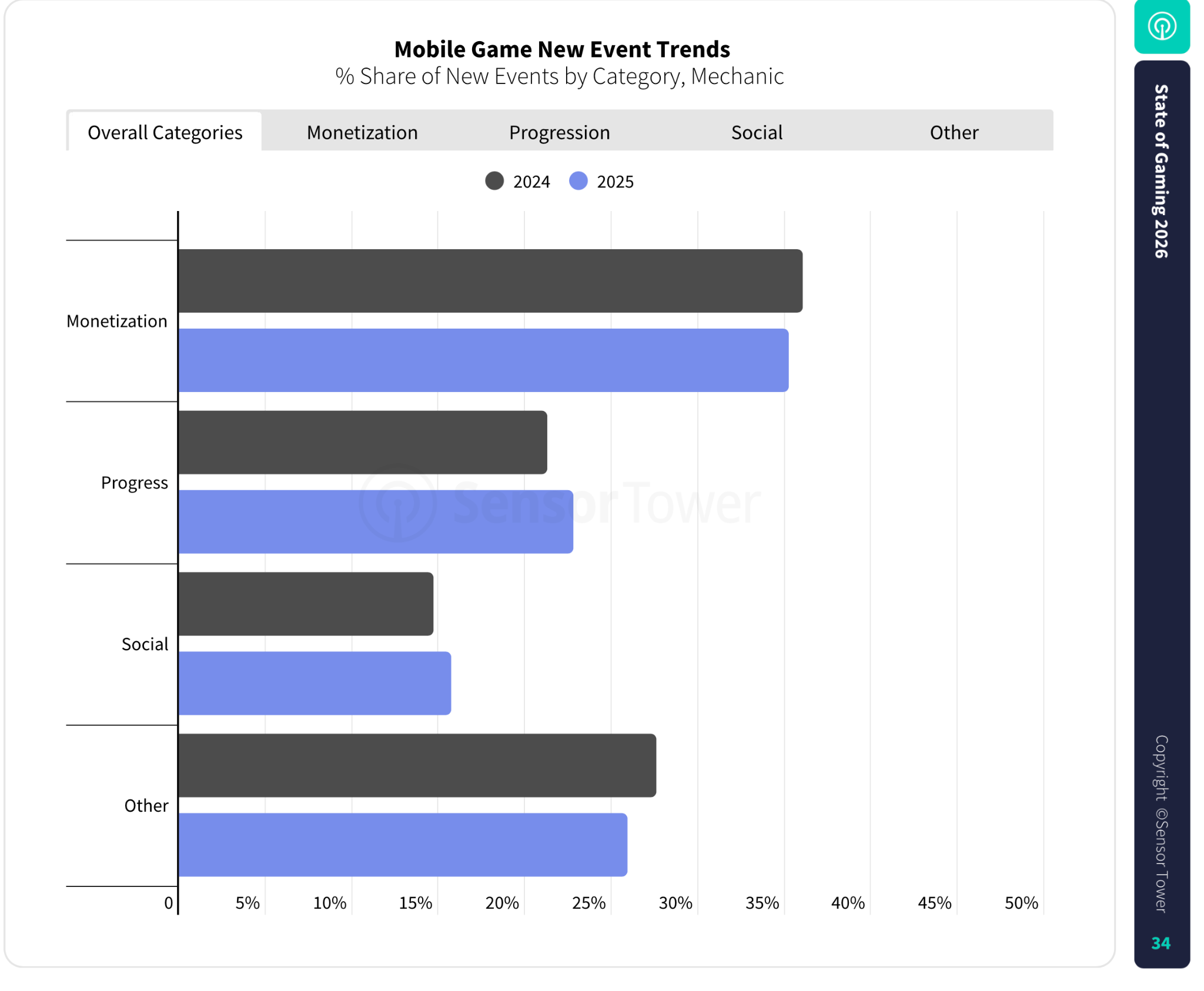
Recent Sensor Tower LiveOps analysis shows a noticeable shift in event design priorities across top-performing mobile games. In 2025, progression-focused events increased their share of LiveOps calendars, while purely monetization-driven events became less dominant.
This reflects a broader market transition away from short-term revenue spikes and toward systems that sustain repeat engagement over longer periods.
Studios are increasingly investing in:
-
Milestone-based progression systems
-
Repeatable competitive loops
-
Long-duration engagement structures
-
Events tied directly to player advancement
The implication is clear: events that extend player lifetime value are outperforming isolated monetization pushes.
Monetization Mechanics — Traditional Offers Are Declining While Layered Systems Expand
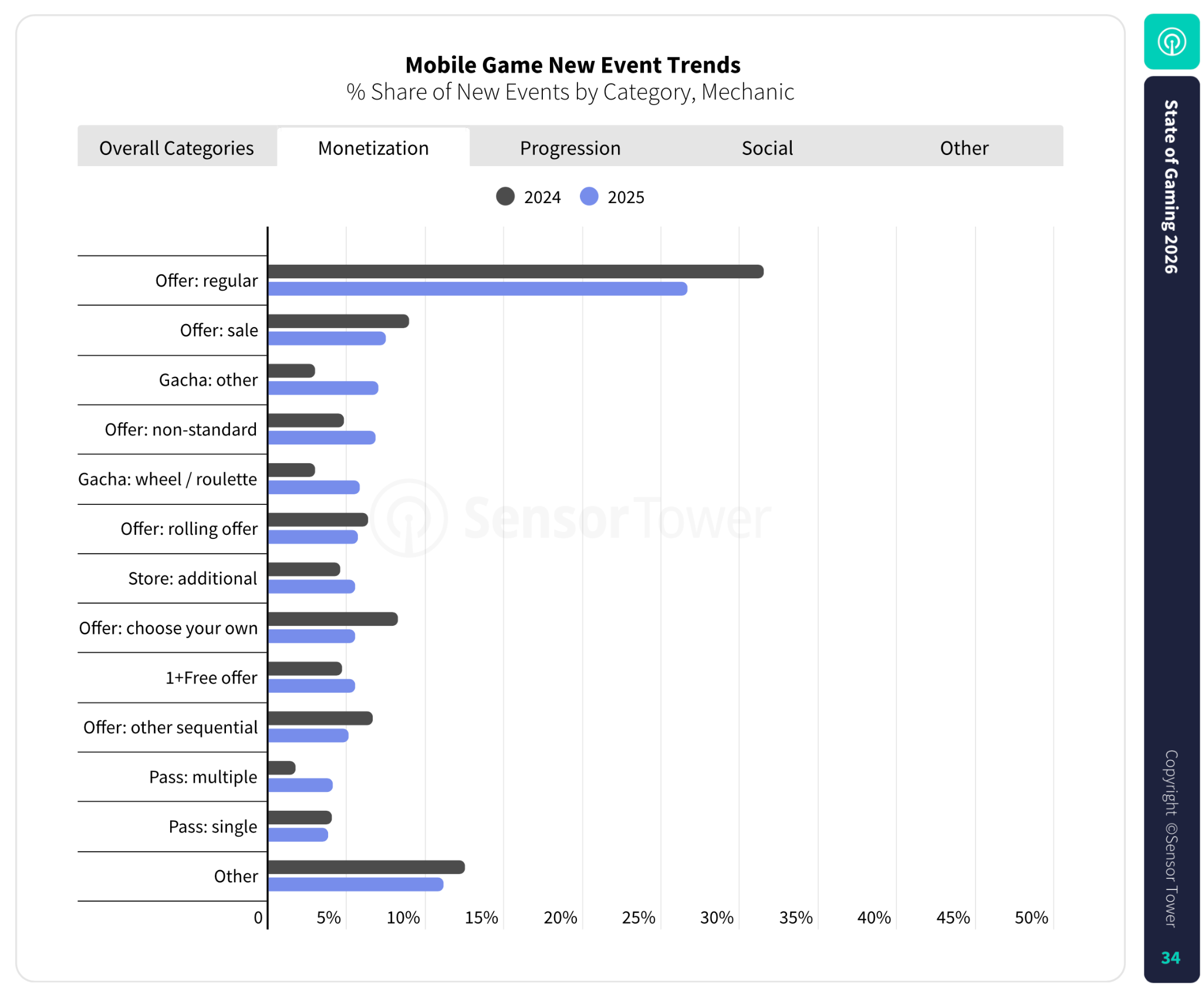
The monetization breakdown reveals a very important trend: traditional “regular offers” still dominate the market, but their share declined noticeably in 2025.
At the same time, more sophisticated monetization mechanics increased adoption, including:
-
Non-standard offers
-
Gacha variations
-
Rolling offers
-
Additional stores
-
Battle pass systems
-
Multi-step monetization funnels
This reflects a broader evolution in player spending psychology.
Players are becoming less responsive to simple static offers and more responsive to monetization systems tied to:
-
Progression
-
Scarcity
-
Event participation
-
Collection systems
-
Time investment
-
Long-term reward accumulation
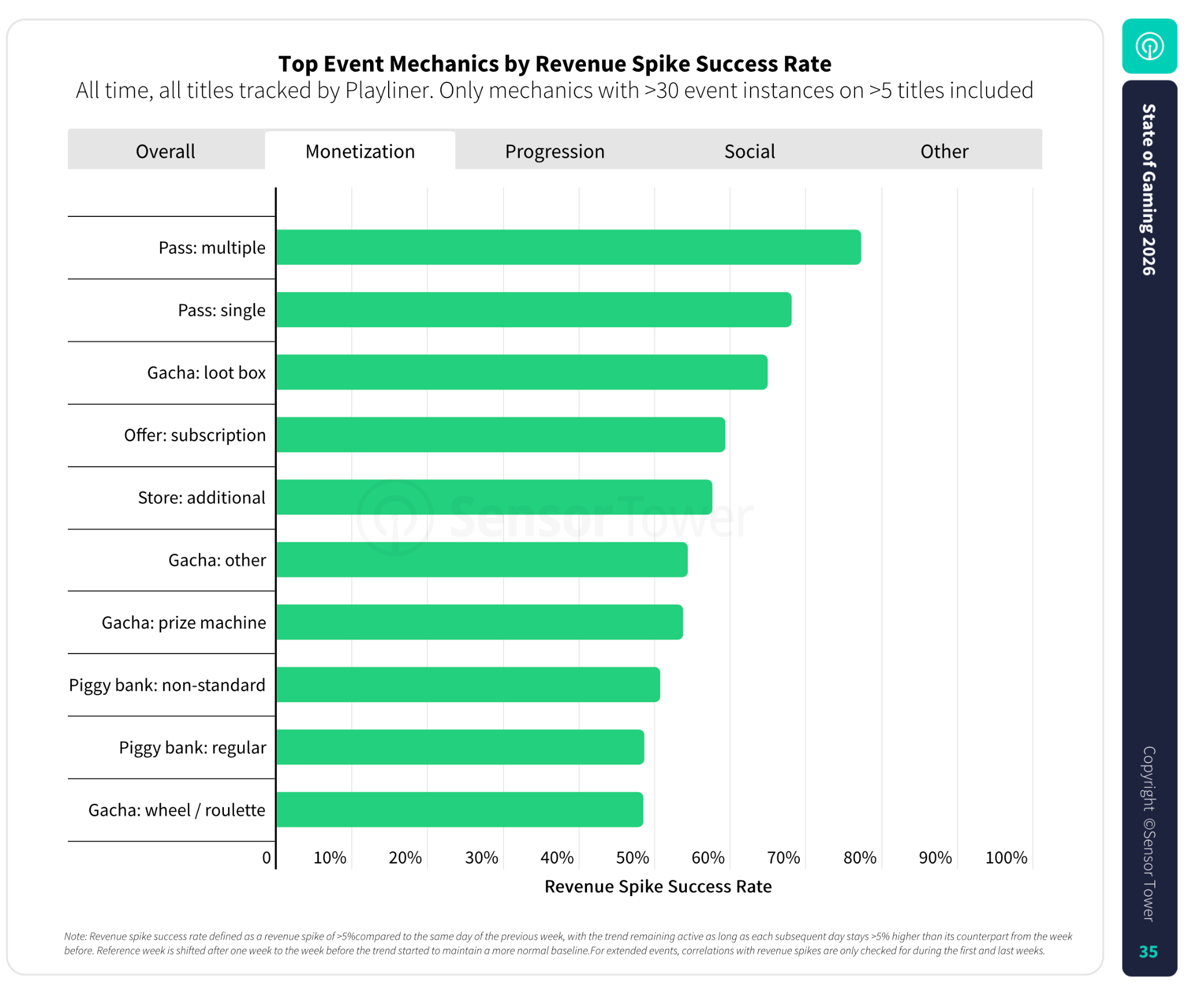
One particularly important signal is the growth of pass-based systems. Even though passes still represent a smaller percentage overall, their expansion suggests that recurring monetization structures continue outperforming one-time purchase models.
The rise of “rolling offers” and customizable offer structures also indicates that personalization is becoming a major monetization driver.
For LiveOps teams, the takeaway is clear:
-
Static shop offers are losing strategic importance
-
Monetization must feel integrated into gameplay
-
Multi-session monetization loops outperform isolated purchases
-
Flexible pricing structures increase conversion efficiency
Strategic implication:
The future of monetization is not larger offer volume — it is better contextual monetization integrated directly into progression and engagement systems.
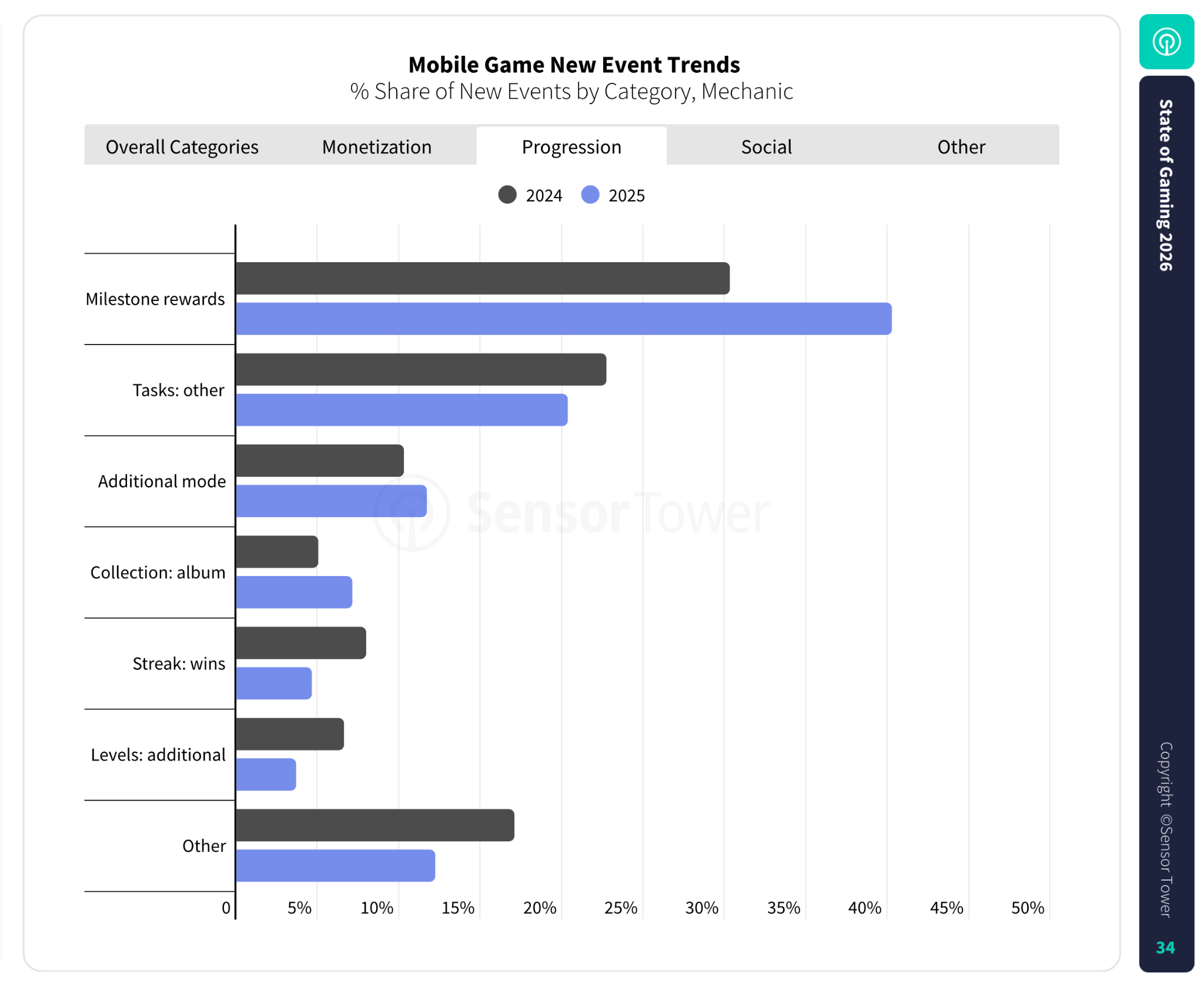
Progression Mechanics — Milestone Rewards Became the Dominant Event Structure
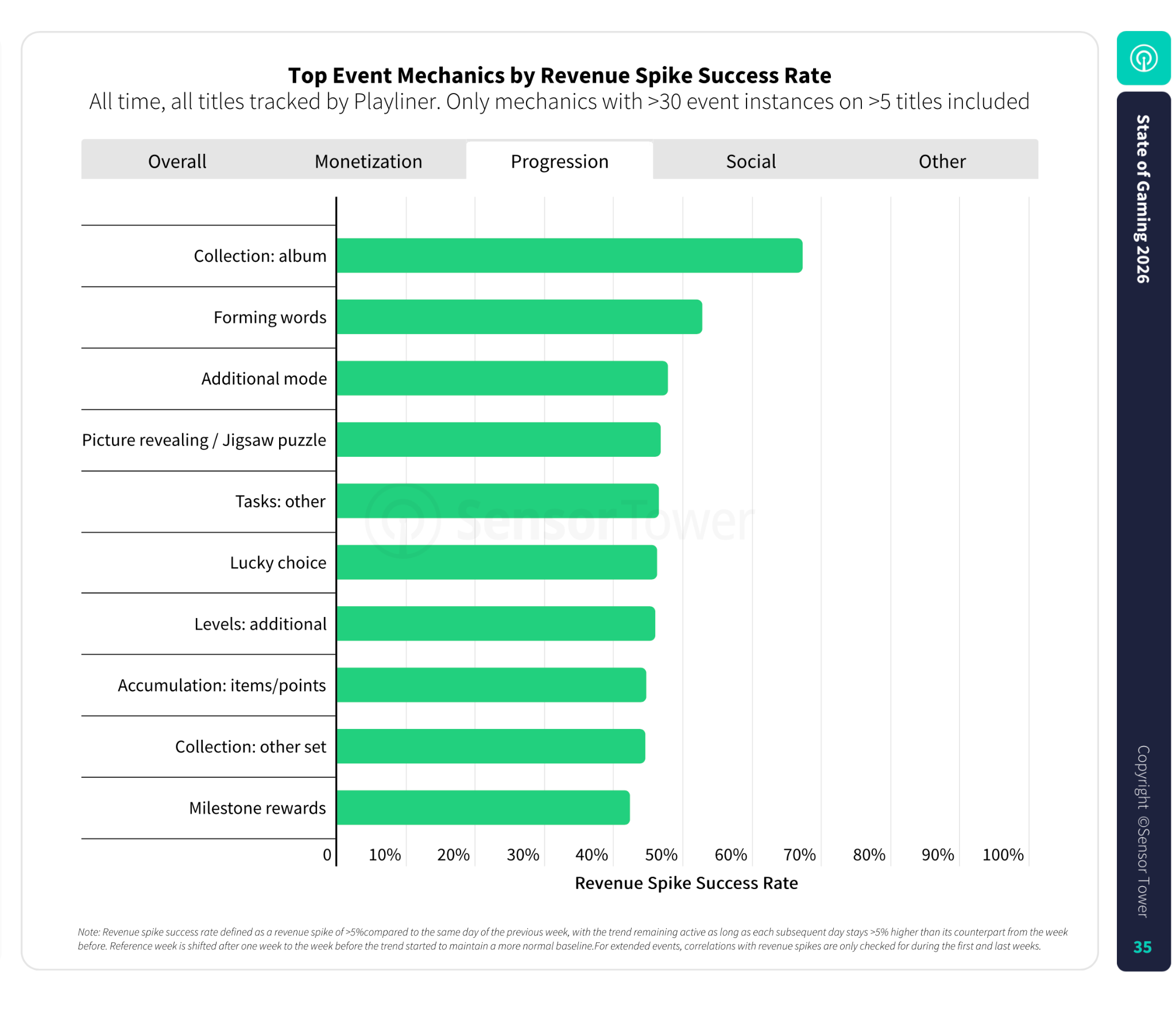
The progression category shows one of the clearest market trends in the entire report: milestone reward systems saw massive growth in 2025.
This is extremely important because milestone systems represent a very specific type of player psychology:
-
Clear goals
-
Predictable progression
-
Visible reward pacing
-
Multi-session commitment
-
Long-term engagement loops
Studios increasingly favor milestone systems because they naturally support:
-
Retention
-
Session recurrence
-
Pass monetization
-
Reward accumulation
-
Daily participation
At the same time, “additional mode” mechanics and collection systems also expanded, suggesting that developers are increasingly introducing temporary gameplay layers without permanently changing the core game.
Meanwhile, “additional levels” and pure streak-based systems declined, implying that players may be experiencing fatigue from repetitive short-cycle progression mechanics.
The rise of album collections is also notable because collection systems create:
-
Long-term goals
-
Scarcity motivation
-
Social sharing opportunities
-
Monetization hooks
-
Cross-event engagement loops
For LiveOps teams, this confirms a major strategic shift:
-
Progression systems are no longer supplemental content
-
They are becoming the foundation of LiveOps retention architecture
Strategic implication:
Modern events should focus less on isolated activities and more on persistent progression ecosystems that encourage players to return repeatedly over longer time windows.
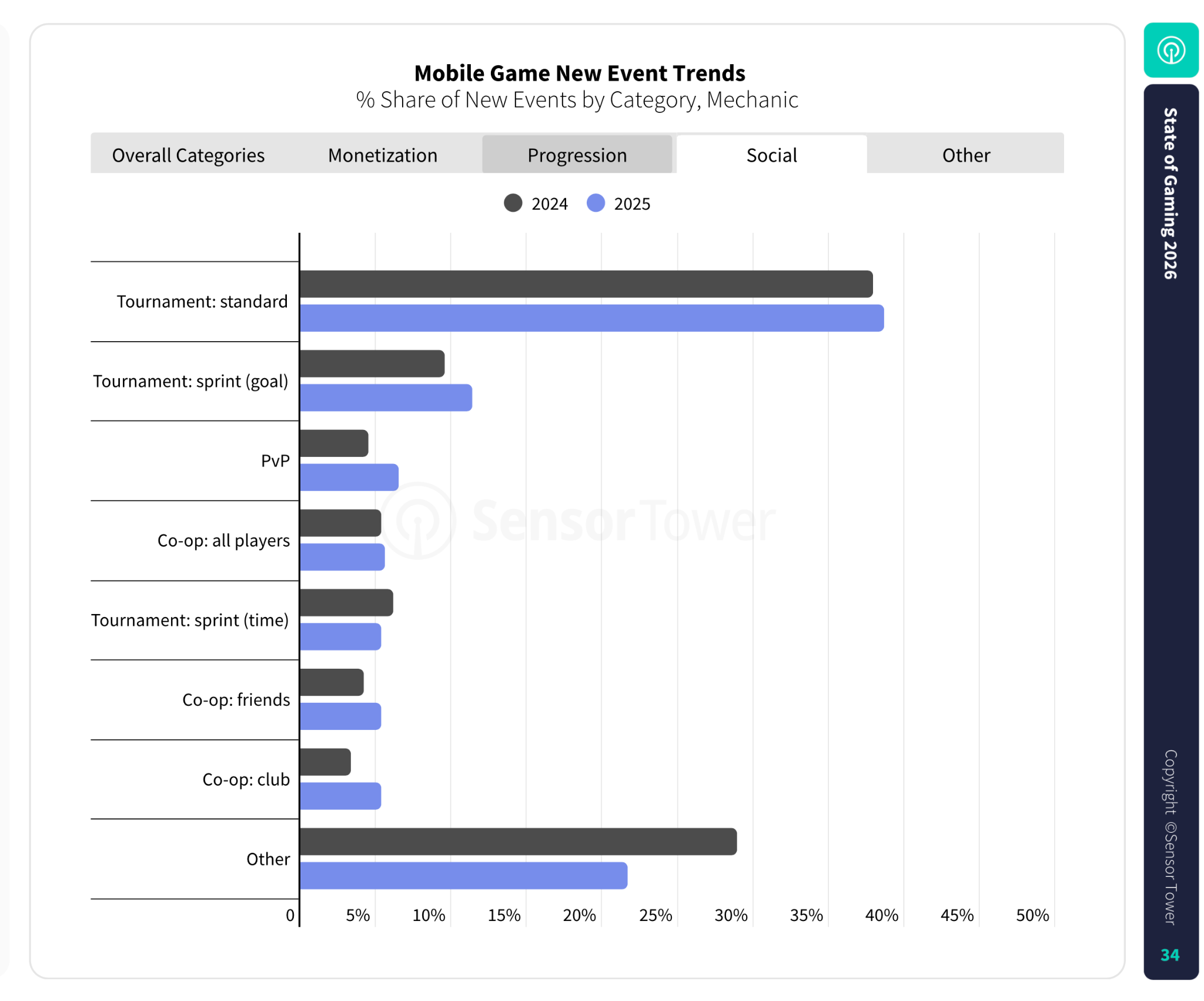
Social Mechanics — Competitive Systems Continue Expanding
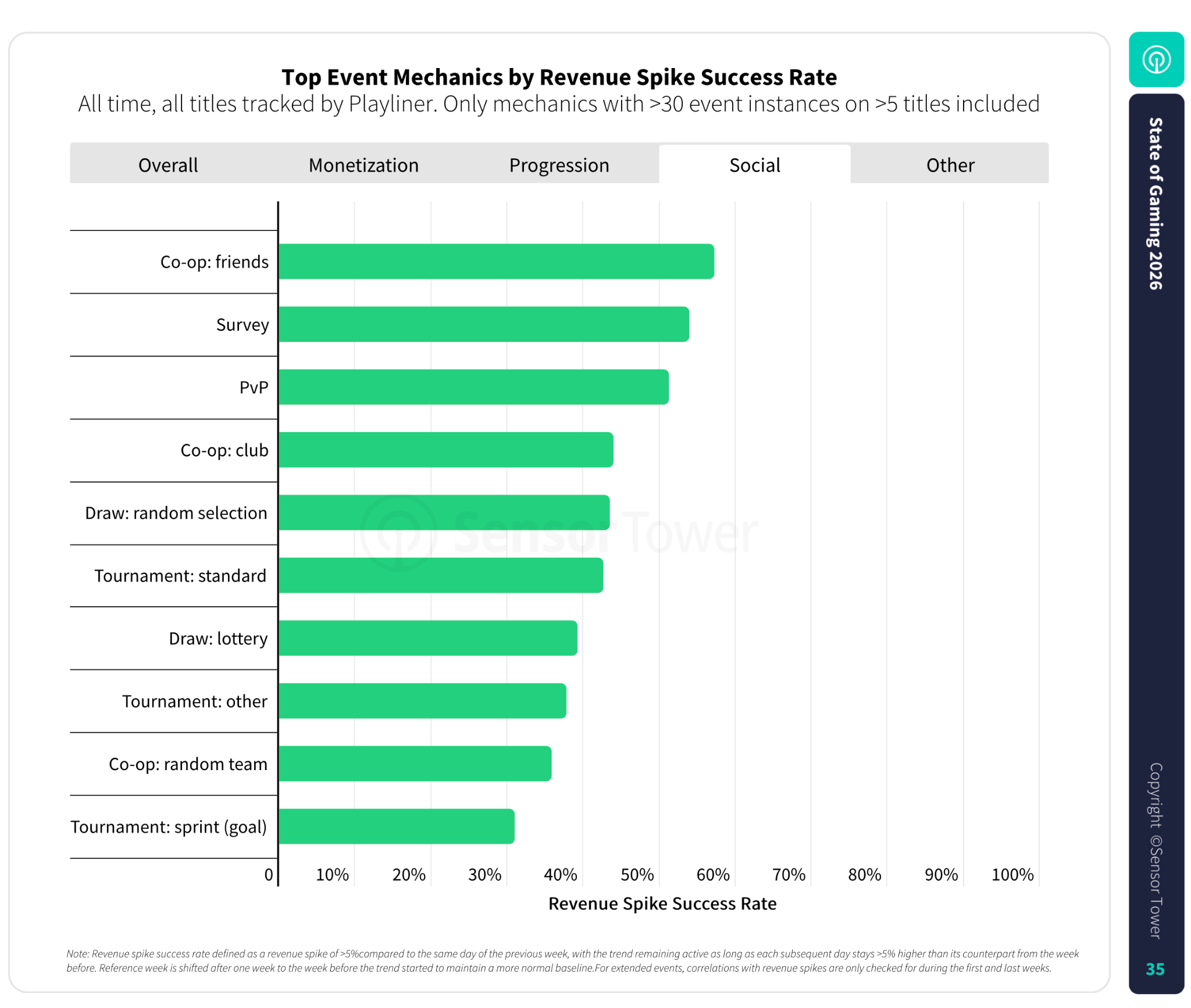
The social category shows strong growth in competitive and cooperative systems, especially:
-
Goal-oriented tournaments
-
PvP events
-
Club-based cooperation
-
Friend-based co-op mechanics
Tournament systems remain the dominant social mechanic by a large margin, which reinforces a broader industry reality:
competition remains one of the strongest retention drivers in LiveOps.
However, the biggest insight is not simply that tournaments are popular — it is that studios are diversifying tournament structures.
Goal-based sprint tournaments increased more than time-based formats, suggesting that players respond better to achievement-focused progression than pure activity grinding.
PvP and club systems also expanded, indicating that developers are investing more heavily in:
-
Social accountability
-
Group participation
-
Team identity
-
Shared progression systems
This matters because social pressure significantly increases:
-
Return frequency
-
Event participation consistency
-
Long-term retention
-
Spending motivation
Friend-based and guild-based systems create emotional investment that is difficult to replicate with solo events alone.
For studios, this means LiveOps design increasingly overlaps with community system design.
Strategic implication:
The strongest LiveOps ecosystems are no longer built around solo progression alone — they increasingly combine progression, competition, and cooperative participation into interconnected engagement lo
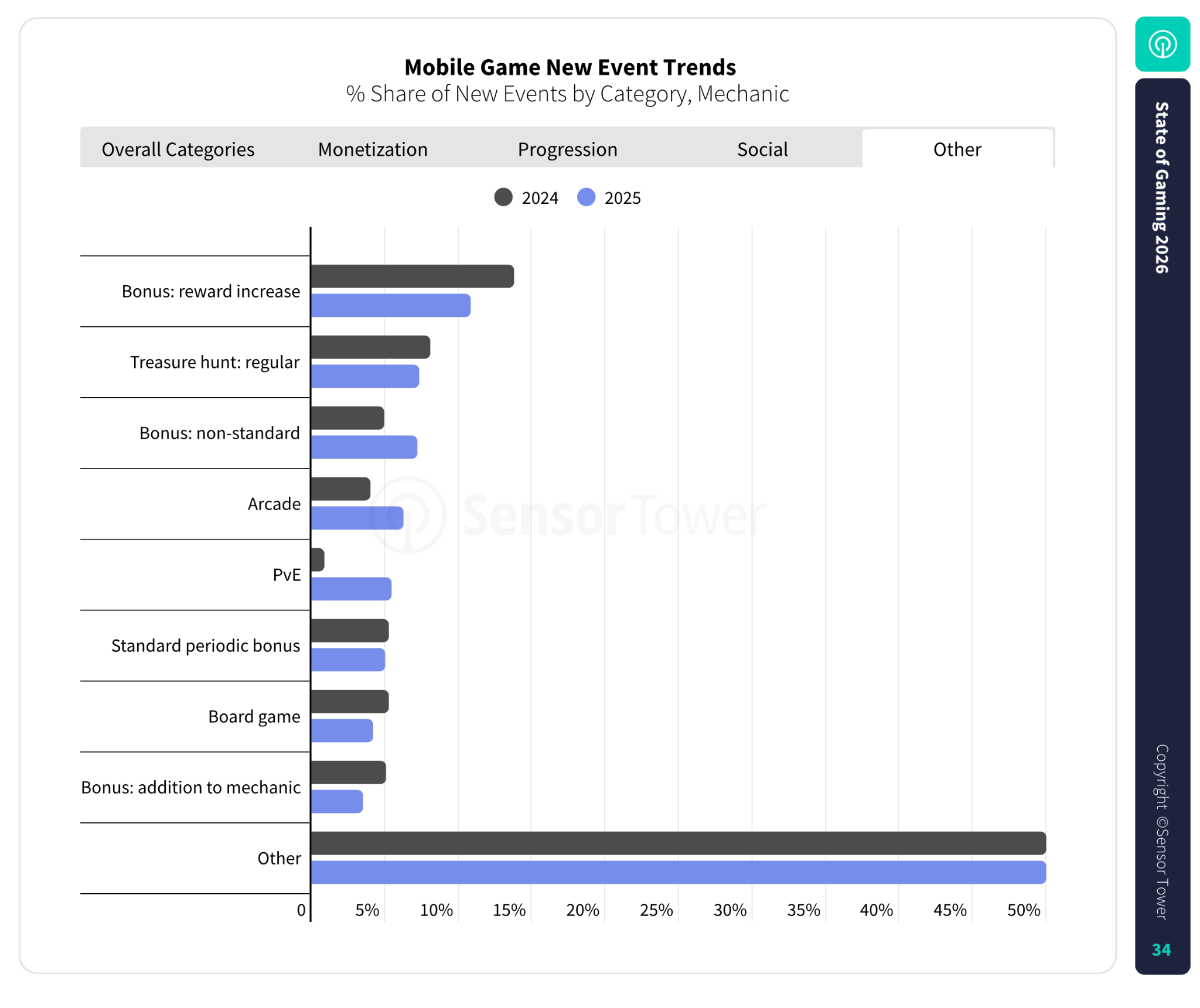
Other Mechanics — Experimental and Hybrid Event Structures Are Growing
The “Other” category reveals how studios are experimenting with more hybridized and unconventional LiveOps systems.
Several trends stand out:
-
PvE event growth
-
Arcade-style mechanics increasing
-
Non-standard bonuses expanding
-
Treasure hunt systems remaining stable
-
Traditional reward boosts declining
This suggests that studios are searching for new engagement formats beyond conventional monetization and progression loops.
The increase in PvE and arcade mechanics is particularly important because it shows developers are introducing:
-
Temporary gameplay novelty
-
Event-exclusive interaction models
-
Low-risk gameplay experimentation
-
Short-term alternative engagement systems
Meanwhile, the decline of simple reward-boost events suggests players are becoming less motivated by generic multiplier mechanics alone.
Instead, engagement increasingly depends on:
-
Interactive participation
-
Unique gameplay structures
-
Temporary event identities
-
Novelty-driven engagement
Treasure hunt systems maintaining stable adoption is also meaningful because they combine several strong psychological motivators:
-
Exploration
-
Uncertainty
-
Collection
-
Session repetition
-
Reward anticipation
For LiveOps teams, this category highlights the growing importance of “event identity.”
Successful events increasingly feel like experiences rather than reward wrappers.
One particularly important takeaway is that social and competitive systems are becoming more deeply integrated into retention design. Tournaments, club competitions, and repeatable sprint formats are appearing more frequently because they reinforce habitual engagement without requiring constant content reinvention.
The Most Common Mistake: Treating Events as Content Instead of Systems
One of the biggest reasons LiveOps ROI stagnates is that many teams still approach events as isolated pieces of content.
They launch a leaderboard, a seasonal challenge, or a reward campaign without integrating it into the broader economy and progression systems.
Top-performing studios approach LiveOps differently.
Events are designed as interconnected systems that influence:
-
Player progression
-
Economy sinks and faucets
-
Social engagement
-
Monetization pacing
-
Daily habit formation
This is why some games generate strong event performance consistently while others experience rapid event fatigue.
High-Performing Events Blend Progression and Monetization Together
Sensor Tower’s 2025 LiveOps benchmarking highlights a major pattern among high-performing event structures: the most reliable revenue-driving events are rarely pure monetization systems.
Instead, they combine progression mechanics with monetization layers.
Examples include:
-
Multi-tier battle pass systems
-
Milestone reward ladders
-
Expedition-style progression tracks
-
Collection systems tied to premium acceleration
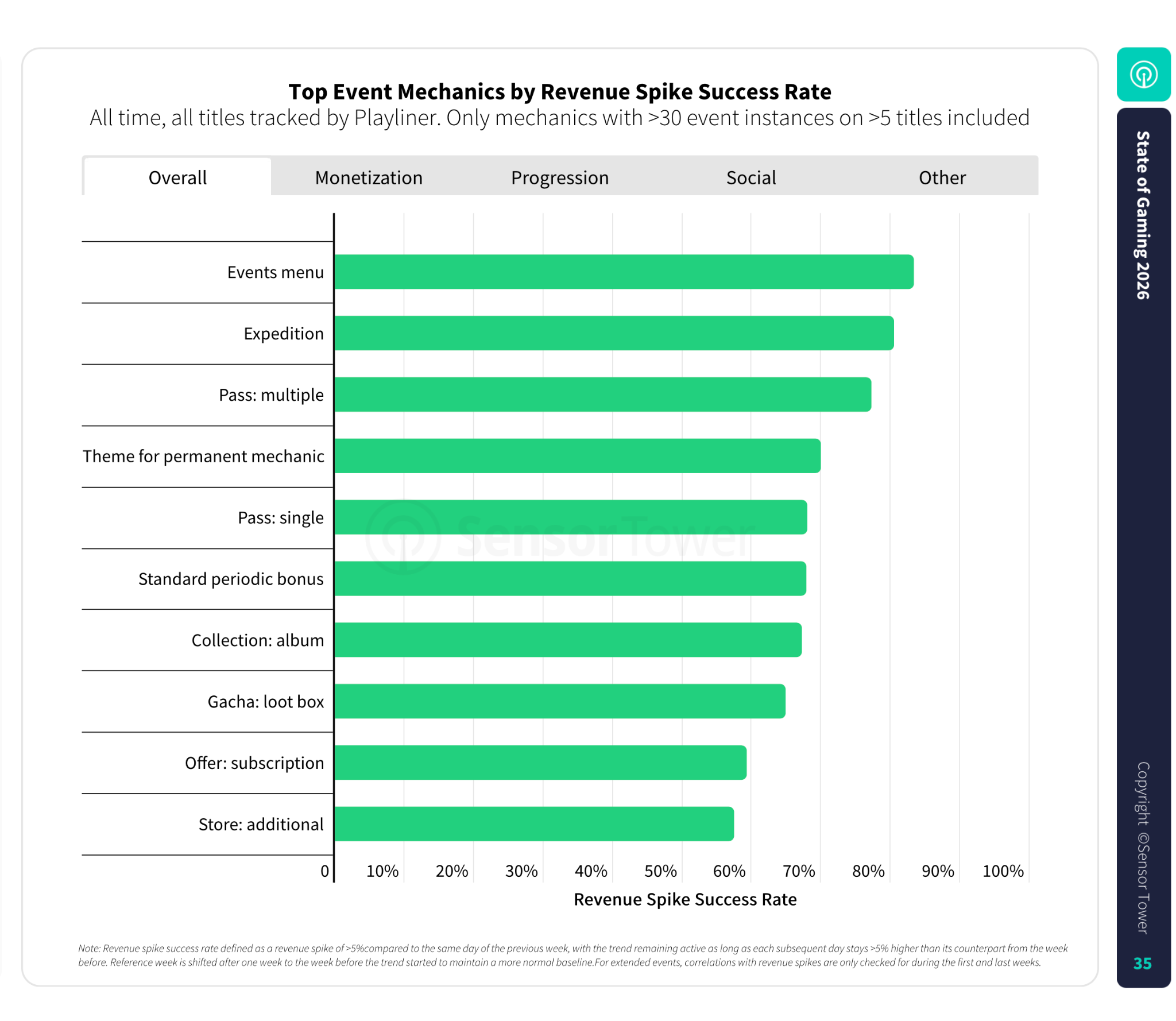
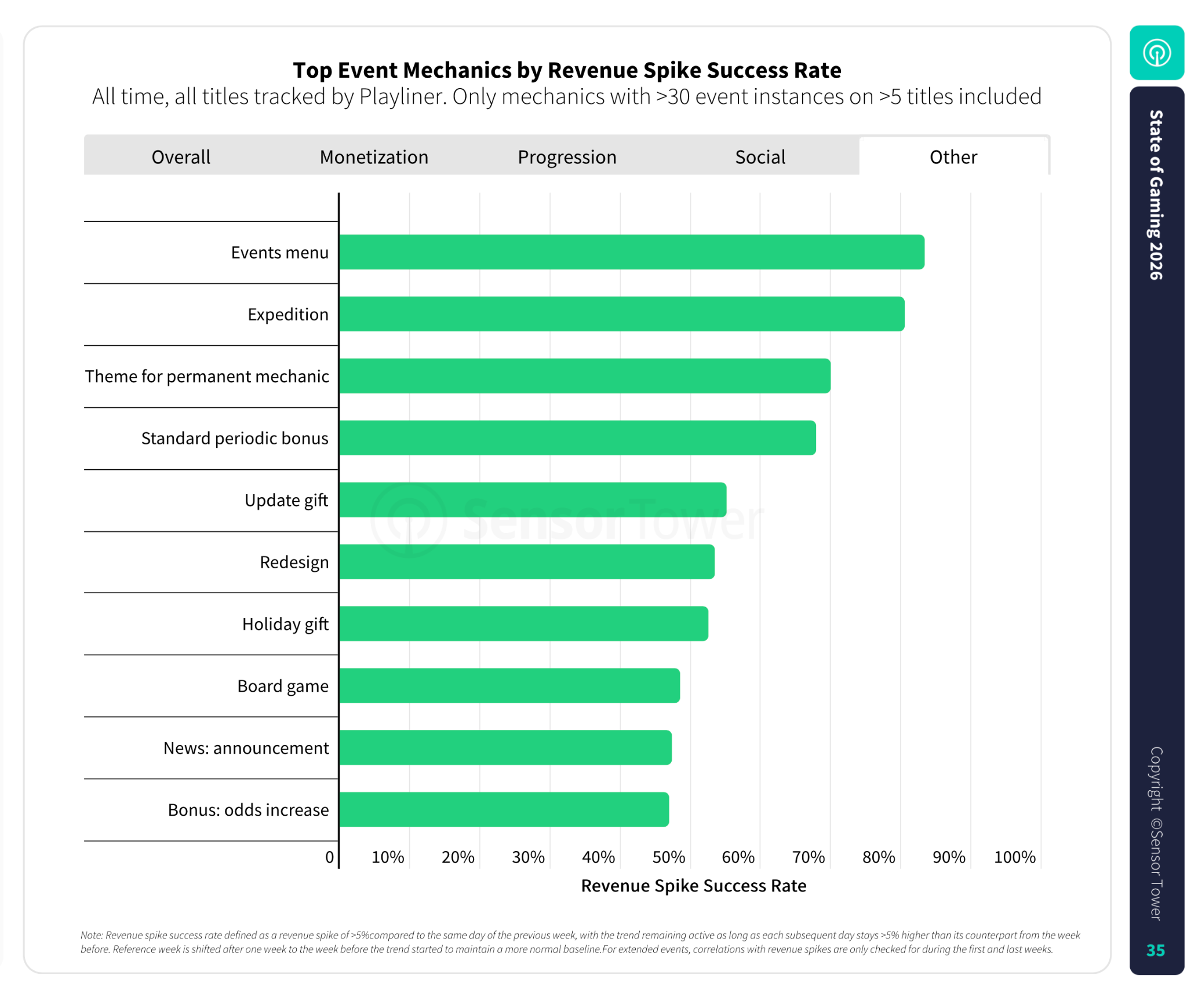
According to the report, event menu systems appeared alongside revenue lifts in more than 80% of tracked cases, suggesting that persistent progression hubs are significantly more effective than isolated offers.
This is important because it changes how LiveOps should be structured.
Rather than asking “How do we monetize this event?”, leading studios ask:
-
How does this event extend progression?
-
How does monetization accelerate participation?
-
How does the event create reasons to return tomorrow?
The strongest LiveOps systems create interconnected motivation loops instead of standalone spending opportunities.
LiveOps event optimization starts with understanding that not all events fail for the same reason. Some fail due to poor timing, others due to misaligned incentives, and many due to treating each event as an isolated content drop rather than a node within a connected system. The studios with the highest event ROI treat optimization as an ongoing process, not a post-mortem exercise.
The Core Drivers Behind High-ROI LiveOps Events
Player segmentation
Not every player should experience the same event in the same way.
High-performing LiveOps strategies rely heavily on segmentation:
|
Player Type |
Event Optimization Goal |
|
New players |
Early engagement and retention |
|
Mid-core active users |
Habit reinforcement |
|
High spenders |
High-value progression offers |
|
Returning users |
Re-activation incentives |
|
Low activity users |
Reduced friction and lighter goals |
Segmentation increases relevance, which directly improves conversion and retention.
Advanced Segmentation Is Becoming Standard Among Top Games
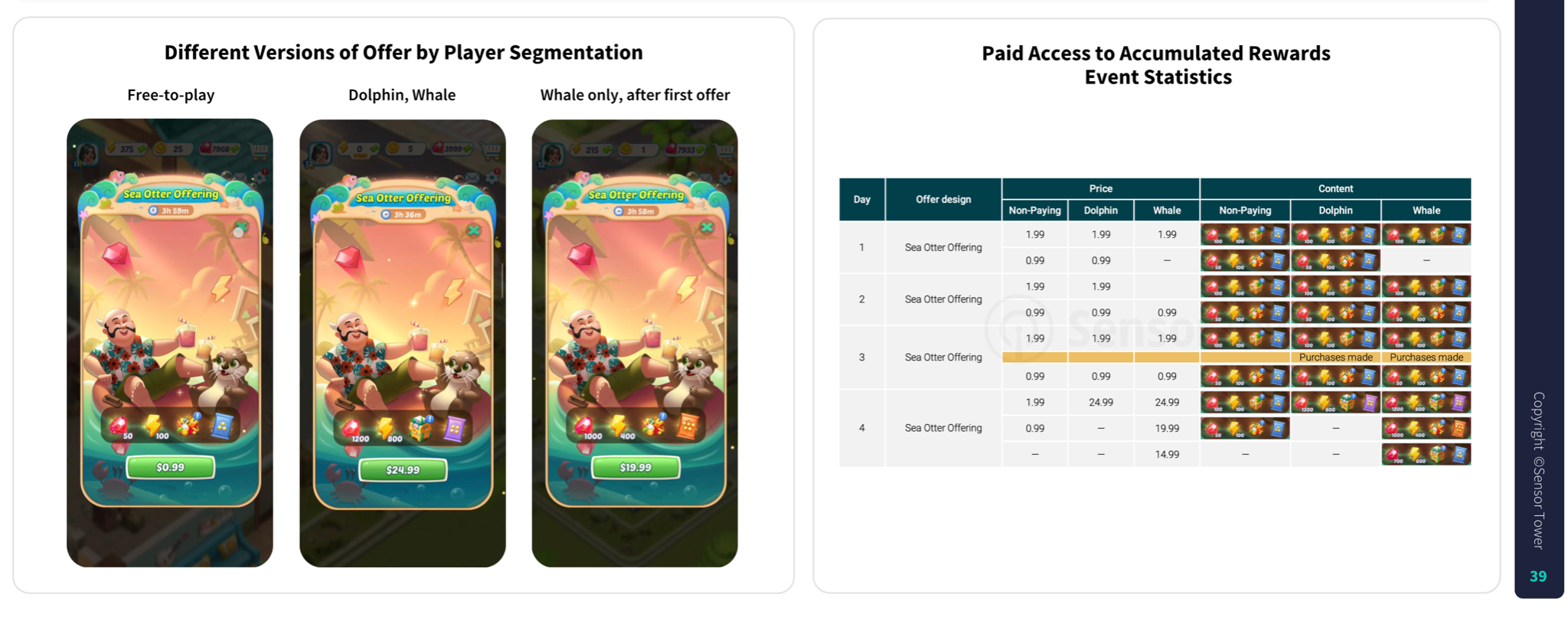
Recent LiveOps analysis from Sensor Tower demonstrates how aggressively leading studios are personalizing event experiences based on player value and spending behavior.
One highlighted example showed different offer structures presented to:
-
Non-paying users
-
Mid-spending players (“dolphins”)
-
High spenders (“whales”)
The differences extended beyond pricing.
Studios adjusted:
-
Reward composition
-
Offer visibility
-
Purchase pacing
-
Premium item density
-
Long-term progression incentives
This is a major evolution from older LiveOps strategies where all players received identical event structures.
Modern LiveOps optimization increasingly focuses on matching event friction and reward value to expected player behavior.
For example:
-
Non-spenders may receive lower-friction onboarding rewards
-
Mid-spenders often receive progression acceleration offers
-
Whales may see premium bundles tied to exclusivity and long-term collection systems
Segmentation is not optional at scale already for many years.
It is becoming one of the clearest differentiators between average and top-performing LiveOps operations.
Reward architecture
Rewards are one of the most misunderstood aspects of LiveOps.
The problem is not reward quantity—it is reward positioning.
Effective reward systems:
-
Reinforce long-term progression
-
Create urgency without pressure
-
Encourage repeat sessions
-
Support monetization without feeling punitive
Poorly balanced rewards often damage the economy by inflating progression or reducing monetization friction too aggressively.
Accumulated Reward Systems Are Gaining Momentum
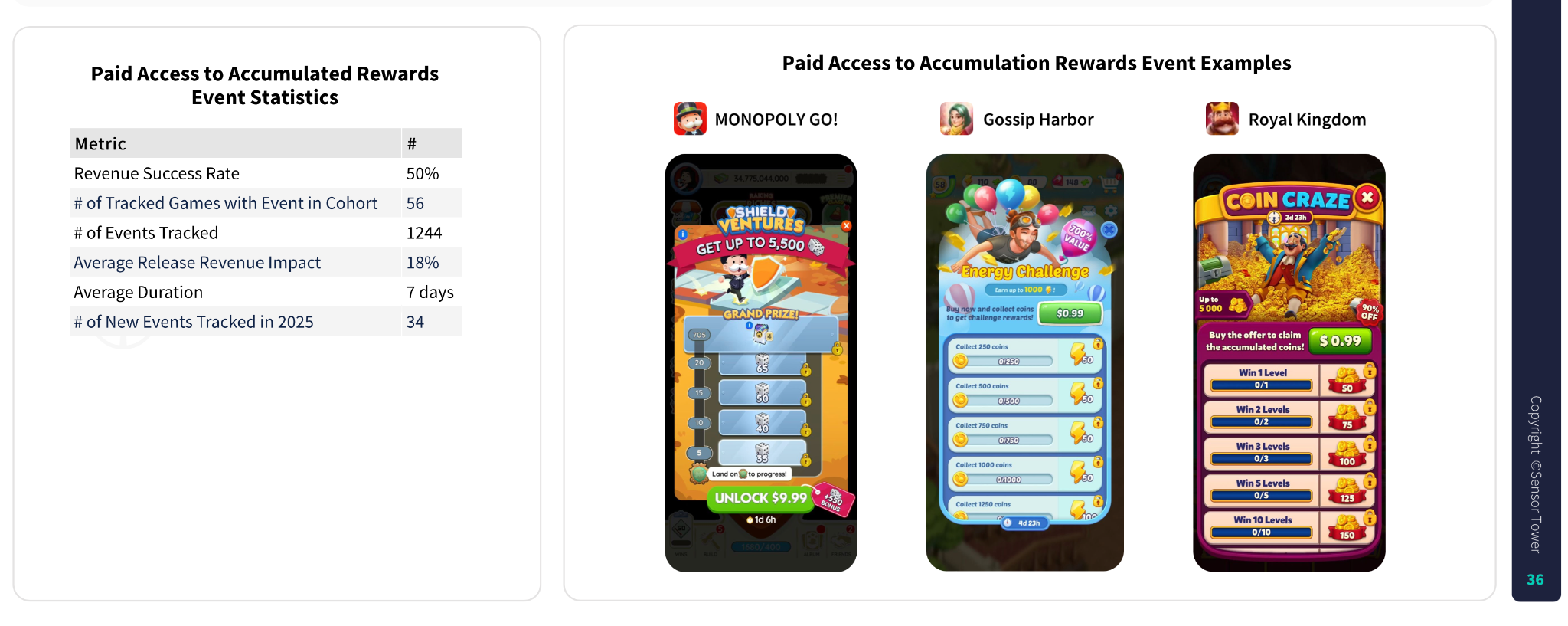
One of the fastest-growing LiveOps structures identified in Sensor Tower’s research involves “accumulated reward unlock” systems.
These events combine milestone progression with monetized unlock layers.
Players progress through a reward track by engaging over multiple sessions, while premium access unlocks additional value once milestones are reached.
Several high-performing games, including major casual and strategy titles, have adopted variations of this structure.
The effectiveness of these systems comes from how they align monetization with engagement rather than interruption.
Instead of selling isolated items directly, the event encourages players to:
-
Return consistently
-
Build investment over time
-
Unlock accumulated value
-
Progress toward visible goals
This creates stronger retention loops while preserving monetization opportunities.
Sensor Tower’s analysis also suggests these events often remain active for longer durations than traditional offer-driven campaigns, increasing overall session frequency and event participation depth.
Event cadence and overlap
One of the clearest differences between top LiveOps operators and average teams is cadence management.
Top games rarely rely on a single event. Instead, they create layered engagement loops:
-
Daily events
-
Weekly competitions
-
Seasonal campaigns
-
Long-term collection systems
The objective is to ensure that players always have multiple motivations to return.
However, too much overlap creates fatigue.
The best studios manage intensity carefully, alternating between:
-
High-pressure competitive periods
-
Lower-intensity progression windows
-
Recovery cycles that reduce cognitive load
Merge Events and Hybrid Mechanics Are Expanding Beyond Their Original Genres
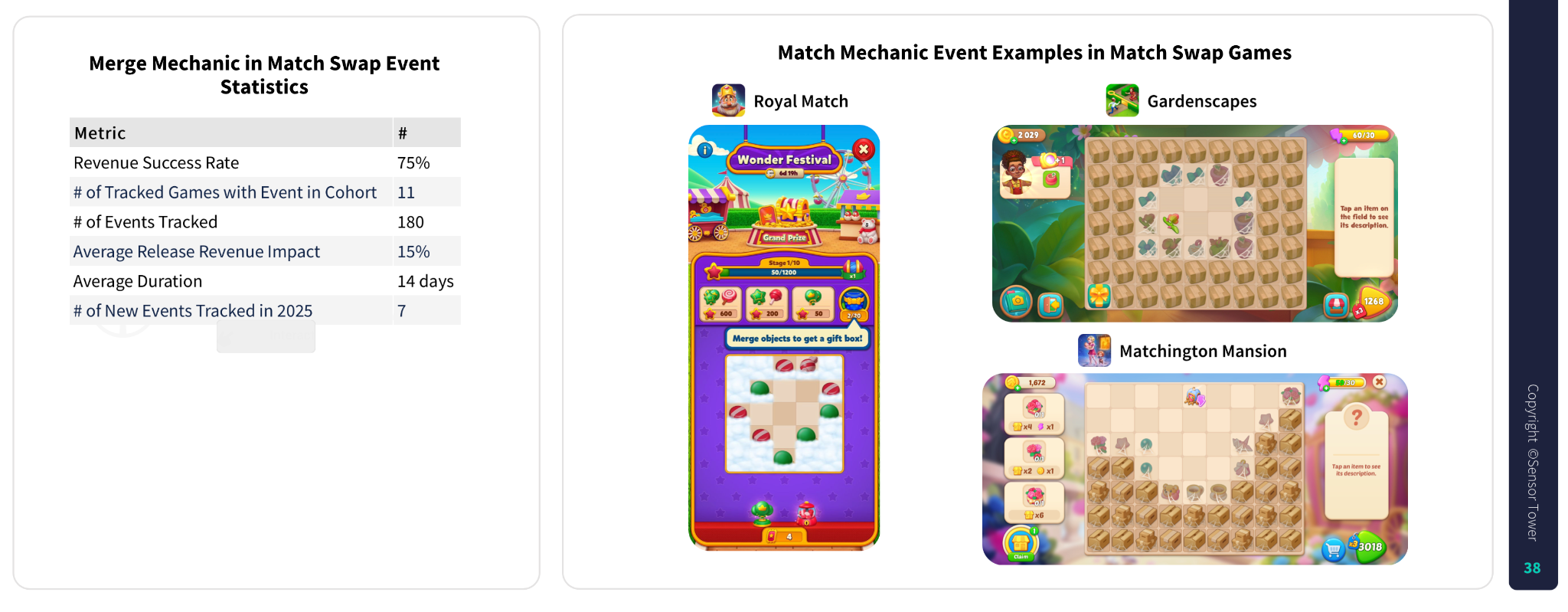
Sensor Tower’s LiveOps report identified a sharp increase in merge-style mechanics appearing inside traditionally non-merge genres.
Match-based puzzle games, in particular, have increasingly adopted temporary merge-event systems as part of their LiveOps calendars.
These mechanics are effective because they:
-
Introduce novelty without changing core gameplay
-
Extend session duration
-
Support long-running progression loops
-
Create event-specific economies
-
Encourage repeated daily engagement
The broader takeaway is that successful LiveOps strategies are becoming more hybridized.
Studios are no longer limiting events to mechanics native to their genre. Instead, they are borrowing successful engagement systems from across the market and adapting them into temporary event structures.
This increases content variety without requiring permanent core gameplay redesign.
Why Some LiveOps Events Fail Completely
Most failed LiveOps events share the same structural problems.
Weak economy integration
Events generate rewards disconnected from progression systems, making participation feel optional or meaningless.
Lack of personalization
Every player receives the same difficulty, pacing, and offers regardless of behavior.
No operational scalability
Teams build events manually every time, making production expensive and unsustainable.
Short-term monetization focus
Aggressive monetization may boost short-term revenue while damaging long-term retention.
Poor post-event analysis
Many studios measure revenue spikes but fail to evaluate retention impact after the event ends.
Pure Offer Events Often Underperform Long-Term Engagement Systems
Sensor Tower’s research suggests that direct monetization events without supporting progression or engagement systems are becoming less dominant across the market.
This does not mean monetization mechanics are disappearing.
Instead, they are evolving into systems that feel integrated with gameplay progression.
For example:
-
Web store promotions increasingly include bonus progression rewards
-
Offer systems are tied to milestone completion
-
Gacha mechanics are layered into longer progression structures
-
Subscription systems are embedded inside seasonal engagement loops
One particularly interesting finding from the report is that battle-pass-related systems consistently ranked among the strongest performers for revenue spike success.
This reinforces a broader market trend:
Players respond more positively to monetization systems that reward ongoing participation instead of isolated purchases.
Game event ROI improvement is rarely about adding more events — it is about running the right events at the right frequency with the right data feedback loops. Studios that improve event ROI the fastest are those that can measure at the event level, not just the session level, and iterate on structure before reskinning for the next cycle.
The Operational Side of LiveOps ROI
One of the least discussed factors in LiveOps profitability is operational efficiency.
A studio may run profitable events individually while still operating inefficiently overall.
This becomes especially visible at scale.
Games operating weekly events, seasonal campaigns, and multiple engagement systems require enormous production throughput. Without structured pipelines, event costs rise rapidly.
This is why leading studios invest heavily in:
-
Internal event management tools
-
Automated scheduling systems
-
Remote configuration infrastructure
-
Modular event frameworks
-
Analytics dashboards
The objective is not only to improve performance—but to reduce the cost of iteration.
Web Stores Are Becoming Part of the LiveOps Stack
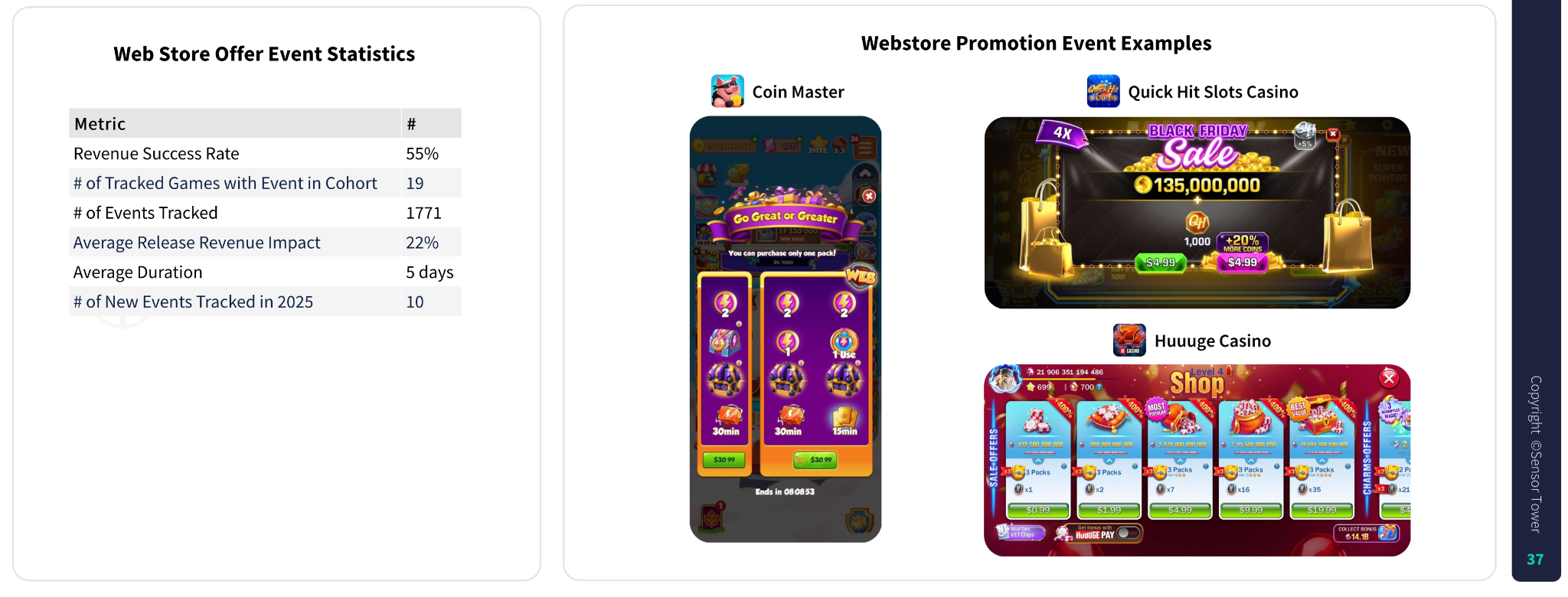
Another notable shift identified in recent Sensor Tower reporting is the growing role of external web stores inside LiveOps operations.
Studios are increasingly building LiveOps campaigns that intentionally direct players toward web-based purchasing environments.
This trend appears particularly strong in:
-
Casino games
-
Midcore strategy titles
-
High-monetization ecosystems
The operational benefit is significant.
Web stores allow studios to:
-
Improve purchase margins
-
Reduce platform dependency
-
Offer exclusive event rewards
-
Run more flexible pricing experiments
-
Build direct purchase journeys outside app stores
As LiveOps systems mature, monetization infrastructure itself is becoming part of event design.
The most effective LiveOps performance strategies are built on modular architecture: the ability to swap event types, adjust reward structures, and test monetization triggers without rebuilding the underlying system. Studios that invest in this infrastructure early see compounding returns — each event improvement costs less and delivers more as the system matures.
Modular Systems as a Competitive Advantage
One of the strongest indicators of mature LiveOps infrastructure is the use of modular systems.
Instead of rebuilding event logic repeatedly, advanced studios rely on reusable frameworks that support faster deployment and optimization.
|
Modular System |
ROI Impact |
|
Reusable event templates |
Faster production cycles |
|
Shared reward frameworks |
Better economy consistency |
|
Remote configuration systems |
Faster balancing and tuning |
|
Segmentation modules |
Higher conversion efficiency |
|
Analytics integrations |
Better optimization decisions |
Over time, these systems create compounding operational advantages.
Studios with strong modular architecture can:
-
Launch events faster
-
Run more experiments
-
Reduce LiveOps production costs
-
Respond to player behavior in real time
-
Scale multiple games simultaneously
This is one of the biggest differences between studios that operate LiveOps successfully for years and those that struggle to sustain content velocity.
High-Spending Players Are Pushing Offer Ceilings Higher
Sensor Tower’s data also highlights a growing willingness among top monetizing audiences to engage with increasingly expensive premium offers.
While many games still cluster around traditional pricing ceilings, some LiveOps-driven economies are successfully supporting offers far above standard expectations.
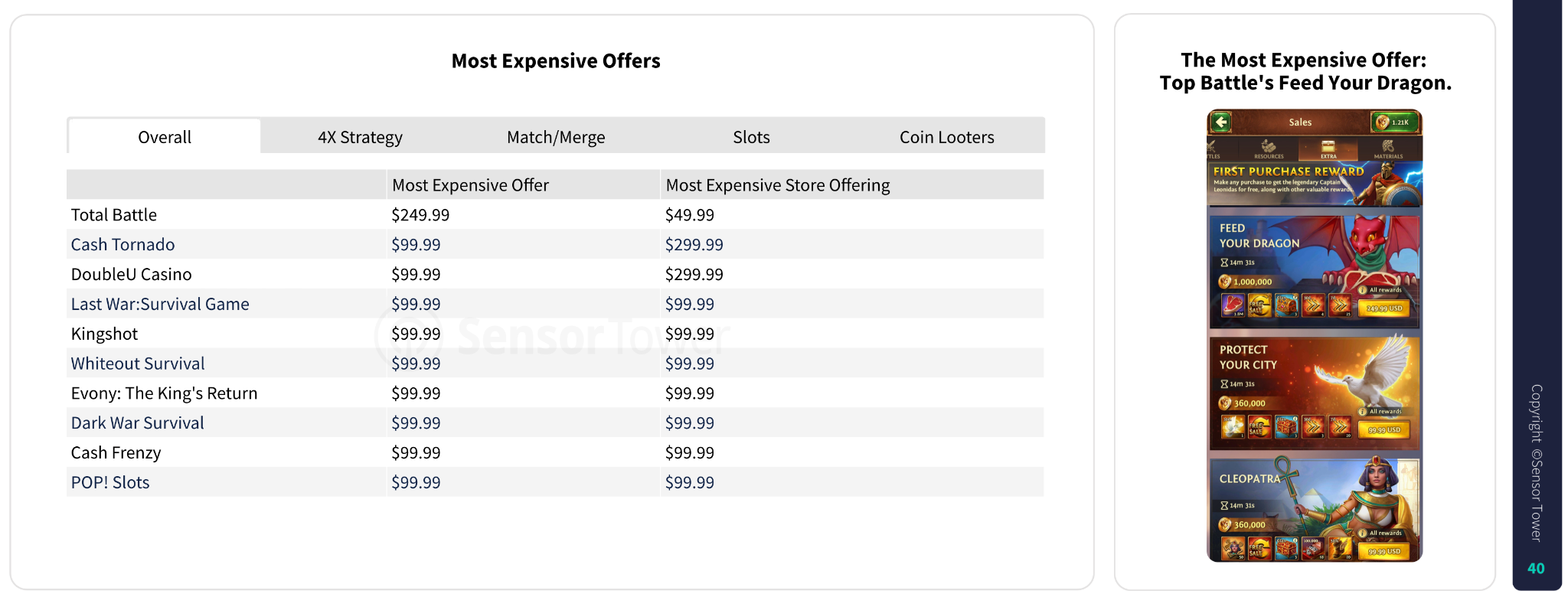
This trend reflects several important market realities:
-
Mature LiveOps ecosystems create higher player investment
-
Long-term progression increases perceived account value
-
Personalized monetization improves pricing tolerance
-
Collection systems strengthen spending motivation
However, these high-price strategies only work when backed by strong retention systems and deep engagement loops.
Without sustained player investment, premium pricing alone becomes unsustainable.
Real Examples of High-ROI LiveOps Execution
Candy Crush Saga (King)
King continues to dominate because of highly optimized event cadence and progression balancing. Events rarely exist independently—they feed directly into broader retention systems.
Monopoly GO! (Scopely)
Scopely has demonstrated how layered LiveOps systems can generate massive engagement loops through overlapping events, collection systems, and social mechanics.
Sensor Tower’s LiveOps examples specifically highlighted how milestone-driven unlock structures and accumulated reward systems are being used to extend session frequency and monetization depth.
Coin Master (Moon Active)]
Coin Master combines scarcity, social systems, and event urgency exceptionally well, creating strong monetization performance without relying on complex gameplay.
The game also reflects the broader trend toward web store integration and recurring offer systems tied directly into event cadence.
Royal Match (Dream Games)
Royal Match demonstrates how merge mechanics, progression loops, and low-friction retention systems can coexist inside highly scalable LiveOps frameworks.
Its event structure aligns closely with the broader industry shift toward progression-first LiveOps design.
How Studios Should Approach LiveOps in 2026
The next evolution of LiveOps is not about bigger events.
It is about smarter systems.
Studios are increasingly moving toward:
-
AI-assisted segmentation
-
Predictive personalization
-
Dynamic economy balancing
-
Cross-event progression systems
-
Short-form engagement mechanics inspired by social platforms
The market is shifting from event quantity to event intelligence.
Recent Sensor Tower reporting reinforces this direction clearly.
The highest-performing LiveOps systems are increasingly characterized by:
-
Longer-term progression design
-
Personalized monetization
-
Persistent event ecosystems
-
Operational scalability
-
Cross-system engagement loops
The studios that succeed over the next generation of LiveOps will not necessarily be the ones shipping the most content.
They will be the ones building the most adaptive systems.
Conclusion
Modern LiveOps optimization is no longer just about scheduling events.
It is about designing scalable engagement ecosystems that improve retention, monetization efficiency, and player lifetime value simultaneously.
The market data increasingly shows that high-performing LiveOps strategies share several characteristics:
-
Progression-first design
-
Layered monetization systems
-
Personalized player experiences
-
Operational scalability
-
Modular event infrastructure
-
Long-term retention integration
Studios that continue relying on isolated content drops and short-term monetization spikes will likely struggle as acquisition costs rise and competition intensifies.
Meanwhile, studios investing in smarter LiveOps systems, stronger segmentation, and scalable operational pipelines are positioning themselves for sustainable long-term growth.
The future of LiveOps belongs to teams that can combine analytics, personalization, progression systems, and operational efficiency into a single continuous engagement strategy.
For studios looking to apply these LiveOps performance strategies in practice, Galaxy4Games brings direct operational experience from running its own live casual titles. Whether you are building a new match-3 game or scaling a hybrid casual title, the principles of LiveOps event optimization apply across all genres that depend on sustained player engagement.
Ready to see who does this best? Explore our roundup of the best LiveOps companies for mobile and PC games.