





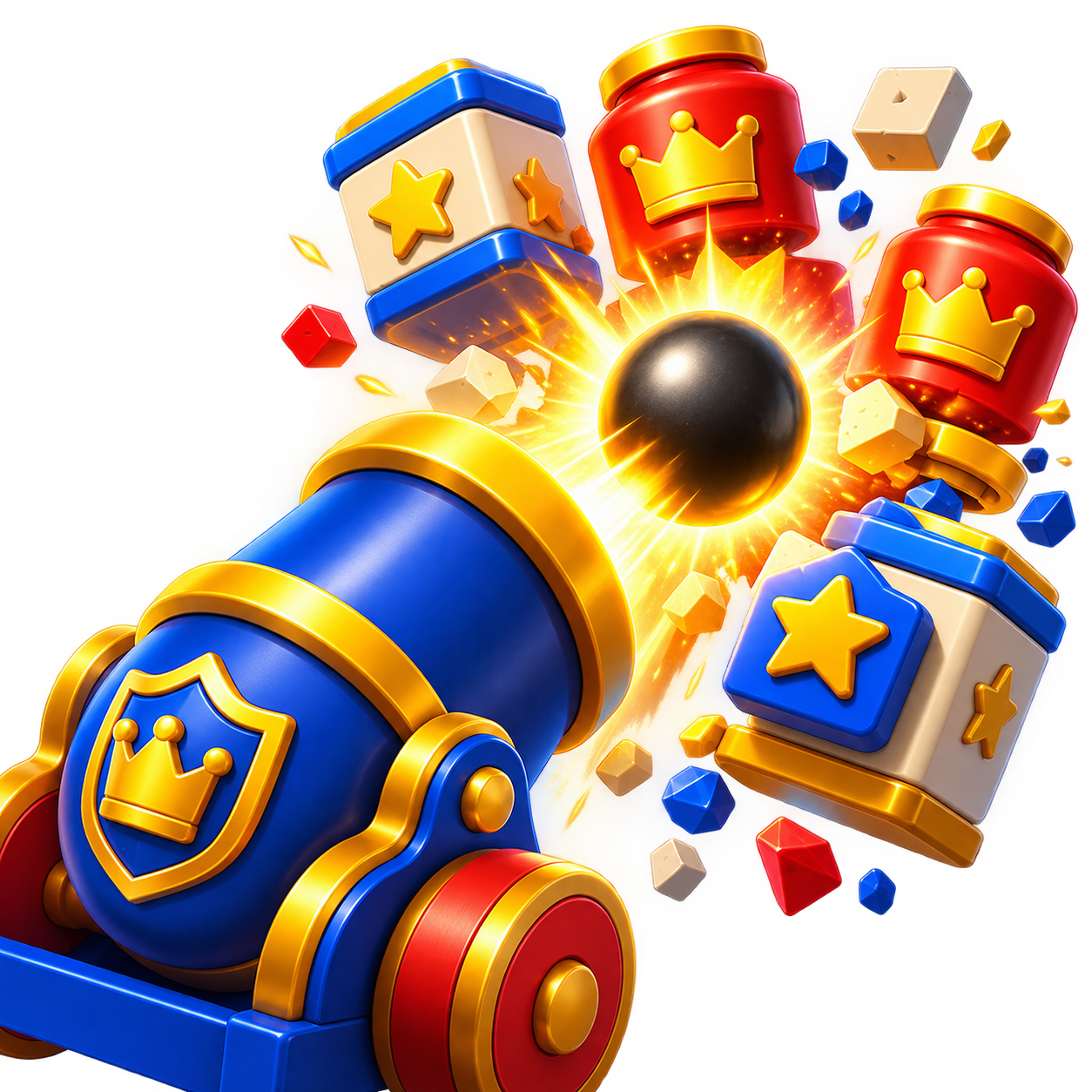
Royal Smash! Cannonball Fest: From Idea to Publisher Interest in 2 Weeks
Most game ideas never get tested. They stall in pre-production, buried under the cost and complexity of building from scratch. By the time a prototype is ready, the market has moved, the budget is thinned, and the original insight that made the idea exciting is already diluted by months of guesswork.
Royal Smash! Cannonball Fest is a case study in doing the opposite.
Galaxy4Games built a fully playable prototype of this colorful 3D physics destruction game in two weeks, ran User Acquisition (UA) tests to validate retention metrics, and secured publisher interest, all before committing to full production. This is not a lucky sprint. It is the result of a repeatable, three-phase process: Prototype. Analyze. Act.
This case study breaks down exactly how that process works, what infrastructure made the two-week build possible, and what the results mean for anyone evaluating whether a game idea is worth developing into a full product.
The Game: Royal Smash! Cannonball Fest
Royal Smash! Cannonball Fest is a colorful, physics-driven mobile game built around one of gaming's most satisfying core loops: aim, fire, destroy.
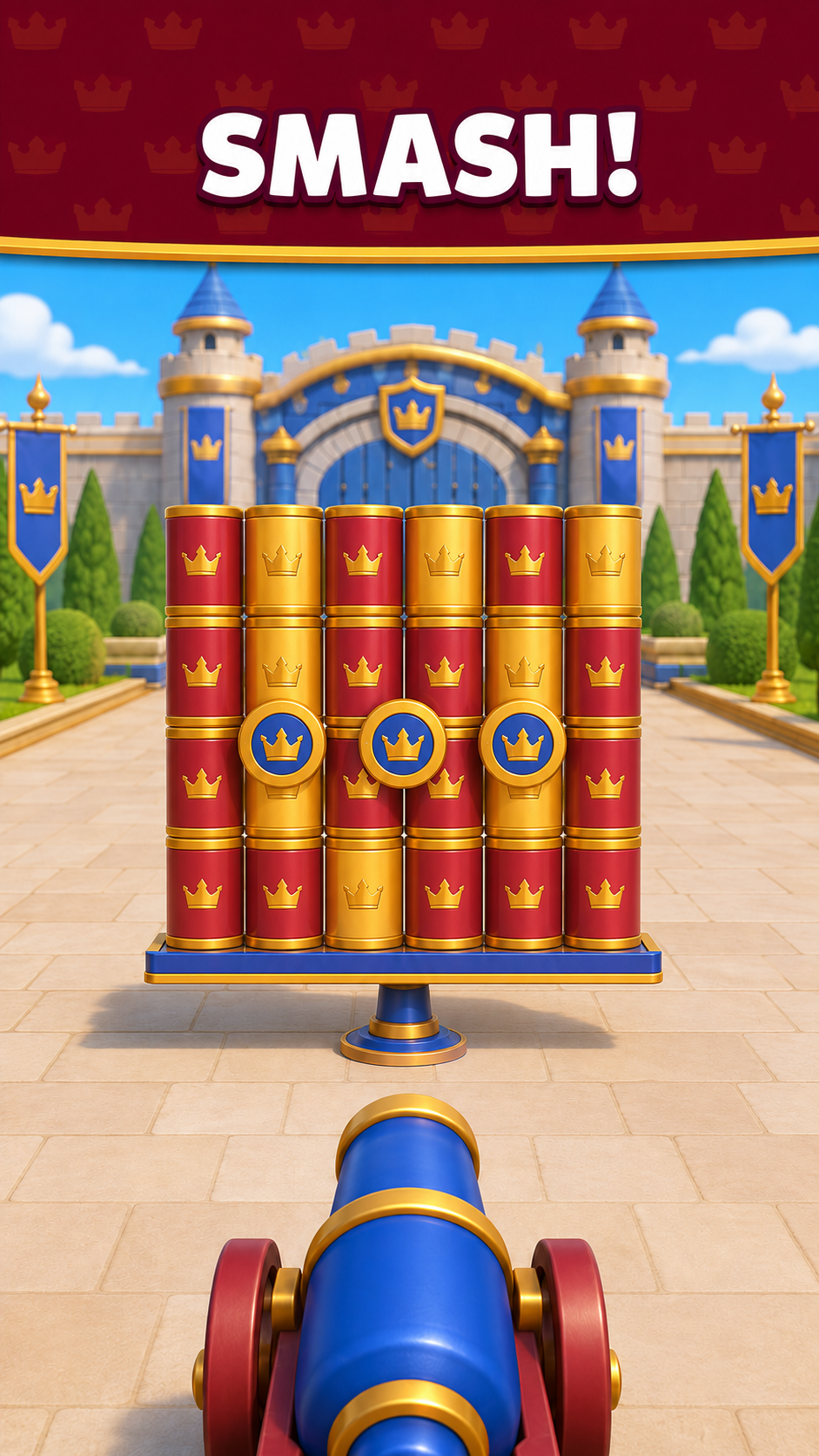
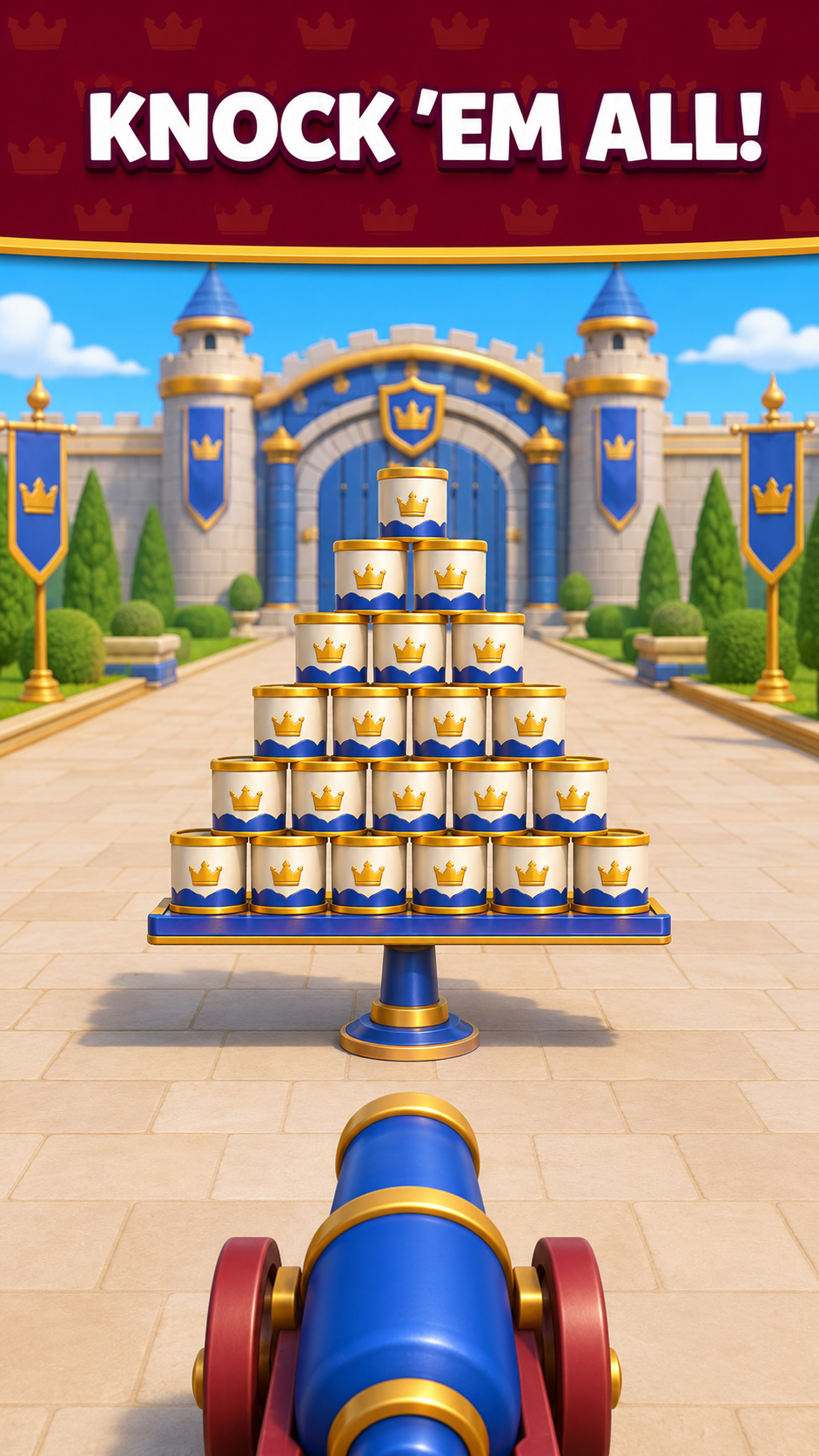

Players take control of a powerful royal cannon and fire cannonballs at towers, blocks, and enemy castles across a series of 3D puzzle levels. The goal is not just to hit targets but to find the perfect angle, trigger chain reactions, and smash everything on the level in the most spectacular way possible. Each level is a physics puzzle with a deeply satisfying destruction payoff.
Core Mechanic Summary
|
Element |
Description |
|---|---|
|
Core loop |
Aim cannon, fire cannonball, destroy structures |
|
Genre |
3D physics puzzle / destruction |
|
Visual style |
Colorful, cartoonish, high-energy |
|
Skill layer |
Angle calculation, chain reaction planning |
|
Emotional hook |
Satisfying destruction + "one more level" progression |
|
Platform target |
Mobile (iOS and Android) |
The mechanic sits in a proven category: physics-based destruction games have demonstrated strong organic discovery and high Day 1 retention on mobile. The colorful art direction and "royal" theme add a distinctive visual identity that supports creative UA (User Acquisition) campaigns.
The strategic question was not only whether the game was fun. It was whether real players would return. That question cannot be answered with a design document. It requires a playable build and real data.
The Three-Phase Process: Prototype, Analysis, Action
The Galaxy4Games approach to new game development is built around a single principle: validate before you invest. Not validate in theory, but validate with real player behavior, real retention numbers, and a real go/no-go decision backed by UA and game data.
The process runs in three phases. Each phase has a defined output, a defined question it answers, and a clear threshold for moving forward.
Phase 1: Prototype
The prototype phase has one goal: get a playable build in front of real players as fast as possible. Not a polished build. Not a feature-complete build. A build that is good enough to test the core mechanic and measure first-session engagement.
For Royal Smash! Cannonball Fest, that build was ready in two weeks.
The speed was not a result of cutting corners on code quality or art direction. It was the direct result of building on a pre-existing, battle-tested foundation: the Galaxy4Games Game Application Template and the Modular Solutions library.
What the two-week timeline actually means: The core architecture, platform integrations, analytics hooks, and UI scaffolding were already built and tested. The team focused entirely on the game-specific work: the physics system, the level design and balance, the cannon mechanic, and the visual identity. That separation of "infrastructure" from "game" is what makes rapid prototyping possible at a professional quality level.
Phase 2: Analysis
A prototype without measurement is just a demo. The analysis phase is where the business case is built or killed.
After the playable build was ready, Galaxy4Games ran structured UA (User Acquisition) tests to drive real traffic to the game and measure first-KPI performance. The key metrics at this stage are:
-
Day 1 retention: Do players come back after the first session?
-
Session length: Are players engaging deeply with the core loop?
-
CPI (Cost Per Install): Does the creative hook work in the market?
-
Progression depth: How far into the level set do players reach before dropping off?
The UA tests for Royal Smash! Cannonball Fest returned strong Day 1 retention numbers. Players were returning. The destruction mechanic and the "one more level" progression were doing their job.
This is the moment that separates data-driven studios from studios that build on instinct. Good retention at prototype stage is not a guarantee of success. But it is the strongest early signal available that the core mechanic resonates with real players.
Phase 3: Action
The action phase is a decision. The data from Phase 2 either supports moving forward into full production, pivoting the mechanic, or stopping entirely. All three outcomes are valid. The entire point of the process is to make that decision cheaply, before full production investment is committed.
For Royal Smash! Cannonball Fest, the data supported moving forward. The retention results were strong enough to generate publisher interest. Publishers reviewed the prototype and the early KPI data, and the game secured commitment to proceed.
Key takeaway: The Prototype, Analysis, Action cycle is not just a development methodology. It is a risk management framework. Every week saved in the prototype phase is a week of full production budget that is not spent on an unvalidated idea.
Why Two Weeks Is Possible: The Infrastructure Behind the Speed
A two-week prototype timeline is not standard in mobile game development. For hyper-casual titles with minimal technical complexity, a CPI-testable prototype typically takes two to four weeks, and those builds are often throwaway quality: fast to ship, but too fragile to carry into full production. A 3D physics puzzle game with chain reaction mechanics, custom level design, and a destruction system would normally take significantly longer to reach a testable state.
The difference here is that Galaxy4Games prototypes are not throwaway builds. They are production-grade MVPs, built on the same architecture the final game will use, ready to scale from day one. That quality is not achieved by magic . It is achieved by building on a foundation that was already proven before the project began:
The Game Application Template
The Game Application Template is a production-ready development foundation that every Galaxy4Games project begins with. It includes:
-
Core architecture: Structured, scalable codebase that avoids the technical debt that typically accumulates during rushed prototype builds
-
Platform integrations: App Store and Google Play compliance, SDK connections, and build pipeline already configured
-
Analytics hooks: Session tracking, event logging, and retention measurement built in from day one
-
UI framework: Menu systems, HUD components, and navigation flows that can be adapted rather than rebuilt
-
FTUE (First-Time User Experience) scaffolding: Onboarding flow structure ready to customize per game
Without the template, the first week of any prototype build is consumed by infrastructure work that has nothing to do with the game itself. With it, the team can focus on what actually needs to be tested: the mechanic.
The Modular Solutions Library
The Modular Solutions library is a collection of battle-tested, plug-and-play game components that have been built, deployed in live titles, and refined through real player data. For Royal Smash! Cannonball Fest, relevant modules included:
-
Progression system: Level unlock logic and completion tracking
-
Monetization framework: Ad placement architecture ready for UA testing
-
Analytics integration: Funnel events, session depth tracking, and retention measurement
-
Audio system: Sound effect and music management, adapted for the game's energetic destruction theme
Each module arrives pre-tested. There is no debugging a progression system from scratch. There is no building an analytics pipeline during a two-week sprint. The team plugs in what already works and spends their time on the physics engine and level design that are unique to Royal Smash!
What This Means for Development Cost
The timeline savings translate directly into budget savings. According to Galaxy4Games' own production data, projects built on this foundation deliver 30 to 50 percent cost reduction compared to building from a blank slate.
For a prototype phase, that reduction is even more significant. The goal of a prototype is to answer a question cheaply. Infrastructure that is already built and paid for means the cost of answering that question is almost entirely limited to the game-specific work.
The real competitive advantage is not speed alone. It is that the prototype built in two weeks is built on the same production-grade foundation that the full game will use. There is no "throwaway prototype" problem, where the speed of the first build creates technical debt that slows down the full production. The foundation scales.
What the UA Tests Measured and What the Results Proved
Building a prototype quickly is only half the challenge. The other half is measuring the right things and interpreting the data honestly.
For Royal Smash! Cannonball Fest, the UA testing phase was designed to answer three specific questions before any full production commitment was made.
Question 1: Does the Creative Hook Work?
The first signal in any UA campaign is whether the game's visual and conceptual hook generates installs at an acceptable CPI. For a physics destruction game, the creative hook is inherently strong: colorful cannonballs, exploding towers, satisfying chain reactions. These are visual, shareable, and immediately understandable.
The UA creatives for Royal Smash! leaned into this directly: gameplay footage showing the most spectacular destruction moments, the cannon aiming mechanic, and the "one more level" progression. The CPI results validated that the hook was working in the market.
Question 2: Do Players Return After the First Session?
CPI alone tells you that the creative works. It does not tell you whether the game itself works. Day 1 retention is the metric that answers that question.
The UA tests for Royal Smash! Cannonball Fest proved strong Day 1 retention. Players who installed the game came back for a second session. This is the most critical early signal for a mobile puzzle game: the core loop is engaging enough to create a habit.
Strong Day 1 retention at prototype stage is significant because the prototype is, by definition, not the best version of the game. Levels are limited. Polish is incomplete. If players are returning to an unpolished prototype, the underlying mechanic is genuinely compelling.
Question 3: Is There a Business Case Worth Pursuing?
The combination of acceptable CPI and strong Day 1 retention creates the foundation for a business case. Publishers evaluate early-stage games on exactly these two metrics because they predict downstream LTV (Lifetime Value) and the viability of a UA scaling strategy.
The results from the Royal Smash! Cannonball Fest UA tests were strong enough to generate publisher interest. The studio was not pitching a concept or a design document. It was presenting real data from real players, on a real build, with a clear signal that the mechanic worked.
This is the difference between a pitch and a proof. A pitch asks a publisher to believe in an idea. A proof asks them to evaluate data. Data-driven pitches close faster and on better terms.
The Go/No-Go Framework
Not every prototype test produces a "go" decision, and that is the point. The Galaxy4Games Prototype, Analysis, Action process is designed to make the "no-go" decision as cheap and fast as the "go" decision. The framework does not bias toward production; it biases toward truth.
|
Outcome |
What It Means |
Next Step |
|---|---|---|
|
Strong retention + acceptable CPI |
Core mechanic validated |
Proceed to full production |
|
Weak retention + strong CPI |
Creative works, game doesn't |
Pivot mechanic or level design |
|
Strong retention + weak CPI |
Game works, creative doesn't |
Iterate UA creative before scaling |
|
Weak retention + weak CPI |
Concept not validated |
Stop or restart with new concept |
Royal Smash! Cannonball Fest landed in the first row. The team had its answer. The next step was clear.
What This Means for Startups, Publishers, and ROI-Focused Developers
The Royal Smash! Cannonball Fest case is not just a story about one game. It is a demonstration of a process that changes the economics of game development decisions.
For anyone evaluating a game idea, the central question is always the same: how much do I need to spend before I know if this is worth building? The traditional answer, months of development and significant budget, makes that question expensive and slow to answer. The Prototype, Analysis, Action approach makes it fast and cheap.
For Startups
Startups evaluating game development face the same challenge as any early-stage business: limited capital, high uncertainty, and the need to validate before committing. The Galaxy4Games process is built for this situation.
A two-week prototype built on the Game Application Template and Modular Solutions costs a fraction of a full production build. The UA test phase adds a defined, bounded cost for a defined, bounded period. The result is a go/no-go decision with real data, made before the majority of the development budget is spent.
The alternative is building for six months and discovering the mechanic doesn't retain players. That is a recoverable situation for a large studio. For a startup, it can be terminal.
For Publishers
Publishers evaluating incoming projects face a different version of the same problem: most pitches are based on concepts, not evidence. The Prototype, Analysis, Action process produces the kind of evidence publishers actually need to make a funding decision.
When a studio brings a publisher a two-week prototype with validated Day 1 retention data and a proven CPI, the conversation changes. It is no longer a pitch about potential. It is a negotiation about a known asset with a demonstrated market signal.
For ROI-Focused Developers
For anyone who treats game development as a business investment, the framework is straightforward: the cost of being wrong should be minimized, and the cost of being right should be maximized. The Prototype, Analysis, Action cycle does both.
The Rapid Game Prototyping service at Galaxy4Games is built on exactly this framework. Playable prototypes, vertical slices, and MVP game development delivered in two to six weeks, with the analytics infrastructure to measure what matters from day one.
The Royal Smash! Cannonball Fest case proves the model works. Two weeks to a playable build. UA tests that validated retention. Publisher interest secured. Full production with a data-backed foundation.
That is the difference between building a game and building a game business.