
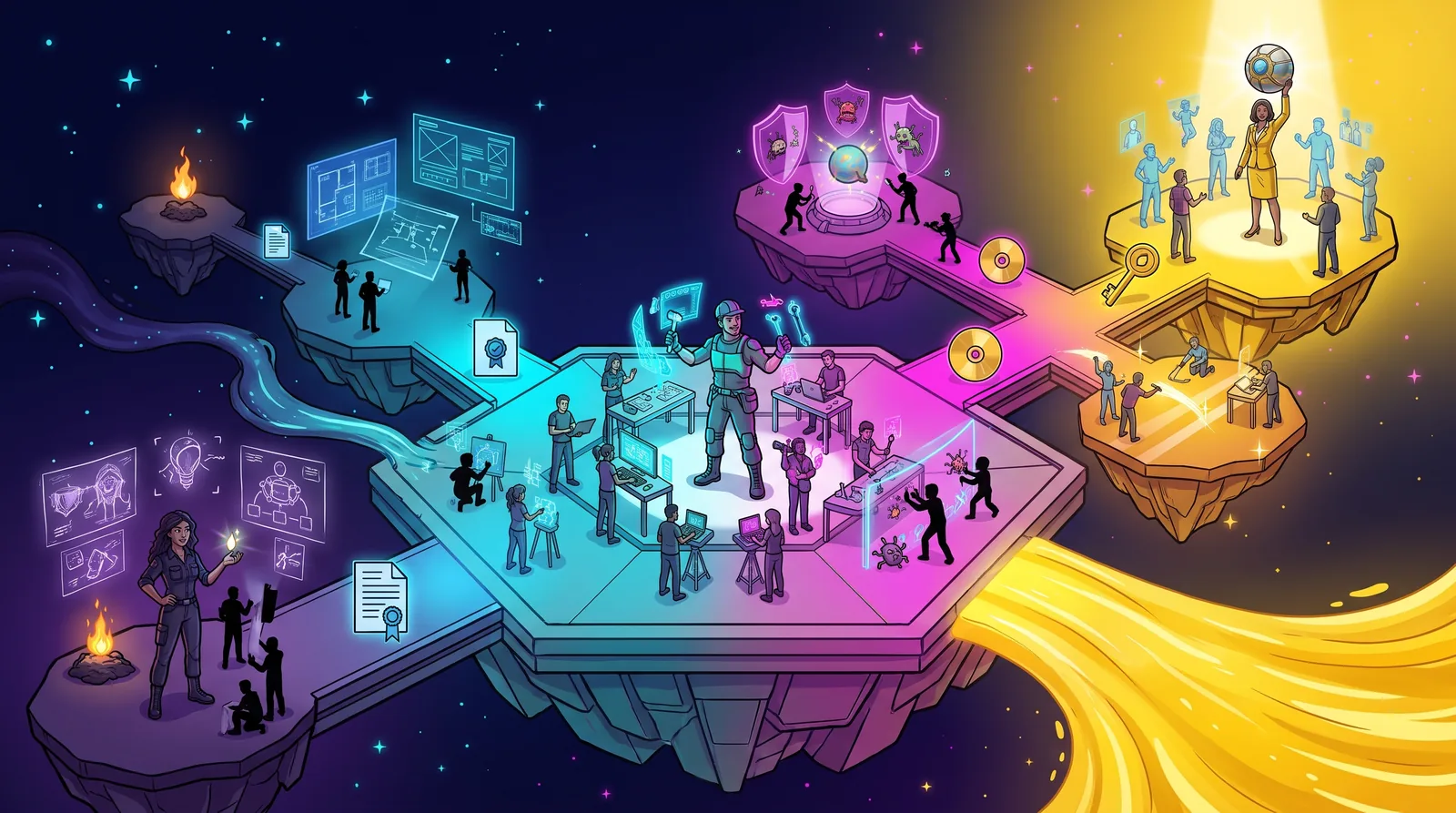
What Is Full-Cycle Game Development? Stages, Team, Timeline and Costs (2026 Guide)
Quick answer: Full-cycle game development is a model in which one studio takes a game through every stage of its life: concept, pre-production, production, QA, launch, LiveOps and scaling. Instead of coordinating separate vendors for design, art, engineering and live operations, the publisher or founder works with a single team accountable for the whole product. Typical timelines range from 2 to 6 weeks for a prototype to 6 to 12 months for a mid-core or RPG title, and market costs range from $15,000 to $40,000 for a prototype up to $200,000 to $500,000 for a mid-core title. Full-cycle is the right model when you need a complete game and want the team that built it to keep growing it after launch.
Quick navigation:
- What full-cycle game development means
- The seven stages of full-cycle development
- Who does what: roles per stage
- Timelines by game type
- What full-cycle development costs
- Full-cycle vs co-development vs staff augmentation
- When full-cycle is the right model
- How to evaluate a full-cycle partner
- Common mistakes in full-cycle projects
- What full-cycle looks like in practice
- FAQs
- Conclusion
- Further Reading
- Sources
What Full-Cycle Game Development Means
Full-cycle game development covers design, development, testing, deployment and post-launch evolution under one team. The defining feature is continuity: the people who design the core loop are connected to the people who build it, test it, launch it and operate it.
That continuity matters because games are not finished at launch. Retention, monetization and content cadence depend on decisions made months earlier in pre-production. When different vendors handle different stages, those decisions are often made without the post-launch reality in mind. A full-cycle partner designs with the whole lifecycle in view from day one.
For publishers and founders, the benefits are practical. There is one point of accountability instead of several vendors to coordinate. Knowledge stays inside one team, so nothing is lost in handoffs between design, development and operations. Technical decisions are made with LiveOps in mind, which avoids expensive rework after launch. And because the same team sees how players respond after release, it can feed real data back into design, content and monetization decisions quickly.
Full-cycle is not the same as fragmented outsourcing, where a publisher hires one company for art, another for engineering and a third for LiveOps, and then carries the coordination risk between them.
The Seven Stages of Full-Cycle Development
| Stage | What happens | Key output |
| 1. Concept | Market and audience analysis, core idea, monetization model | Validated concept and high-level plan |
| 2. Pre-production | Game design document, art direction, technical architecture, rapid prototype | Playable prototype and production plan |
| 3. Production | MVP, then full content, systems, art and backend | Feature-complete build |
| 4. QA | Functional, device, performance and compliance testing | Store-ready builds |
| 5. Launch | Store preparation, soft launch, KPI tracking, global launch | Live game with baseline data |
| 6. LiveOps | Events, content updates, economy tuning, analytics | Retained, engaged player base |
| 7. Scaling | New features, markets and growth based on performance data | Long-term product growth |
In practice, the stages overlap. QA starts during production, LiveOps tooling is built before launch, and soft-launch data feeds back into design. A strong full-cycle partner manages those overlaps rather than treating the stages as a strict sequence.
Who Does What: Roles Per Stage
| Role | Most active in | Responsibility |
| Product manager | All stages | Goals, KPIs, priorities and client communication |
| Game designer | Concept to LiveOps | Core loop, meta, economy, levels and events |
| Art director and artists | Pre-production and production | Visual identity, 2D and 3D assets, UI, animation, VFX |
| Developers and team lead | Pre-production to scaling | Gameplay, architecture, backend, integrations |
| QA team | Production to LiveOps | Testing, device coverage, regression and store compliance |
Seniority matters more than headcount. A small, senior team that has shipped and operated games usually moves faster than a large team assembled for a single project.
Timelines by Game Type
Based on Galaxy4Games' published service tiers, typical timelines are:
| Scope | Typical timeline |
| Prototype / proof of concept | 2–6 weeks |
| MVP (core loop + basic meta) | 1–3 months |
| Full casual / hybrid casual game | 4–8 months |
| Mid-core / RPG title | 6–12 months |
LiveOps and scaling are ongoing rather than fixed phases. For a live game, they continue for as long as the title is operated.
What Full-Cycle Development Costs
| Scope | Market rate | With Galaxy4Games solutions |
| Prototype / proof of concept | $15,000–$40,000 | $7,000–$20,000 |
| MVP | $40,000–$120,000 | $15,000–$85,000 |
| Full casual / hybrid casual game | $120,000–$300,000 | $30,000–$95,000 |
| Mid-core / RPG title | $200,000–$500,000 | $180,000–$450,000 |
The difference between the columns comes from reuse. Galaxy4Games builds on the Game Application Template, a pre-built project foundation, and the Modular Solutions Library of tested game systems, together with its LiveOps-ready Framework. The studio reports that this approach reduces development time and cost by 30 to 50% compared with building from a blank slate.
Full-Cycle vs Co-Development vs Staff Augmentation
| Full-cycle | Co-development | Staff augmentation | |
| Who owns product decisions | Shared, with the studio driving execution | Client | Client |
| Partner's scope | The whole game | Specific features or disciplines | Individual roles |
| Client management load | Low | Medium | High |
| Typical contract | Milestone-based | Dedicated team or per feature | Monthly per person |
| Best for | Complete new games | Productions in flight | Short-term capacity gaps |
When Full-Cycle Is the Right Model
-
You have a concept and budget but no internal studio.
-
You are a publisher launching a new title without diverting your core team.
-
You want one accountable partner rather than coordinating several vendors.
-
You need the game to be operated and grown after launch, not just delivered.
-
You want to validate the idea quickly with a prototype before committing to full production.
Full-cycle is less suitable when your internal team already owns product leadership and only needs extra capacity. In that case, co-development or staff augmentation is usually more efficient.
How to Evaluate a Full-Cycle Partner
Many studios describe themselves as full-cycle. These checks separate those who have actually delivered complete games from those who mainly provide single disciplines:
-
Complete games delivered. Ask for titles the studio took from concept to launch and post-launch support for a client, and whether the result matched the client's goals.
-
Live titles of their own. Studios that operate their own games treat LiveOps and scaling as daily practice, not as an add-on.
-
Reusable technology. Ask which systems the studio already has and which it will build from scratch. Reuse lowers cost and technical risk.
-
Milestones with exit criteria. Each stage should end with defined deliverables and a clear go or no-go decision, not just a date.
-
Ownership terms. Confirm that you will own the final game and codebase, and how any studio technology used in production is licensed.
-
Post-launch commitment. Ask who stays on the project after launch and how KPIs will be tracked and improved.
Common Mistakes in Full-Cycle Projects
Even with the right partner, a few avoidable mistakes slow full-cycle projects down:
-
Skipping the prototype. Going straight to production without validating the core loop risks building months of content on an unproven idea.
-
Treating launch as the finish line. Budgets that stop at release leave no room for the LiveOps work that drives retention and revenue.
-
Defining success too late. KPIs such as retention targets and monetization goals should be agreed before soft launch, not negotiated afterwards.
-
Changing scope without changing the plan. New features are normal, but each one should be weighed against timeline and budget at a milestone, not added informally.
A capable full-cycle partner will raise these points early, because they protect both the game and the partnership.
What Full-Cycle Looks Like in Practice
Two published Galaxy4Games projects show the model at different scales. Zongtopia, an EU-funded educational music game, was built full-cycle from concept to soft launch in five months, covering game design, backend, cross-platform builds and LiveOps architecture. Frontstrike, a multiplayer FPS for PrimeSkill Studios, was built full-cycle in two and a half months to meet a hard public deadline, including 5v5 matches, 10+ weapons, custom matchmaking and low-latency networking.
Beyond client work, Galaxy4Games builds and operates its own live titles on the App Store and Google Play, so the LiveOps and scaling stages are part of its daily operations rather than a service added at the end.
Conclusion
Full-cycle game development is about accountability across the whole life of a game. It gives publishers and founders one partner responsible for turning an idea into a live product and keeping it growing, with design decisions made in the light of what happens after launch.
To explore full-cycle development built on proven, LiveOps-ready foundations, see Galaxy4Games' full-cycle game development services.
Further Reading:
- Full-Cycle Game Development Outsourcing for RPGs: What Publishers Should Ask — Galaxy4Games
- Game Co-Development: A Complete Guide to Models, Costs, Risks and Choosing the Right Partner — Galaxy4Games
- Game Launch Strategy in 2026: From ASO and Ad Creatives to Launch-Ready KPIs, UA Scaling and Publishers — Galaxy4Games
Sources:
- Full-Cycle Game Development — Galaxy4Games
- Game Application Template — Galaxy4Games
- Modular Solutions Library — Galaxy4Games
- Unity Game Development — Galaxy4Games