How to Hire a Unity Game Developer or Studio: Staff Augmentation vs. Full-Cycle vs. Co-Development
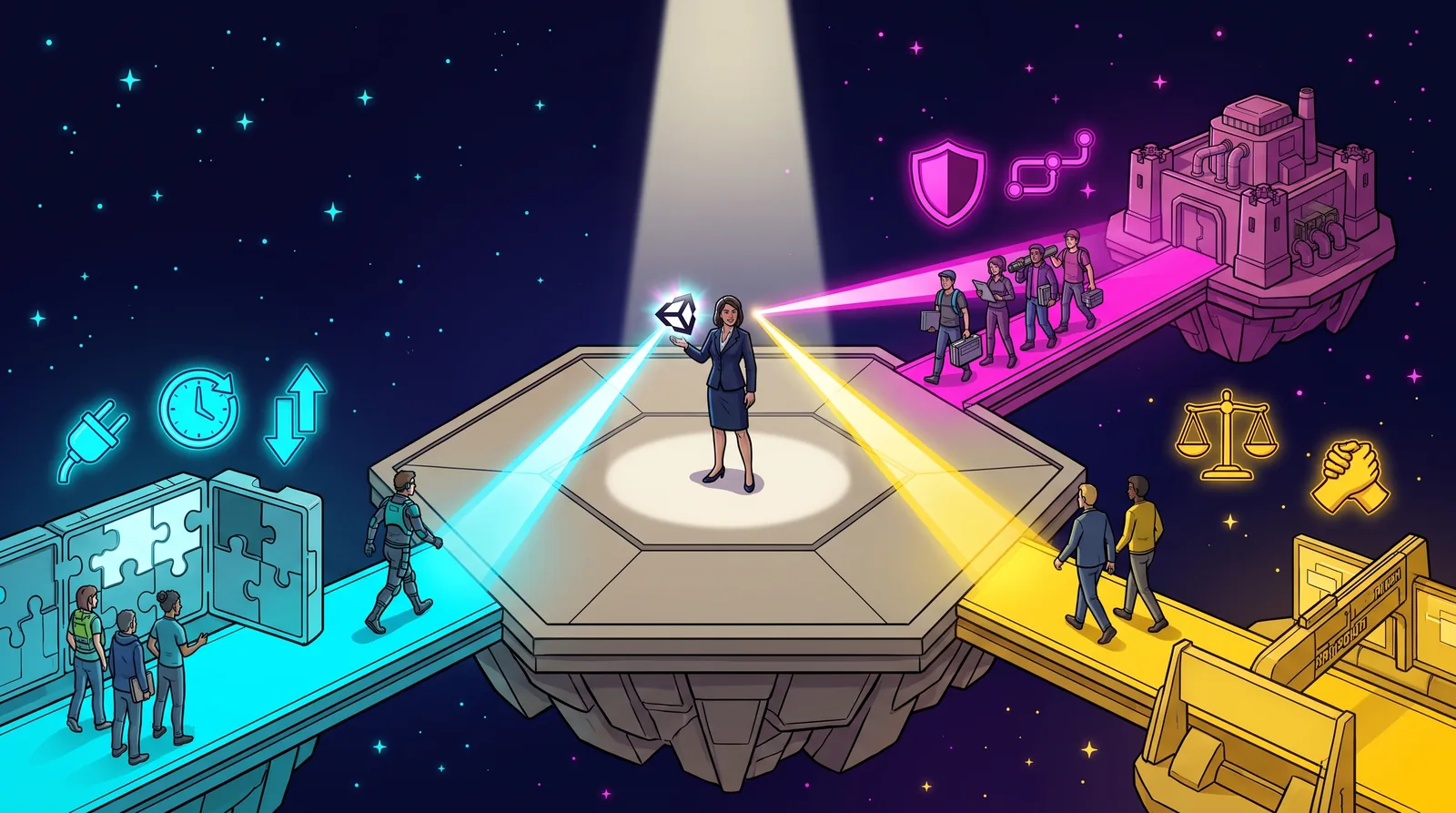
Quick answer: There are three main ways to hire Unity talent. Staff augmentation adds individual Unity developers to your team under your management. Co-development brings in a partner team that owns specific features or disciplines inside your production. Full-cycle development hands a studio the entire game, from concept to launch and LiveOps. Staff augmentation suits teams with strong internal leadership and a short-term capacity gap, co-development suits productions already in flight, and full-cycle suits publishers and founders who need a complete game without building an internal studio. The right choice depends on who owns product decisions, how much management capacity you have and what happens after launch.
Quick navigation:
- Why buyers confuse the three models
- Model 1: Staff augmentation
- Model 2: Co-development
- Model 3: Full-cycle development
- What each model costs per month
- IP ownership in each model
- Model-selector table
- Signs you picked the wrong model
- How to vet Unity talent in any model
- FAQs
- Conclusion
- Further Reading
- Sources
Why Buyers Confuse the Three Models
Unity remains one of the most widely used engines in game development. In the GDC 2026 State of the Game Industry survey, 30% of developers reported using Unity on their latest project, and it was the most popular engine among free-to-play projects and smaller teams. That popularity means almost every outsourcing company lists Unity as a core skill, and almost every one offers some mix of staff augmentation, co-development and full-cycle work.
The problem is that these labels are used loosely. One vendor's "co-development" is another's staff augmentation with a different name. Buyers end up comparing proposals that look similar but assign very different responsibilities, risks and ownership. The result is often a mismatch: a publisher hires individual developers when it actually needs a team that owns outcomes, or commissions a full game when it only needed extra hands for three months.
The clearest way to choose is to start with one question: who will own product decisions?
Model 1: Staff Augmentation
What it is. Individual Unity developers, artists or QA specialists join your existing team. They follow your processes, use your tools and report to your leads.
The scenario it fits. You already have a producer, technical lead and game design ownership in-house, and you need more hands for a defined period: a feature push, a content spike or a launch crunch.
What the contract looks like. Usually time and materials, billed monthly per person, with notice periods for scaling up or down. The vendor is responsible for providing qualified people, not for the outcome of the work.
Watch out for. Management load. Augmented developers are only as effective as the direction they receive. If your leads are already stretched, adding people can slow a team down rather than speed it up.
Model 2: Co-Development
What it is. A partner studio provides a team that takes ownership of specific features, systems or disciplines within your production, such as multiplayer, a meta layer, art production or LiveOps content, while you keep overall creative and product leadership.
The scenario it fits. Your game is already in production and you need a capability your team lacks, or you are a publisher managing several titles without a full internal studio for each. Co-development is often the right answer mid-flight, when the core team is established but scope or ambition has grown.
What the contract looks like. Either a dedicated team billed monthly or statements of work per feature or milestone, with clear acceptance criteria. The partner is accountable for delivering defined pieces of the game.
Watch out for. Integration. The partner must work inside your pipeline, tools and code standards. Ask how they onboard into an existing codebase and how they handle dependencies between their work and yours.
Model 3: Full-Cycle Development
What it is. A studio takes responsibility for the whole game: concept, game design, art, engineering, QA, store launch and, ideally, LiveOps and scaling after release.
The scenario it fits. You are a publisher or founder with a concept and a budget but no internal studio, or you want to launch a new title without diverting your core team. Full-cycle is also the natural fit when the studio's own technology and live-game experience are a large part of the value.
What the contract looks like. Usually milestone-based, with payments tied to defined deliverables such as prototype, MVP, soft launch and global launch, and a separate agreement for LiveOps after release.
Watch out for. Scope delivered. Many studios list full-cycle services but have mostly delivered single disciplines. Ask for complete games the studio took from idea to launch and post-launch support.
What Each Model Costs Per Month
Costs depend heavily on region and seniority. Galaxy4Games' mobile game cost guide puts typical market hourly rates at $150 to $280 in the USA and Canada, $80 to $150 in Western Europe, $40 to $80 in Eastern Europe and $25 to $50 in Southeast Asia. Based on roughly 160 working hours a month, that translates into the following approximate monthly market cost for one full-time Unity developer:
| Region | Hourly market rate | Approximate monthly cost per developer |
| USA and Canada | $150–$280 | $24,000–$44,800 |
| Western Europe | $80–$150 | $12,800–$24,000 |
| Eastern Europe | $40–$80 | $6,400–$12,800 |
| Southeast Asia | $25–$50 | $4,000–$8,000 |
Staff augmentation is priced close to these per-person figures. Co-development teams are typically priced as a monthly team rate or per feature, so the total depends on team size and seniority mix. Full-cycle projects are usually quoted per milestone or per project rather than per month, and studios that reuse proven systems can deliver the same scope for less, because fewer hours go into rebuilding standard features.
IP Ownership in Each Model
| Model | Typical IP position | What to clarify |
| Staff augmentation | All work product belongs to the client | Assignment clauses for every individual contractor |
| Co-development | Deliverables transfer to the client on payment | Ownership of shared code, tools and any partner technology used |
| Full-cycle | Final game and codebase transfer to the client | Which pre-existing studio technology is licensed rather than transferred |
The full-cycle question deserves the most attention. Studios that build on their own technology should state clearly what the client owns. With Galaxy4Games, for example, clients fully own the final delivered game and codebase, even though production uses the studio's in-house foundation.
Model-Selector Table
| Your situation | Best model |
| Strong internal leads, short-term capacity gap | Staff augmentation |
| Game in production, missing a specific capability | Co-development |
| Publisher with several titles and limited internal studio capacity | Co-development (dedicated team) |
| Concept and budget, no internal studio | Full-cycle |
| Need to validate an idea fast before committing | Full-cycle, starting with a prototype |
| Live game that needs ongoing events and content | Co-development or full-cycle with LiveOps |
Signs You Picked the Wrong Model
Model mismatches usually show up within the first few weeks. Watch for these signals:
-
Augmented developers waiting for direction. If external developers spend time idle or blocked, your team lacks the management capacity for staff augmentation. A co-development team that owns its own scope may fit better.
-
A co-development partner making product calls. If the partner is effectively deciding game design because nobody internally owns it, the project needs a full-cycle partner with explicit product responsibility.
-
A full-cycle studio waiting for approvals. If every decision goes back through a large internal team, you may be paying for full-cycle accountability while keeping full control in-house. Co-development may be a cleaner structure.
Switching models mid-project is possible, but it is easier when the contract allows teams and scope to change at defined milestones.
How to Vet Unity Talent in Any Model
-
Shipped Unity titles: ask for live games on the App Store and Google Play, not only demos.
-
Mobile optimization: ask how the team profiles performance and tests across Android devices.
-
Architecture habits: ask how they structure projects for LiveOps, remote configuration and content updates.
-
Reusable technology: ask which systems they bring and which they will build from scratch.
-
Communication: agree on reporting cadence, build access and points of contact before work starts.
Galaxy4Games builds Unity projects on the Game Application Template and the Modular Solutions Library, a proprietary foundation of tested systems for analytics, payments, events, progression and gameplay mechanics accumulated over 15+ years. The studio offers all three engagement models, from staff augmentation and dedicated co-development teams to full-cycle development, so the model can follow the project rather than the other way around.
Conclusion
Staff augmentation, co-development and full-cycle development are not competing options so much as answers to different situations. The deciding factors are who owns product decisions, how much management capacity you have and whether the partner needs to stay with the game after launch.
Choose the model first, then the partner. To discuss which model fits your Unity project, explore Galaxy4Games' Unity game development services.
Further Reading:
- Game Co-Development: A Complete Guide to Models, Costs, Risks and Choosing the Right Partner — Galaxy4Games
- Unity Game Development Cost in 2026: What Drives Price Up (and What Doesn't) — Galaxy4Games
- How to Structure a Publisher-Studio Deal: Contracts, Milestones and IP Ownership — Galaxy4Games
Sources:
- GDC: The State of the Game Industry 2026 — GameDev Reports
- How Much Does It Cost to Develop a Mobile Game in 2026? — Galaxy4Games
- Game Co-Development & Partnerships — Galaxy4Games
- Modular Solutions Library — Galaxy4Games
- Game Application Template — Galaxy4Games