Brand Gamification in 2026: How Companies Use Custom Games for Marketing, Loyalty and Engagement
Quick answer: Brand gamification is the use of game mechanics and custom games to drive marketing, loyalty and customer engagement for non-gaming companies. Common formats include advergames, loyalty mini-games, gamified campaigns, event games and gamified training. Success is measured through engagement time, completion rates, lead capture, retention and conversion lift. A focused gamification layer for an existing app typically starts around $50,000, while a full gamified platform usually ranges from $100,000 to $200,000 or more, with 3 to 6 months from discovery to soft launch. Working with an experienced game studio helps brands build experiences people genuinely want to play.
Quick navigation:
- What brand gamification means in 2026
- Why brands are investing in games
- The main brand gamification formats
- Real examples from global brands
- KPIs that show whether it works
- Budgets and timelines
- Common brand gamification mistakes
- Gamification beyond consumer marketing
- How to brief a game studio
- Why a game studio, not only an agency
- FAQs
- Conclusion
- Further Reading
- Sources
What Brand Gamification Means in 2026
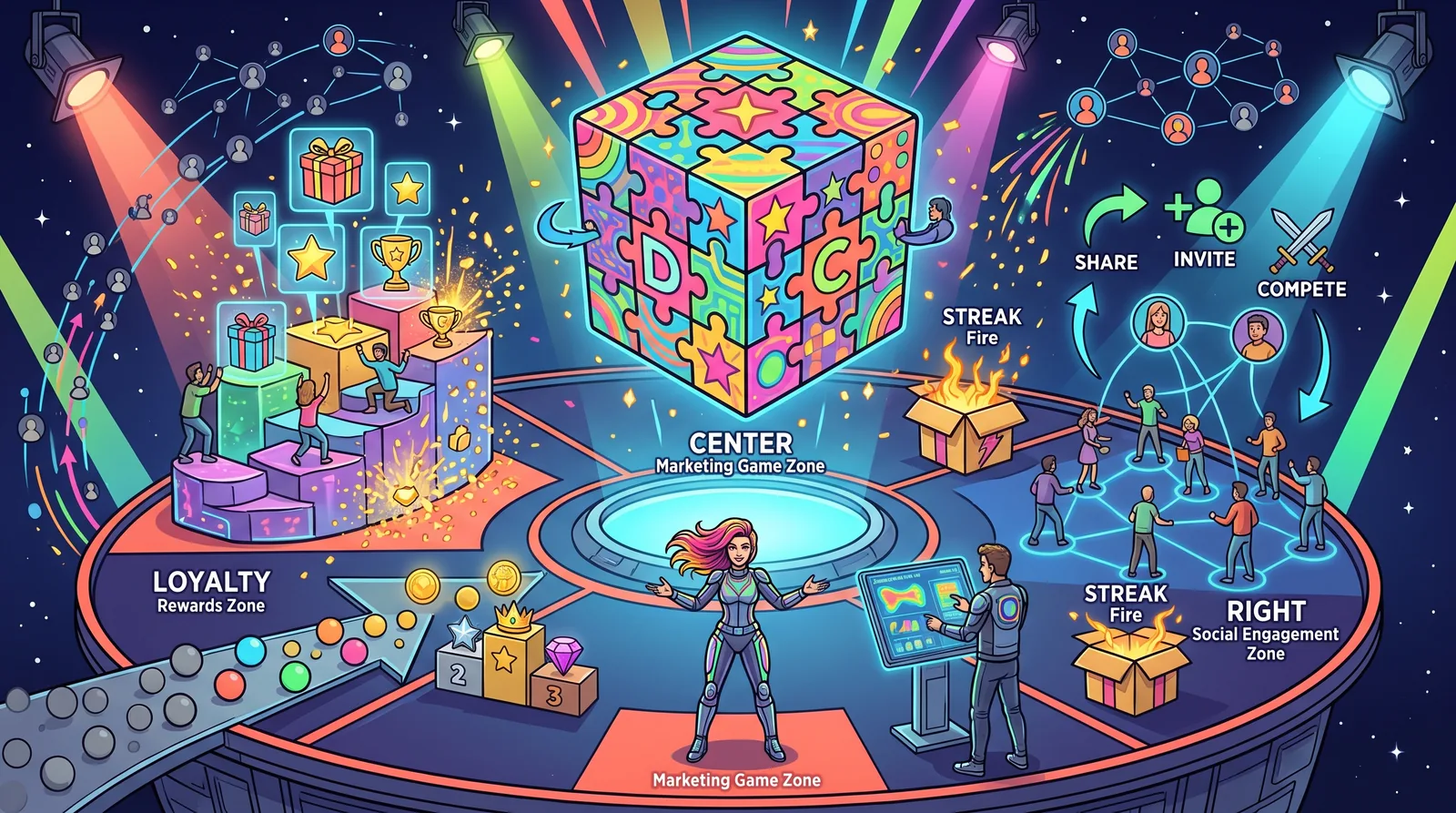
Brand gamification applies the mechanics that make games engaging, such as progression, rewards, challenges, competition and collection, to marketing, loyalty and customer experiences. It ranges from a single branded mini-game in a campaign to a full loyalty program built around points, levels and seasonal events.
What has changed in recent years is the bar. Consumers now spend hours a week in polished mobile games, and they notice immediately when a branded experience feels like a thin marketing wrapper. The brands that succeed with gamification treat it as product design, not decoration.
Why Brands Are Investing in Games
-
Attention. A game holds attention for minutes rather than seconds, which few other marketing formats can match.
-
Loyalty and repeat visits. Progression, streaks and rewards give customers a reason to come back regularly.
-
First-party data. Players willingly share preferences and contact details in exchange for rewards, which is increasingly valuable as third-party tracking declines.
-
Differentiation. A well-made game makes a brand memorable and shareable in crowded categories.
-
Learning and onboarding. Gamified training and product education improve completion and recall.
The Main Brand Gamification Formats
| Format | What it is | Typical goal |
| Advergame | A standalone branded game on web or mobile | Awareness, reach and time with the brand |
| Loyalty mini-games | Games inside a loyalty app, such as spin wheels, scratch cards or daily challenges | Repeat visits and program engagement |
| Gamified campaign | A limited-time promotion built around collecting, competing or unlocking | Sales lift during the campaign |
| Event game | A game for trade shows, launches or live events | Lead capture and booth traffic |
| Gamified app layer | Points, levels, badges and leaderboards added to an existing product | Retention and feature adoption |
| Gamified training | Learning paths with progression and rewards for employees or customers | Completion and knowledge retention |
Real Examples from Global Brands
McDonald's Monopoly
One of the longest-running gamified campaigns, McDonald's Monopoly began in the United States in 1987 and has since run in many countries. Customers collect game pieces from packaging to complete property sets and win prizes. The promotion has steadily moved into digital: in its 2025 U.S. return, the game ran largely inside the McDonald's app for MyMcDonald's Rewards members, connecting a classic collection mechanic directly to the brand's loyalty program.
Starbucks Rewards
Starbucks uses game mechanics throughout its loyalty program: Stars as a currency, visible progress toward rewards and higher tiers, and time-limited bonus challenges such as double-star days. The result is a loyalty experience that feels like progression rather than a simple discount.
Sephora Beauty Insider Challenges
Sephora added task-based challenges to its Beauty Insider program, rewarding members with points for completing a series of activities and a bonus for finishing the full set. The approach turns routine loyalty actions into a sequence of small goals.
What these examples share is a simple, well-understood core mechanic, a clear reward structure and a direct connection to the brand's commercial goals.
KPIs That Show Whether It Works
Every brand game should be measured against the goal it was built for. The most useful KPIs are:
| Goal | KPIs to track |
| Awareness | Players reached, average engagement time, shares |
| Lead generation | Registrations, opt-ins, cost per lead |
| Loyalty | Return visits, Day 1, Day 7 and Day 30 retention, reward redemption |
| Sales | Conversion lift, average order value during the campaign |
| Learning | Completion rates, assessment scores |
Analytics should be designed into the game from the start, so results can be measured accurately and the experience can be improved while the campaign or program is live.
Budgets and Timelines
Budgets depend on scope, platforms, content volume and how long the experience will run. Based on Galaxy4Games' published service information, a focused gamification layer for an existing app typically starts around $50,000 and scales with complexity, while a full gamified platform usually sits in the $100,000 to $200,000+ range. A typical delivery timeline is 3 to 6 months from discovery to soft launch.
The biggest cost variables are the number of game mechanics, integration with existing systems such as CRM, loyalty or e-commerce platforms, art and content volume, and whether the experience needs ongoing LiveOps such as seasonal events and new challenges.
Common Brand Gamification Mistakes
Most brand games that underperform make one of a few predictable mistakes:
-
Branding over gameplay. Logos and product shots cannot rescue a game that is not fun. Players stay for the experience, and the brand benefits from that time.
-
Rewards with no value. If prizes feel unreachable or irrelevant, players stop after the first session. Small, frequent rewards usually outperform one large prize that few people can win.
-
Too much friction at the start. Long registration forms before the first play lose most of the audience. Let people play first and ask for details when they have a reason to share them.
-
No plan after launch. A loyalty game without new challenges, seasons or content quickly feels stale. Long-running programs need a LiveOps calendar, just like commercial games.
-
Measuring the wrong thing. Downloads or plays alone say little. Tie the game to the business KPI it was built to move.
-
Ignoring promotion rules. Prize mechanics, sweepstakes and data collection are regulated differently across markets, so legal review should be part of the plan from the beginning.
Gamification Beyond Consumer Marketing
Brand gamification is not limited to consumer campaigns. B2B companies use gamified product tours and onboarding to help new users discover features faster, while HR and training teams use progression, badges and team challenges to improve course completion and knowledge retention. Event organizers use short competitive games to drive booth traffic and capture qualified leads. The same principles apply in every case: a clear goal, a mechanic that fits the audience and measurement built in from day one.
How to Brief a Game Studio
A strong brief helps a studio propose the right format and give an accurate estimate. It should cover:
-
Business goal: awareness, leads, loyalty, sales or learning, and the one KPI that matters most
-
Audience: who the players are and how much time they are likely to spend
-
Channel: web, mobile app, in-store, event or inside an existing product
-
Duration: a short campaign or a long-running program
-
Integrations: CRM, loyalty, payments, e-commerce or analytics systems the game must connect to
-
Brand guidelines: visual identity, tone and any regulatory constraints for prizes and promotions
-
Success criteria: how results will be measured and reported
Why a Game Studio, Not Only an Agency
Creative agencies are strong at concepts and campaigns. Building a game that people genuinely want to play, and keep playing, is a different discipline that requires game design, balancing, monetization logic, performance optimization and LiveOps.
Galaxy4Games designs and builds custom gamification systems for brands across mobile, web and cross-platform environments, covering loyalty and retention programs, gamified learning, customer engagement and app gamification. Its process runs from discovery and strategy through game design, development and integration, QA and launch, to LiveOps and optimization. Because projects are built on the Game Application Template and the Modular Solutions Library, proven systems such as daily rewards, events, spin wheels, offers and progression can be adapted to a brand's identity instead of being built from scratch, which shortens timelines and keeps budgets focused on what makes the experience unique.
Conclusion
Brand gamification works when it is built like a real game: a clear core mechanic, rewards that feel meaningful, measurable goals and content that evolves over time. Done well, it delivers something few marketing channels can, which is customers who choose to spend time with a brand.
To explore how a custom game or gamification layer could support your marketing and loyalty goals, see Galaxy4Games' brand gamification services.
Further Reading:
- Game Launch Strategy in 2026: From ASO and Ad Creatives to Launch-Ready KPIs, UA Scaling and Publishers — Galaxy4Games
- Modular Game Development: How It Speeds Up Production Without Sacrificing Quality — Galaxy4Games
Sources:
- Brand Gamification Services — Galaxy4Games
- Modular Solutions Library — Galaxy4Games
- Game Application Template — Galaxy4Games
- McDonald's Monopoly — Wikipedia
- Gamified Loyalty Programs — CleverTap