





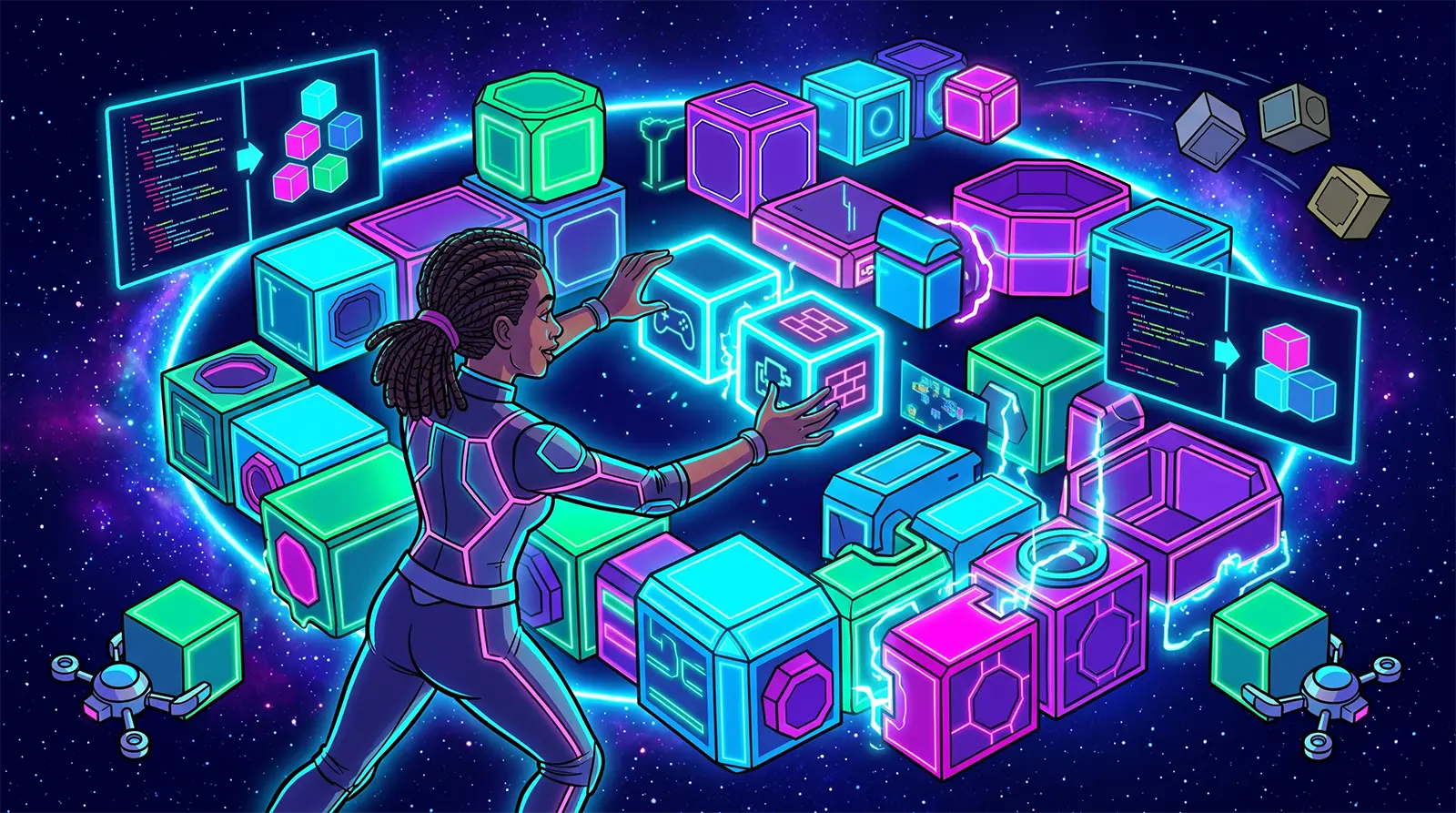
Simplifying Game Development with Reusable Components: Galaxy4Games' Modular Approach
The Problem Every Game Studio Knows But Few Solve
Every game studio, at some point in production, builds something it has already built before.
An onboarding flow. An economy system. A daily reward cadence. A progression framework. A live event template. These systems are not unique to any single game — they are foundational components that appear, in some form, in virtually every mobile game ever built. And yet, the default production model in the industry treats each of these as a new build every time.
The cost of this approach is not just financial. It is temporal, architectural, and operational. Every system built from scratch is a system that hasn't been tested at scale. Every new codebase introduces new failure modes. Every project that starts at zero takes longer to reach a point where the team can focus on what actually differentiates the game — its creative vision, its genre execution, its player experience.
Galaxy4Games was built around a different premise: that the most valuable thing a development studio can do is not start every project from scratch, but build on a foundation that has already been proven.
That premise is embodied in a proprietary system Galaxy4Games calls the Galaxy4Games Technology Framework — built around two core components: the Game Application Template and the Modular Solutions Library. Together, they represent something categorically different from what most studios mean when they claim to use a "modular approach" — and a fundamentally different way of thinking about what it means to build a game efficiently without compromising its quality or commercial potential.
What Modular Game Development Actually Means — And Why Most Studios Get It Wrong
The term "modular" is used loosely across the game development industry. For most studios, it is a synonym for well-organized code — a clean architecture that separates concerns and makes systems easier to maintain. That is a sound engineering practice — and Galaxy4Games takes it significantly further.
The difference is significant, and it matters to anyone evaluating a development partner.
When other companies claim to use a modular approach, they typically mean their engineers write flexible, decoupled code. That is a baseline quality standard. Galaxy4Games has taken that baseline and built an entire operational framework on top of it — years of accumulated production work, encoded into a living system that every project draws from.
Modular game development, as Galaxy4Games practices it, is the systematic use of pre-built, battle-tested reusable game components — systems, frameworks, and templates that have been designed, refined, and validated across multiple production cycles and genres, from match-3 to RPG — as the starting point for every new project. These components are not theoretical. They have been proven in live environments, under real player load, across real monetization conditions.
This is not a shortcut. It is an architecture decision with downstream consequences for production speed, post-launch stability, LiveOps capability, and the total cost of bringing a game to market and sustaining it.
The distinction matters because there are two ways to be fast in game development:
-
Move fast by cutting corners — skipping architecture decisions, accumulating technical debt, shipping something that works until it doesn't
-
Move fast by starting from a proven foundation — spending less time rebuilding solved problems and more time solving the creative and commercial challenges that actually define the game
Galaxy4Games' modular approach is built on the second model. The speed comes from the foundation, not from the shortcuts. And critically, there is no sacrifice to quality. This is not an external game constructor or a no-code assembly tool. It is high-quality, production-grade code, built for scalability from day one.
The bottom line: The Galaxy4Games Technology Framework is not a claim about coding style. It is a fully realized production system — built, refined, and battle-tested across nearly every major mobile game genre over 15+ years of development and live operations.
The Game Application Template
The Game Application Template is the first pillar of the Galaxy4Games Technology Framework. Think of it as a complete game template — production-ready and architected to be reskinned, populated with modules from the Modular Solutions Library, and scaled without rebuilding the foundation each time.
When Galaxy4Games begins a new project, the team is not starting from a blank repository. They are starting from a framework that already includes:
-
Core game loop architecture. The foundational structure for turn-based, real-time, or session-based gameplay, pre-configured for mobile performance and battery efficiency.
-
Analytics instrumentation. Event tracking, session measurement, funnel analytics, and cohort infrastructure built in from day one — not instrumented retroactively after launch when the data is needed most.
-
Monetization scaffolding. IAP integration, soft and hard currency architecture, rewarded ad placement hooks, and paywall framework — designed to be configured for each game's specific economy rather than built from scratch.
-
LiveOps infrastructure. Event management systems, content delivery architecture, A/B testing capability, and push notification infrastructure — the operational layer that enables a live game to be updated, tested, and iterated on efficiently post-launch.
-
Platform compliance and submission framework. iOS and Android submission pipelines, privacy framework compliance, and platform-specific performance optimization — the unglamorous but essential infrastructure that determines whether a game ships on time.
The value of the Game Application Template is not just speed — it is the quality of the foundation. These are not untested components assembled for convenience. They are systems refined across multiple shipped titles, with known performance characteristics, known failure modes, and established optimization patterns.
A game built on this foundation starts its production cycle weeks ahead of a game built from scratch — and starts its live phase with measurement and operational infrastructure already in place.
The Modular Solutions Library
Where the Game Application Template provides the foundational architecture, the Modular Solutions Library provides the functional building blocks — a curated, continuously growing collection of pre-built game systems and components that can be configured and integrated into any project.
The library is the product of years of developing and operating games across nearly every major genre. Match-3, RPG, casual puzzle, mid-core, educational, MMORPG — each project has contributed proven components back into the library. That accumulation is ongoing: every new title Galaxy4Games builds or operates is a potential source of new modules, refined mechanics, and validated LiveOps patterns. The library grows with every project.
Every component has been built to a production standard, tested at scale, and refined based on real live game performance data. The Modular Solutions Library includes components across several categories:
-
Progression systems. Level progression, meta progression, battle pass frameworks, achievement systems, and mastery tracks — designed to be configured for the specific pacing and reward architecture of each game's design.
-
Economy systems. Soft currency flows, hard currency architecture, shop frameworks, bundle design templates, and limited-time offer systems — built with monetization intent at the structural level, not applied as surface-layer features.
-
LiveOps components. Event management modules, seasonal content frameworks, daily and weekly challenge systems, tournament infrastructure, and re-engagement mechanics — the operational layer that drives the content cadence a live mobile game requires.
-
Social and retention mechanics. Guild and social graph infrastructure, referral system frameworks, leaderboard architecture, and social sharing mechanics — systems that drive the k-factor and social retention that reduce UA dependency over time.
-
Onboarding frameworks. Structured onboarding flows with branching logic, tutorial system architecture, and first-session design templates — built around the behavioral insight that the first three minutes of a mobile game determine whether most players return.
The Modular Solutions Library does not replace creative design — it enables it. By handling the structural and technical complexity of these systems at the library level, the development team can focus on the creative and genre-specific configuration that makes each game distinct.
How the Galaxy4Games Technology Framework Changes Production Economics
The economic impact of Galaxy4Games' modular approach operates across three dimensions: time, cost, and risk. But underlying all three is a single commercial reality that most studios don't address directly: every dollar and every week spent rebuilding solved problems is distance between you and positive ROI.
In conventional game development, budget overruns don't just hurt the bottom line — they push the break-even point further out, compress the runway for post-launch iteration, and reduce the margin for error when monetization needs tuning. The Galaxy4Games Technology Framework is a direct response to that reality. By eliminating the cost of rebuilding foundational systems that have already been built, tested, and refined, the framework keeps development lean and the path to ROI shorter — from the first day of production, not the first day after launch.
Time
A mobile game built from scratch typically spends a significant portion of its production timeline on systems that are not creatively differentiated — the foundational infrastructure that every game needs but that doesn't define what makes any specific game compelling.
Starting from the Game Application Template and the Modular Solutions Library eliminates most of that undifferentiated build time. The analytics are already there. The monetization scaffolding is already there. The LiveOps infrastructure is already there. The production team spends its time on the systems and content that actually make the game what it is.
In practice, this translates to meaningfully shorter paths from concept to MVP and from MVP to launch-ready product — which has direct implications for funding timelines, time-to-market, and the competitive window available to a new title.
Cost
Shorter timelines translate directly to lower production costs — but the cost efficiency of the modular approach goes deeper than timeline compression alone. It also reduces the cost of iteration.
In traditional from-scratch development, changing a core system mid-production is expensive. The system is tightly coupled to other systems; changing one requires auditing and potentially rebuilding adjacent components. In a modular architecture, components are designed for configurability. Changing the progression pacing, rebalancing the economy, or restructuring the onboarding flow are configuration decisions rather than engineering projects.
This modularity of iteration is particularly valuable in the MVP phase, where the whole point is to learn and adjust based on player behavior. The faster and cheaper iteration is, the more validation cycles the team can run before committing to full production.
Risk
Production risk in game development is concentrated in two places: the systems that have never been built before and the systems that have to work perfectly at launch. The modular approach directly reduces both.
Systems from the Modular Solutions Library have known performance characteristics. They have been tested under real live game conditions. Their failure modes are understood and their optimization patterns are established. This doesn't eliminate engineering risk — it displaces it from solved problems to the creative and commercial challenges that actually deserve the team's full attention.
Why This Approach Produces Better Live Games
The benefits of Galaxy4Games' modular approach are most visible not at launch but in the live phase — the ongoing operations period that determines whether a game sustains its player base and commercial performance over time.
Live games fail for many reasons, but a recurring structural cause is architecture that was not designed for the demands of live operations. Systems that are tightly coupled make updates expensive. Content pipelines that were not planned at the start of production become bottlenecks during live operations. Economy systems that were not designed for extensibility require partial rebuilds every time a new monetization mechanic is introduced.
Games built on the Galaxy4Games Technology Framework avoid these structural failure modes by design. The LiveOps infrastructure is built in from the start. The content pipeline is designed for the update cadence the live phase demands. The economy system is built for extensibility — new monetization mechanics can be introduced without restructuring the underlying architecture.
The result is a live game that can move at the pace the market demands:
-
Faster event cycles
-
More responsive balance updates
-
Lower-cost content expansion
-
A more stable player experience through every update cycle
AI-Assisted Development Within the Modular Framework
Galaxy4Games' modular approach intersects naturally with the AI-assisted development workflows that are reshaping production efficiency across the industry in 2026.
Where AI tools — code generation, asset production, content creation, QA automation — deliver the most value is in high-volume, well-structured tasks with clear parameters. The modular framework provides exactly that structure. AI-assisted code generation works better when it operates within a defined architectural context. AI-assisted asset production is more efficient when it operates within established visual systems and component specifications.
The modular foundation amplifies the efficiency gains from AI tooling — and the AI tooling accelerates the configuration and customization of modular components. The result is a development workflow that compounds efficiency gains rather than accumulating them additively.
What This Means for Studios Evaluating Partners
For publishers, IP holders, and founders evaluating development partners, the practical question is: what does a partner's production methodology mean for my project specifically?
In the context of the Galaxy4Games Technology Framework, the answer operates on several levels:
-
Faster path to MVP. A project that starts from the Game Application Template reaches a testable MVP significantly faster than one that builds foundational infrastructure from scratch. For studios under funding pressure or working within tight competitive windows, this speed advantage is directly commercial.
-
Lower structural risk in full production. A project built on battle-tested modular components carries less architectural risk than one built on a bespoke codebase assembled under production pressure. The structural failure modes are known and managed before production begins.
-
LiveOps readiness from day one. A game built on the Galaxy4Games Technology Framework launches with the operational infrastructure already in place — analytics, event management, content delivery, A/B testing. The live phase begins from a position of operational readiness rather than retroactive infrastructure scramble.
-
Scalable content production post-launch. The modular content pipeline enables the update cadence that live mobile games require to sustain retention and monetization. Studios that launch without this infrastructure face a choice between expensive post-launch rebuilds or a content velocity that is too slow to sustain player engagement.
-
ROI orientation from day one, not day of launch. Because the commercial infrastructure is built into the foundation rather than bolted on at the end, the economics of the project are active from the start of development. That is not a feature of the framework — it is the point of it.