






Best Companies Offering Scalable LiveOps Solutions for Mobile and PC Games
LiveOps (Live Operations) has become one of the most critical pillars of modern game development. In today's market, launching a game is only the beginning. Long-term success depends on continuous content delivery, real-time optimization, player engagement systems, and monetization strategies that evolve over time.
In 2026, scalable LiveOps solutions are not optional. They are essential for any mobile or PC game that aims to retain players, increase lifetime value (LTV), and compete in a saturated market. Games that fail to implement strong LiveOps systems often experience rapid churn, limited monetization, and declining engagement.
This article explores how LiveOps works, why it is essential, what defines a scalable LiveOps solution, how these systems are built, and which companies are best positioned to deliver them. We also break down the three distinct categories of LiveOps expertise: the benchmark publishers who set the standard, the outsourcing partners who build and operate these systems for you, and the technology platforms that power LiveOps infrastructure at scale.
What Is LiveOps in Game Development?
LiveOps refers to the ongoing management, optimization, and expansion of a game after its launch. Instead of treating a game as a static product, LiveOps transforms it into a continuously evolving service.
Core components of LiveOps include:
-
Content updates (levels, features, items)
-
Time-limited events and seasonal campaigns
-
Economy balancing and tuning
-
Monetization optimization
-
Player segmentation and personalization
-
Data-driven decision making
The goal is to keep the game fresh, engaging, and financially sustainable over time.
Why LiveOps Is Essential in 2026
The gaming industry has shifted decisively toward live-service models, where long-term engagement is more important than initial downloads. According to industry data, games with strong LiveOps systems achieve 2 to 3x higher lifetime value (LTV) per player, and D30 retention for top-performing LiveOps titles exceeds 15%, compared to under 8% for games without structured live operations.
Key reasons why LiveOps is critical:
-
Players expect continuous updates and new content
-
Retention directly impacts revenue and LTV
-
Monetization improves through iterative optimization
-
Data enables constant improvement of gameplay and economy
-
Competition requires ongoing engagement strategies
Without LiveOps, even well-designed games struggle to maintain momentum after launch. In 2026, 84% of mobile game in-app purchase revenue comes from players engaged through LiveOps events, making it the single most important post-launch discipline in the industry.
What Defines a Scalable LiveOps Solution
A scalable LiveOps system allows teams to update, optimize, and expand a game without heavy engineering overhead. The most important factor is flexibility: teams must be able to react quickly to player behavior and market conditions without waiting on development cycles.
Key characteristics of a scalable LiveOps solution include:
-
Modular content systems that allow reusable components across events and updates
-
Remote configuration tools that push changes without requiring an app store update
-
Real-time analytics and dashboards that surface actionable player data instantly
-
Event management systems for scheduling, launching, and monitoring live events
-
Player segmentation and targeting tools for personalized offers and experiences
-
Scalable backend infrastructure that handles traffic spikes without degradation
Studios that lack these systems spend 40 to 60% more time per event cycle on engineering overhead, which compounds into significant competitive disadvantage over a 12-month live-service window.
The Three Categories of LiveOps Expertise
Understanding who does what in the LiveOps ecosystem matters before you decide where to invest. There are three fundamentally different types of players, and confusing them leads to bad sourcing decisions.
|
Category |
What They Do |
Best For |
|---|---|---|
|
Benchmark Publishers |
Operate their own live games at massive scale |
Studying proven strategies and patterns |
|
Outsourcing Service Partners |
Build and operate LiveOps systems for your game |
Studios that need a team or full infrastructure |
|
Technology Platforms |
Provide backend tools and SDKs you integrate yourself |
Teams that want to build in-house on proven infrastructure |
Each category serves a different need. The benchmark publishers are inspiration, not vendors. The technology platforms give you tools, not expertise. The service partners give you both, and the best ones bring real operational experience from running their own live games.
Category 1: Benchmark LiveOps Publishers (The Standard-Setters)
These are the companies that defined what great LiveOps looks like. They don't sell services, but their games are the reference point every serious LiveOps team studies. Understanding what they do, and why it works, is essential context for anyone building or buying LiveOps capability.
Playrix
Playrix is the gold standard for content-driven LiveOps in casual mobile games. Their titles, including Homescapes, Gardenscapes, and Township, maintain years-long player engagement through narrative-integrated event systems. Playrix's signature approach is weaving time-limited events directly into story progression, creating emotional investment that drives both retention and monetization simultaneously.
What to study: How they use narrative as a LiveOps engine, not just a design layer.
King
King has built one of the most sophisticated data-driven LiveOps operations in mobile gaming. Candy Crush Saga has been running continuous live events since 2012 and remains a top-grossing title over a decade later. King's strength is in relentless A/B testing, economy balancing, and event personalization at scale, running thousands of simultaneous experiments across their player base.
What to study: Their approach to data-driven economy optimization and event frequency.
Scopely
Scopely is known for aggressive monetization-focused LiveOps across titles like Monopoly GO and Star Trek Fleet Command. Their player lifecycle management systems are among the most sophisticated in the industry, combining deep segmentation with time-sensitive offers that convert high-value players at exceptional rates.
What to study: Player segmentation and revenue-per-user optimization strategies.
Supercell
Supercell takes a player-centric approach to LiveOps that prioritizes long-term engagement over short-term extraction. Clash of Clans has been running continuous live events for over a decade while maintaining unusually high player satisfaction scores. Supercell's discipline in saying no to aggressive monetization mechanics has proven to be a long-term revenue strategy, not a sacrifice.
What to study: How to design LiveOps systems that build loyalty rather than just driving short-term spend.
Zynga / Take-Two Interactive
Zynga, now part of Take-Two Interactive, pioneered many of the social and event mechanics that define mobile LiveOps today. Their contribution to the field is the foundation of what most studios now treat as standard practice: daily login rewards, gifting systems, social leaderboards, and time-limited seasonal content.
What to study: The foundational social mechanics that underpin most casual game LiveOps today.
Category 2: LiveOps Outsourcing Partners (Build and Operate for You)
These are the companies you hire to design, build, and run LiveOps systems for your game. The right partner brings not just technical capability but operational experience: they've shipped live games, run events under pressure, and know what breaks at scale. The difference between a good partner and a great one is whether they've actually operated live games themselves, or whether they're applying theory.
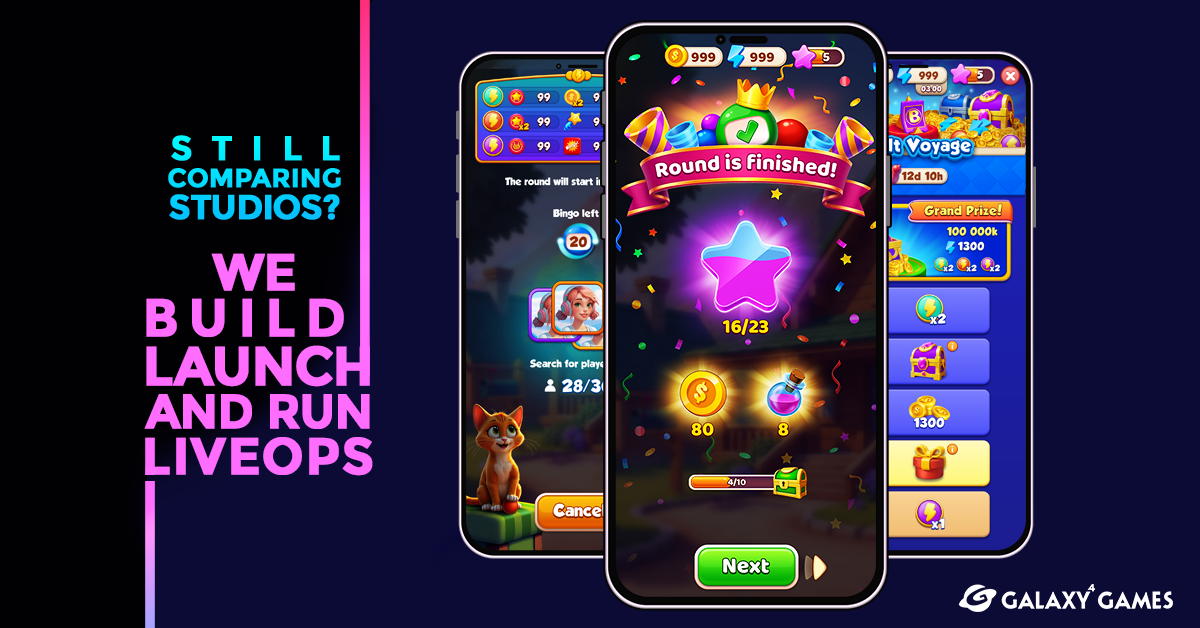
Galaxy4Games
Galaxy4Games occupies a unique position in this category. Most outsourcing studios offer LiveOps as a service. Galaxy4Games has been operating their own live mobile games for over 15 years, including published titles like Animal Sort! (4.9 stars on Google Play), Bingo: Love in Montana, and SaveIT! That operational track record is the foundation of everything they build for clients.
Galaxy4Games provides full-cycle game development and LiveOps services, but the real differentiator is their proprietary LiveOps Framework: a modular, production-tested system with integrated backend analytics, admin panels, and AI-powered optimization tools built for efficient scaling.
What sets Galaxy4Games apart:
-
Proprietary LiveOps Framework with modular architecture, backend analytics, admin panels, and AI tooling built over 15+ years of operating their own games
-
Full-cycle capability from concept and game design through launch, post-launch LiveOps, and ongoing operations
-
Own published live games currently active in stores, meaning every recommendation comes from real operational experience, not theory
-
Modular solutions library that dramatically reduces development time for event systems, economy tools, and content pipelines
-
AI-integrated operations for data analysis, player segmentation, and automated optimization at scale
For studios looking for a partner who has genuinely lived the challenges of live game operation, Galaxy4Games brings a depth of practical expertise that pure service studios cannot replicate. Learn more about their LiveOps services here.
Other Established LiveOps Service Partners
Beyond Galaxy4Games, several studios offer LiveOps as part of their outsourcing services. The quality and depth varies significantly. The key question to ask any service partner is always: do they operate their own live games, or are they applying frameworks learned from client work alone?
Room 8 Group
Room 8 Group is a Cyprus-headquartered co-development studio with 14 years of experience supporting live games across platforms. Their dedicated LiveOps offering covers roadmap planning, KPI management, retention strategy, and monetization, with around-the-clock coverage across time zones for games that can't afford downtime. Room 8 positions their LiveOps teams as a direct extension of the client studio, taking over at launch or during sunset phases so internal teams can focus on new titles.
Best for: Publishers and mid-to-large studios that need a reliable co-development partner to absorb ongoing live operations without disrupting internal development momentum.
Keywords Studios (Sperasoft)
Keywords Studios is one of the largest game services groups in the world, with LiveOps delivered through specialist studios including Sperasoft (US and Europe). Their globally distributed teams work directly from KPI and user data to plan, create, implement, and release live content, handling the ongoing operational load so internal teams can stay focused on new development. The scale of their operation means they have deep cross-genre LiveOps experience across hundreds of titles.
Best for: Large publishers or studios with complex, multi-title LiveOps needs that require a partner with enterprise-scale capacity and global time zone coverage.
Stepico
Stepico is a full-cycle game development studio with over 9 years of dedicated LiveOps experience across mobile, PC, and console titles. Their LiveOps service covers new feature implementation, content development and deployment, bug collection and prompt fixes, and ongoing economy tuning. Stepico offers a dedicated team model, meaning clients pay only for active work time rather than maintaining a standing internal headcount.
Best for: Small to mid-size studios that need a dedicated LiveOps team without the overhead of full-time hires, particularly for mobile titles on iOS and Android.
Choosing the Right Service Partner
When evaluating any LiveOps outsourcing partner, look for:
-
Verifiable published game portfolio in active app stores
-
Dedicated LiveOps team structure (not generalist developers assigned to events)
-
Proprietary tooling or frameworks, not just off-the-shelf platforms
-
References from games that have run live operations for 12 months or more
Category 3: LiveOps Technology Platforms (Infrastructure You Integrate)
These are the backend-as-a-service platforms and SDKs that provide the technical infrastructure for LiveOps. They are tools, not teams. You still need the expertise to configure, operate, and get value from them, but they dramatically accelerate the time to build scalable LiveOps systems compared to building from scratch.
This category is particularly relevant for studios with strong internal engineering teams that want to own their infrastructure, or for teams working with an outsourcing partner who integrates these platforms as part of their stack.
Azure PlayFab (Microsoft)
Azure PlayFab is one of the longest-running and most comprehensive LiveOps backend platforms, having launched in 2014. It provides a full suite of LiveOps tools including Economy v2 (a massively scalable inventory and catalog service), player communication, remote configuration, A/B testing, and real-time automation. PlayFab integrates directly with Microsoft's Azure cloud infrastructure, making it a strong choice for studios that need enterprise-grade scalability.
Best for: Studios that want a proven, enterprise-scale LiveOps backend with strong Microsoft ecosystem integration.
Unity Gaming Services
Unity Gaming Services (UGS) provides backend and LiveOps infrastructure designed to work with any engine, not just Unity. UGS includes remote configuration, economy management, analytics, cloud saves, and leaderboards. Its strength is tight integration with Unity's development ecosystem, making it a natural fit for studios already building on Unity.
Best for: Unity-based studios that want seamless integration between their development environment and live operations infrastructure.
Heroic Labs (Nakama + Satori)
Heroic Labs offers a composable open-source stack built around two core products. Nakama is a scalable open-source backend server for multiplayer and social features, while Satori is their dedicated LiveOps platform providing live events, feature flags, A/B experiments, and real-time data streaming. The open-source approach gives studios full control over their infrastructure, and Heroic Cloud provides managed deployment on GCP or AWS with SOC 2 Type II compliance.
Best for: Studios that want open-source flexibility and full infrastructure control, with optional managed cloud hosting.
brainCloud (bitHeads)
brainCloud is a Backend as a Service (BaaS) platform purpose-built for games and apps. It covers cloud data storage, identity management, analytics, push notifications, economy systems, and leaderboards. At $30/month for entry-level plans, it is one of the most accessible options for indie studios and smaller teams that need a full-featured backend without enterprise pricing.
Best for: Indie developers and smaller studios that need a complete, affordable backend with strong LiveOps capabilities out of the box.
Metaplay
Metaplay is a fully programmable backend platform and SDK specifically designed for live-service Unity mobile games. It includes a pre-built, customizable LiveOps and player management dashboard covering player engagement, retention, and monetization. Metaplay's differentiator is its deep Unity integration and the programmability of its backend, which allows studios to extend and customize every aspect of the system.
Best for: Unity mobile studios that want a deeply customizable LiveOps backend with a built-in management dashboard.
Choosing the Right Platform
|
Platform |
Best Fit |
Open Source |
Managed Cloud |
|---|---|---|---|
|
Azure PlayFab |
Enterprise, multi-platform |
No |
Yes (Azure) |
|
Unity Gaming Services |
Unity-based studios |
No |
Yes |
|
Heroic Labs (Nakama/Satori) |
Full control, multiplayer-heavy |
Yes (Nakama) |
Yes (optional) |
|
brainCloud |
Indie, budget-conscious |
No |
Yes |
|
Metaplay |
Unity mobile, deep customization |
No |
Yes |
Important note: These platforms provide infrastructure, not expertise. Integrating them effectively and using them to run high-performing LiveOps operations still requires significant know-how. Many studios combine a technology platform with an experienced outsourcing partner like Galaxy4Games to get the best of both worlds: proven infrastructure and operational expertise.
How to Choose the Right LiveOps Approach for Your Studio
The three categories above serve very different needs. Here is a practical framework for deciding where to focus.
If you are building your first live-service game
You need a service partner, not a platform. The learning curve for running effective LiveOps from scratch is steep, and the cost of mistakes (player churn, economy imbalance, failed events) is high. Look for a partner with a proven track record of operating their own live games, not just building systems for others.
If you have an internal team and need infrastructure
A technology platform like PlayFab, Unity Gaming Services, or Heroic Labs gives you the backend you need without building from scratch. Budget for integration time and make sure your team has someone who has run live events before, not just built the systems.
If you are scaling an existing live game
This is where the combination approach works best. A strong technology platform handles infrastructure at scale, while an experienced partner like Galaxy4Games handles the operational strategy: event design, economy tuning, player segmentation, and the judgment calls that come from years of running live games.
Key takeaway: The benchmark publishers show you what great looks like. The technology platforms give you the tools. The service partners, especially those with their own live games, give you the expertise to actually execute. Most studios that struggle with LiveOps are using the right tools with the wrong operational approach.
Questions to Ask Any LiveOps Partner
Before signing with any service partner, ask these directly:
-
Do you operate your own live games? Which ones, and how long have they been live?
-
What does your proprietary tooling look like, and what is built on third-party platforms?
-
How many live events has your team run in the past 12 months, across how many titles?
-
What is your process when an event underperforms? Walk me through a specific example.
-
How do you handle economy imbalances discovered mid-event?
How LiveOps Systems Are Built Step by Step
Regardless of which approach you choose, the technical architecture of a scalable LiveOps system follows a consistent pattern. Understanding this helps you evaluate partners and platforms more accurately.
1. Backend Infrastructure Setup
The foundation of LiveOps is a scalable, cloud-hosted backend. This includes servers and cloud infrastructure, databases for player data and game state, and APIs for real-time updates and event delivery. Most studios today use a managed platform (PlayFab, UGS, Heroic Labs) rather than building this from scratch.
2. Remote Configuration System
The single most important LiveOps capability is the ability to change game parameters without pushing an app store update. This means adjusting rewards, changing difficulty curves, launching new events, and modifying pricing, all from an admin panel, in real time. Without this, your team spends engineering cycles on every change instead of focusing on strategy.
3. Analytics Integration
Data collection is what separates reactive LiveOps from proactive LiveOps. Teams track player behavior patterns, retention cohorts, conversion rates by segment, session duration and frequency, and event participation rates. The goal is not just dashboards but actionable signals that drive daily decisions.
4. Event Management System
A dedicated event management system supports creation, scheduling, and monitoring of live events. This includes timed events with automatic start and end triggers, rewards systems and distribution logic, leaderboard infrastructure, and participation tracking by player segment.
5. Monetization Systems
LiveOps monetization goes beyond static IAP catalogs. Dynamic pricing, personalized bundle offers, time-limited sales, and A/B-tested economy changes all require backend infrastructure that can respond to individual player behavior in real time. These systems are continuously optimized based on data, not set-and-forget.
Challenges in LiveOps Implementation
Even with the right tools and partners, LiveOps is operationally demanding. The most common failure points are not technical; they are organizational.
-
Managing system complexity as the number of active events, player segments, and economy variables grows
-
Scaling infrastructure globally without latency or reliability degradation during peak event traffic
-
Maintaining consistent content flow without burning out a small team
-
Balancing the in-game economy when multiple simultaneous events interact in unexpected ways
-
Avoiding player fatigue from event frequency that exceeds what the player base can meaningfully engage with
The most underestimated challenge: Remote configuration tools that let designers launch events without engineering involvement. Studios that lack this capability spend 40 to 60% more time per event cycle on engineering overhead, which directly limits how frequently and ambitiously they can run LiveOps programs.
Successful teams address these challenges through modular system design, clear ownership of LiveOps operations, and data-driven processes that remove guesswork from event and economy decisions.
Final Thoughts
LiveOps is the foundation of modern game success. It transforms games from static products into evolving platforms that grow with their players. But the path to effective LiveOps looks different depending on where your studio is today.
Study the benchmark publishers to understand what great looks like. Evaluate technology platforms to find the right infrastructure for your team's capabilities. And when you need a partner who has actually operated live games at scale, for over 15 years and counting, Galaxy4Games is ready to help.
Our proprietary LiveOps Framework, modular solutions library, and hands-on experience running our own live mobile games means we bring operational expertise to every client engagement, not just technical delivery. If you are building a game that needs to perform beyond launch, we can help you design and implement a LiveOps system built for long-term growth.
Looking for more specialized partners? Check out our list of top LiveOps providers known for innovative solutions.