





How Game Development Companies Are Using AI in 2026
| The State of AI Adoption | Where AI Is Actually Working | How We Use AI at Galaxy4Games | Why Production Architecture Matters | Limitations Honest Studios Acknowledge | Conclusion | FAQ |
AI in game development is no longer a conference panel topic. In 2026, it is a production reality embedded in the workflows of studios ranging from AAA publishers to indie teams, reshaping how games are built, tested, balanced, and sustained post-launch.
The shift has been fast and uneven. Some studios have integrated AI tooling deeply into their pipelines, compressing timelines and reducing costs in measurable ways. Others have adopted surface-level tools without the architectural foundation to make them effective. And a significant portion of the industry is still navigating the gap between what AI promises and what it actually delivers under real production conditions.
The core insight most coverage misses: AI tools deliver their highest value in structured, well-defined production contexts. The studio's architecture determines the ceiling, not the tool.
This article maps the AI landscape as it actually exists in game development today: where it is working, what it is changing, and how production architecture determines how much value any studio can extract from AI tooling. We also share how we apply these principles at Galaxy4Games using our proprietary In-House Technology.
The State of AI Adoption in Game Development
The numbers tell a clear story. According to Google Cloud's 2025 Games Industry Report, conducted with The Harris Poll across 615 developers in the US, South Korea, Norway, Finland, and Sweden:
-
90% of game developers are already using some form of AI in their workflows
-
97% believe generative AI is transforming the industry
-
95% say AI is reducing repetitive tasks, freeing them for more strategic work
-
94% expect AI to reduce total development costs over time
The market reflects this momentum. The global AI in games market was valued at approximately $4.8 billion in 2025 and is projected to reach $22.6 billion by 2034 at a CAGR of 18.8%. In game development specifically, BCG's Video Gaming Report 2026 found that around 20% of new games on Steam disclosed AI use by mid-2025, double the figure from a year earlier, with an estimated 50% of studios now using AI in some capacity.
What this actually means for studios: the question is no longer whether to use AI. It is which applications are mature enough to deliver real production value, and whether your infrastructure is set up to support them.
The Adoption Gap Is Real
Not all AI usage translates into results. Hartmann Capital's Q3 2025 AI Gaming Report found that while AI captured 53% of global VC funding in H1 2025, only 5% of pilot AI projects actually reach production and generate real benefits. The gap between "we use AI tools" and "AI is delivering measurable production value" is where most studios currently sit.
The studios on the right side of that gap share a common trait: they built the architectural foundation before layering in the AI tooling.
Where AI Is Actually Working in Game Development in 2026 six-primary-applications
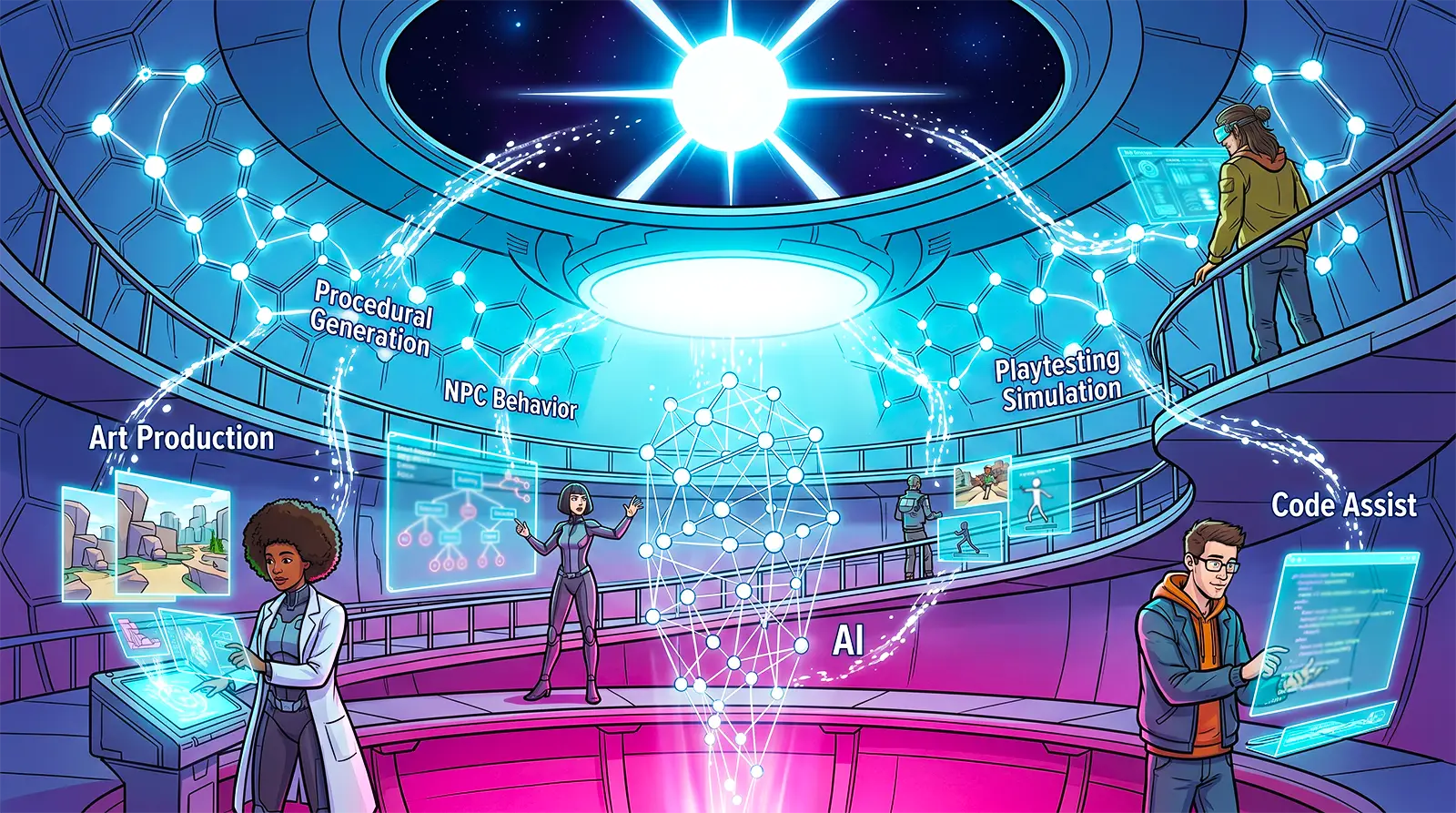
AI in game development is not a single technology. It is a collection of distinct use cases, each with specific production implications, specific limitations, and specific value propositions. Here is where it is working in 2026.
|
AI Use Case |
Maturity Level |
Primary Production Value |
Key Limitation |
|
Procedural Content Generation |
High |
Infinite content variety at low marginal cost |
Quality control requires heavy parameterization |
|
NPC Behavior & AI Characters |
Growing |
Adaptive dialogue, emergent behavior |
LLM costs at scale; coherence guardrails needed |
|
Art Asset Acceleration |
High |
Speed and volume in concepting, textures, animation |
Requires strong art direction to avoid incoherence |
|
QA Automation & Testing |
High |
Surface area coverage impossible for manual QA |
Setup investment; modular codebase required |
|
Game Balance & Economy Tuning |
Growing |
Pre-launch simulation; real-time live data analysis |
Data volume requirements; model training overhead |
|
AI-Assisted Code Generation |
High |
Boilerplate speed; scaffolding efficiency |
Value scales with codebase structure and clarity |
1. Procedural Content Generation
Procedural generation is the oldest intersection of AI and game development, and in 2026 it has reached a level of sophistication that makes it a mainstream production tool rather than a niche technique.
Modern systems go well beyond terrain and dungeon layouts. Studios are using AI-driven procedural generation to create narrative branches, quest structures, dialogue variations, enemy behavior trees, and entire world regions with design intent encoded into the generation parameters.
The production value is significant. A procedural system that generates 10,000 dungeon variations from 200 handcrafted room templates gives players effectively infinite content variety at a fraction of the cost of hand-building each environment. For live games where content freshness is a direct retention driver, procedural generation is increasingly a core infrastructure decision.
The limitation: procedurally generated content that is not carefully parameterized produces inconsistent experiences. The studios getting the most from procedural AI invest as much in the curation and constraint systems as they do in the generation itself.
2. NPC Behavior and AI-Driven Characters
NPC behavior has historically been one of the most labor-intensive and brittle systems in game development. Behavior trees built by hand, tested exhaustively, and still producing edge cases that break immersion at launch.
In 2026, large language model integration and reinforcement learning are changing what is possible. Studios are building NPCs that adapt to player behavior in real time, generate contextually appropriate dialogue without pre-scripted responses, and exhibit emergent behavior that makes the game world feel genuinely alive.
According to the Google Cloud survey, 89% of developers report that AI is already changing what players expect, with 34% noting players now demand smarter, more adaptive NPCs. The commercial implication is real: industry tracking data found that average player session duration on AI-enhanced titles was 23% longer than on comparable non-AI titles.
For mobile games, where NPC sophistication has historically been limited by both technical constraints and development cost, AI-driven character systems are opening up narrative and social experiences that were previously only viable at AAA production scales.
3. Art Asset Acceleration
Art production is one of the most resource-intensive phases of game development. AI-assisted art generation has moved from a controversial experiment to a practical production tool for a significant portion of the industry. By 2025, an estimated 43% of global game developers had used generative AI tools in at least one phase of production, up from just 11% in 2022.
The applications are specific:
-
Concept art and ideation: AI image generation tools have become standard in the early concepting phase at many studios, accelerating iteration from brief to visual reference.
-
Texture generation and variation: AI tools generate texture variants, material alternatives, and environmental details at a speed that would require significantly larger art teams to match manually.
-
Animation assistance: AI-driven motion synthesis and pose estimation tools reduce the pipeline from motion capture to in-game animation, with AI handling interpolation, retargeting, and variation generation.
-
Asset optimization: AI tools for automatic LOD generation, texture compression, and platform-specific asset adaptation reduce the technical art workload.
The important nuance: AI art tools are accelerators, not replacements. The studios using them most effectively are those with strong art direction. Without that human-defined direction layer, AI-generated art produces volume without coherence.
4. QA Automation and Testing
Quality assurance has historically been one of the most expensive phases of game development, scaling directly with game complexity and platform count. AI-driven QA automation is changing that cost structure in meaningful ways.
According to the Google Cloud survey, 47% of developers are already using AI specifically for playtesting and balancing. Leading studios are deploying:
-
Automated playtesting: AI agents that explore edge cases, trigger rare code paths, and identify bugs that human testers would take weeks to find organically, running thousands of test sessions in parallel.
-
Visual regression testing: AI systems that compare game builds frame by frame, automatically flagging visual anomalies and rendering errors.
-
Performance profiling automation: AI-driven tools that identify bottlenecks and memory leak patterns across device configurations at a scale manual profiling cannot achieve.
The production impact is faster release cycles, higher pre-launch quality, and a meaningful reduction in the post-launch bug rate that drives player churn in the critical first weeks of live operations.
5. Game Balance and Economy Tuning
Game economy design has traditionally been a combination of designer intuition and post-launch iteration. AI is changing both sides of that equation.
Simulation tools can model player behavior across millions of virtual sessions before launch, identifying economy imbalances and monetization friction points that would previously only surface after a real player cohort experienced them. Post-launch, machine learning systems analyze live player data to identify balance issues in real time and surface specific tuning recommendations to the design team.
For live mobile games where economy imbalance directly drives churn and monetization underperformance, this capability represents a fundamental improvement in the speed and precision of live operations. Design decisions that previously required weeks of player data and manual analysis can be surfaced in hours.
6. AI-Assisted Code Generation
Code generation tools have become standard in the development workflows of a significant portion of game studios in 2026. For boilerplate code, system scaffolding, and well-defined technical tasks, AI-assisted code generation delivers real productivity gains. The Google Cloud survey found 44% of developers are already using AI for code generation and scripting support.
The more nuanced picture is that code generation tools deliver the most value when they operate within a well-defined architectural context. A developer working within a structured, modular codebase with clear conventions gets significantly more leverage from AI code generation than one working in a loosely organized bespoke codebase.
This dynamic shapes how much value any studio can extract from AI-assisted development, and it is one of the strongest arguments for investing in production architecture before investing in AI tooling.
How We Use AI at Galaxy4Games: Our Three-Layer Framework
We want to be honest about what AI actually does in our production process, because the honest answer is more useful than the marketing answer.
At Galaxy4Games, we use AI as a strategic accelerator layered on top of our proprietary In-House Technology: the Modular Solutions Library, Game Application Template, and LiveOps Framework. The architecture came first. The AI tooling amplifies it.
One thing we want to clarify upfront, because it is a common misconception: when we talk about AI in game development, there are two very different concepts in play.
|
Concept |
What It Means |
Current Reality |
|
Real-Time AI-Generated Worlds |
Games that adapt infinitely in real time, generating content on the fly as players interact |
Technically possible but extremely resource-intensive; hardware, network, and cost limits make it impractical at scale today |
|
Pre-Generated AI Games |
AI builds core content (art, levels, dialogue, sound, mechanics) before release; players receive a finished build |
This is where AI currently delivers real production value, and where we focus |
Our work sits firmly in the second category, with a structured system for how AI integrates into each layer of a game.
The Three-Layer AI Framework
We designed a three-layer system that integrates AI into our modular game development pipeline. Each layer has a specific role, and they work together rather than in isolation.
Layer 1: Gameplay Foundation This is the traditional game layer: engaging mechanics, core gameplay loops, and the foundational systems that make a game run. We build this layer using our Modular Solutions Library, which gives every project a production-ready starting point built from battle-tested components. AI does not replace this layer. It supports the layers above it.
Layer 2: Pre-Generated Content Here, AI tools generate the content that populates the gameplay foundation: visuals, dialogue, quests, sound design, level variations. All of this content must be compatible with Layer 1 mechanics, which is why having a structured, modular Layer 1 matters so much. Without clear parameters, AI-generated content produces volume without coherence. With them, it produces scalable variety at a fraction of the manual production cost.
Layer 3: Player Communication This is where players interact with the game world in ways that go beyond fixed content. Players can make requests to NPCs, create or modify elements, and trigger responses that interact with Layers 1 and 2 to retrieve information, regenerate content, or introduce new mechanics. We are currently implementing Layer 3 in test mode for Skiesverse MMORPG, our large-scale multiplayer title.
AI Agent for LiveOps and Backend Analytics
Beyond the Three-Layer Framework, we have a fourth area of AI application that is specific to how we operate live games. Our LiveOps Framework includes an AI agent that works directly within our backend analytics and LiveOps management tooling.
In practice, this means our team does not sit in front of dashboards manually hunting for signals. The AI agent monitors live player data continuously, flags retention anomalies, surfaces event timing recommendations, and helps prioritize which interventions to run and when. When you are operating multiple live titles and managing ongoing client projects simultaneously, that kind of operational intelligence is not a convenience. It is what makes the difference between reacting to problems and preventing them.
This capability is available to client projects built on our LiveOps Framework, because the infrastructure was designed from day one to expose clean, structured data to analytics and AI layers. It is not something that can be retrofitted onto a game that was not architected for it. The LiveOps Framework is the prerequisite.
AI for Workflow Automation: From Art Creation to QA
Beyond the Three-Layer Framework and our LiveOps AI agent, we use AI as a direct accelerator across the day-to-day production workflows that consume the most time in any studio: art concepts creation, animation, QA, and code scaffolding.
In practice, this means our artists use AI tools to accelerate concepting and asset iteration - working faster without compromising the creative direction that defines each project's visual identity. Our QA process uses AI agents to run automated playtesting and regression checks across builds, covering a surface area that manual testing cannot match at any practical cost. Our engineers use AI-assisted code generation within our modular architecture to handle boilerplate and scaffolding, freeing senior developers for the decisions that actually require judgment.
The important distinction: AI does not replace human creativity in any of these workflows. It handles the repetitive, high-volume, and well-defined tasks so that our artists, designers, and engineers can spend their time on the work that requires genuine creative and technical thinking. The quality bar is still set by people. AI helps us reach it faster.
AI Trained on Our Proprietary Modular Solutions Library
This is where our approach diverges from what other studios describe when they talk about "AI-assisted development." We have trained AI directly on our Modular Solutions Library. That means when a developer needs to implement a feature, AI does not suggest generic code that then needs to be reconciled with our architecture. It suggests the specific modules, methods, and integration patterns from our own proprietary system.
This is not a workflow any studio can replicate by purchasing an AI tool. It is the result of having a mature, documented, battle-tested modular library in the first place, and then doing the work of making that library legible to AI. Most studios do not have the first part. We built it over 15+ years and across our own live titles before we ever layered AI on top of it.
In practice, this means:
-
AI-assisted code generation produces suggestions that are coherent with our existing architecture from the first output, eliminating the review and rework cycle that generic AI code generation typically requires.
-
Procedural content generation integrates directly into our modular content pipeline, with design parameters defined at the system level. The AI operates within a defined production context, not in a vacuum.
-
QA automation tools work against clear, discrete modules with defined interfaces, which improves test coverage and eliminates the false positives that plague AI-driven QA on monolithic codebases.
The result is a compounding efficiency that is specific to our infrastructure: the Modular Solutions Library accelerates AI-assisted workflows, and the AI-assisted workflows accelerate the configuration and customization of modular components. No other studio offers clients this combination, because no other studio has built this particular foundation.
A note on "AI-only" development: We get asked fairly often about building games entirely with AI-generated code. Our honest answer: AI-only development works for rapid prototyping and investor demos. It is not a path to a scalable, maintainable product.
Here is what most founders and investors do not realize until it is too late. AI-generated code produced without proper architecture typically cannot be scaled, extended, or handed to a new team without a full rewrite. That rewrite costs money - often more than building it right the first time would have. For a founder chasing ROI, that is a compounding loss: time spent on a throwaway build, plus the cost of replacing it. For an investor, it means paying twice for the same product.
This is exactly where our Modular Solutions Library and Game Application Template change the equation. Every project we build starts from a production-ready, battle-tested foundation - not a blank slate, and not AI-generated scaffolding that looks functional until it needs to grow. The result is a codebase that is maintainable, extensible, and built to support a live game over time.
The pricing reality is worth stating directly: clients who came to us after paying another studio for a fast AI prototype - something they ultimately had to discard - typically paid about the same amount they would have paid us for a high-quality MVP built on our proprietary In-House Technology. The difference is that our MVP was ready to ship, scale, and operate. Theirs was not.
Why Production Architecture Determines AI Value
The most important insight about AI in game development in 2026 is not about any specific tool. It is about the relationship between AI tooling and the production infrastructure it operates within.
AI tools are pattern-recognition and pattern-generation systems. They work best when the patterns are clear. Production architecture that creates clear patterns, modular systems, defined conventions, structured pipelines, creates the conditions where AI tools can deliver on their promise.
The practical consequence: studios with well-organized, modular production infrastructure extract significantly more value from AI tooling than studios with bespoke, tightly-coupled codebases. The AI amplifies what is already there, and what is already there determines the ceiling.
The Architecture-AI Value Matrix
|
Infrastructure Quality |
AI Code Generation |
Procedural Content |
QA Automation |
Economy Tuning |
|
Modular, well-documented codebase |
High value |
High value |
High value |
High value |
|
Partially modular, mixed conventions |
Medium value |
Medium value |
Medium value |
Medium value |
|
Bespoke, tightly-coupled codebase |
Low value |
Low value |
Low value |
Limited value |
This is why the 5% production success rate from Hartmann Capital's research makes sense. Studios that treat AI as a plug-and-play solution consistently underestimate the integration overhead and overestimate near-term productivity gains. Studios that invest in architecture first, then layer in AI tooling, are the ones generating real results.
What "Architecture-First" Looks Like in Practice
For studios evaluating development partners in the AI era, the right question is not "do they use AI tools?" It is "does their production architecture allow AI tools to deliver real value, and do they have the operational experience to know which tools to use where?"
Specifically, architecture-first means:
-
Modular codebase: systems that can be isolated, tested, and updated independently, which is the prerequisite for effective AI code generation and QA automation
-
Defined conventions: consistent naming, structure, and patterns that give AI tools the context they need to generate coherent suggestions
-
Structured content pipelines: clear parameters for what content looks like, which enables procedural generation to produce quality rather than just volume
-
LiveOps-ready infrastructure: systems designed from day one to support continuous updates, which is where AI-driven economy tuning and balance systems can deliver the most sustained value
Our Game Application Template and Modular Solutions Library create exactly this context. Every client project starts with architecture that was designed for the AI tooling era, not retrofitted for it. The 30-50% development time compression we deliver compared to building from a blank slate comes from this compounding effect.
The Limitations Honest Studios Acknowledge
A complete picture of AI in game development requires acknowledging what AI tools do not yet do well. The gap between the promise and the current reality is where most AI experimentation in game studios fails.
Creative Direction Still Requires Humans
AI tools generate volume efficiently but require human direction to generate quality. A studio without strong creative leadership will produce more mediocre content faster with AI, not better content. This is not a temporary limitation waiting to be solved by the next model release. It is a structural feature of how generative AI works: it optimizes for coherence within a distribution, not for originality or creative vision.
Integration Overhead Is Real
Adopting AI tools into existing production pipelines requires investment in integration, training, and workflow redesign. The Google Cloud survey found that the top challenges developers cite when adopting AI are the cost of integration (24%), the need for upskilling staff (23%), and difficulty measuring success (22%). Studios that treat AI tools as plug-and-play solutions consistently underestimate this overhead.
The honest math: if a tool promises 30% productivity gains but requires three months of integration work and two months of team training, the net-positive timeline is longer than most studios plan for.
Quality Control Cannot Be Automated
AI-generated content, whether art, code, or game systems, requires human review and curation. The studios that get the most from AI tooling are the ones that invest in the quality control layer rather than assuming the generation layer handles it. Removing human review from the pipeline does not save time; it creates expensive rework downstream.
The Legal Landscape Is Still Evolving
The legal landscape around AI-generated game assets, training data, and IP ownership is active and unresolved in multiple jurisdictions. Studios integrating AI into commercial production need legal guidance on how these tools interact with IP, licensing, and platform requirements. This is not a reason to avoid AI tooling, but it is a reason to approach it with proper due diligence rather than assuming existing frameworks apply cleanly.
Fully AI-Generated Games Remain Impractical at Scale
Real-time AI-generated worlds require massive compute power. Running such games, even with cloud infrastructure, is extremely expensive. The ROI model struggles when you have to earn more to pay for the power required to run the game. The more you rely on runtime AI generation, the more you pay for maintenance, and the more you need to think carefully about production expenses.
This is why we, and most studios building commercially viable products, focus on pre-generated AI content rather than runtime generation. The technology for runtime AI worlds is advancing rapidly, but the cost structure does not yet support a viable business model for most games.
Conclusion
AI in game development in 2026 is not a future trend. It is a present production reality that is reshaping how games are built, tested, balanced, and sustained. The studios capturing the most value from this shift are not necessarily the ones with the most advanced AI tooling. They are the ones with the production architecture to support it.
The data makes this clear. Ninety percent of developers use AI in some form. Only 5% of AI pilot projects reach production and generate real benefits. The gap between those two numbers is architecture.
At Galaxy4Games, our proprietary In-House Technology, the Modular Solutions Library, Game Application Template, and LiveOps Framework, creates the structured production context where AI-assisted development delivers genuine efficiency gains. We built the architecture first. The AI tooling amplifies it. And because we also launch and operate our own live titles, we understand the full production lifecycle that AI tools need to support, not just the build phase.
For studios evaluating development partners in the AI era, the question is not just capability. It is architecture. And architecture is where the real competitive advantage lives.
Ready to explore what AI-assisted development looks like within a proven production framework? Get in touch with the Galaxy4Games team for a free consultation.
Sources and Further Reading
-
Google Cloud 2025 Games Industry Report (Harris Poll, 615 developers, August 2025)
-
BCG Video Gaming Report 2026: The Next Era of Growth (Boston Consulting Group, December 2025)
-
AI in Games Market Research Report 2034 (Dataintelo, 2026)
-
The AI Revolution Reshaping Gaming: Q3 2025 Report (Hartmann Capital, October 2025)
-
AI-Powered Game Development: Turning Ideas into Scalable Games (Galaxy4Games, November 2025)
-
How AI Is Transforming Video Game Development (Galaxy4Games, 2025)
Frequently Asked Questions
Code generation: GitHub Copilot and similar AI coding assistants for engineering workflows
Art generation: Leonardo.Ai, Midjourney, and Scenario for concept art and texture production
Sound design: Soundraw and Mubert for AI-generated soundtracks and SFX
NPC and behavior systems: Unity ML-Agents for training adaptive NPCs
ML frameworks: TensorFlow and PyTorch for machine learning-based behavior systems
The right tools depend on the studio's specific production needs, existing infrastructure, and the architectural context in which the tools will operate.