





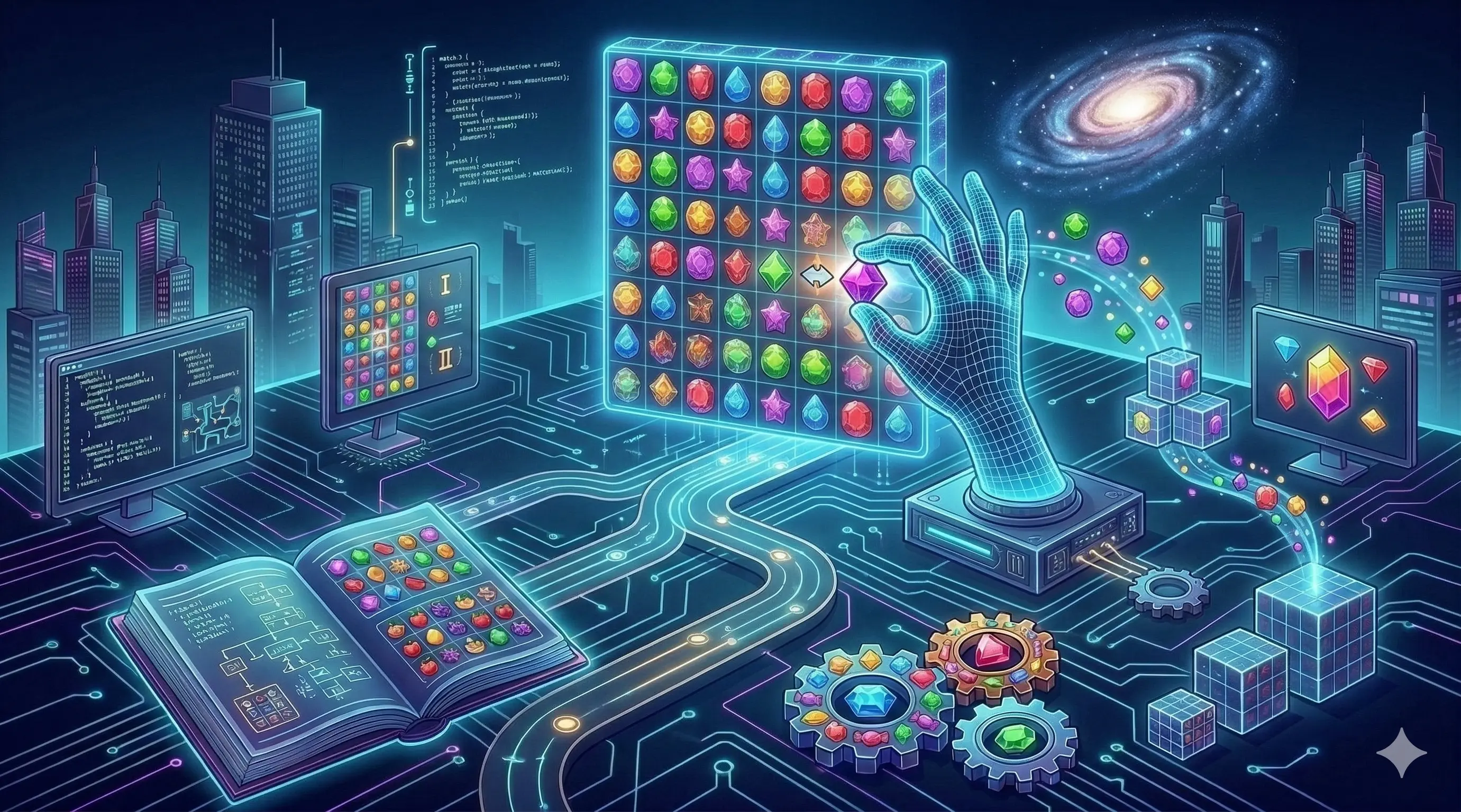
Best Match-3 Game Development Companies in 2026
Match-3 games remain one of the most successful and profitable genres in the mobile gaming industry. Titles like Candy Crush, Gardenscapes, and Homescapes have demonstrated that simple mechanics, when combined with strong LiveOps, well-designed progression systems, and strategic monetization, can generate massive long-term revenue.
In 2026, Match-3 game development services — according to GamesIndustry.biz, one of the most revenue-generating categories in mobile — has evolved far beyond aligning pieces on a board. Leading studios now build complete product ecosystems powered by scalable content pipelines, virtual economies, behavioral design, advanced analytics, and continuous LiveOps.
This article explains what defines the best Match-3 game development companies, how they build successful products step by step, the key systems behind their performance, and how to choose the right partner.
Why Match-3 Games Continue to Dominate Mobile Gaming
The success of Match-3 games is driven by a unique balance of accessibility and depth.
Key reasons include:
-
Extremely simple and intuitive mechanics
-
Minimal onboarding friction
-
Short, mobile-friendly sessions
-
Strong long-term retention systems
-
Scalable content (thousands of levels)
-
Broad audience appeal, including non-gamers
Players can start instantly, but the design keeps them engaged for months or even years.
What Defines a Great Match-3 Game Development Company
Top companies don’t just design puzzles. They design systems.
They excel in:
-
Advanced level design systems
-
Scalable content pipelines
-
LiveOps infrastructure
-
Monetization balancing
-
Retention optimization
-
Data-driven iteration
-
Scalable backend architecture
In this genre, success depends more on systems than on core mechanics.
Top Match-3 Game Development Companies in 2026
To provide a clearer and more useful overview of the market, it’s important to distinguish between two types of companies:
-
Companies that dominate the genre with their own products
-
Companies that offer Match-3 game development services (outsourcing or co-development)
This helps clarify who sets the benchmark and who can actually build your product.
A. Market Leaders (Product Companies & Benchmarks)
These companies define the Match-3 genre through their own successful titles. They typically do not offer outsourcing, but they serve as key references.
1. King
King remains one of the most influential companies in Match-3 gaming. Their titles set global standards in level design, monetization, and LiveOps.
Best for: Benchmarking retention and monetization
Strength: Advanced LiveOps and data-driven optimization
Note: Does not offer outsourcing
2. Playrix
Playrix transformed the genre by integrating narrative-driven meta systems with puzzle gameplay.
Best for: Meta systems and storytelling
Strength: Emotional engagement and long-term retention
Note: Serves as a benchmark, not a service provider
3. Zynga
Zynga focuses on analytics, monetization, and scalable systems.
Best for: Data-driven optimization
Strength: Monetization and segmentation
4. Jam City
Jam City combines Match-3 gameplay with storytelling and IP integrations.
Best for: Hybrid and branded experiences
Strength: Narrative-driven design
B. Match-3 Game Development Companies (Outsourcing & Co-Development)
These are the companies you can partner with to build Match-3 games.
5. Galaxy4Games
At Galaxy4Games, we develop Match-3 games using modular and scalable systems designed for long-term performance.
Best for: End-to-end Match-3 development
Strength: Modular architecture, LiveOps readiness, and monetization optimization
Our capabilities include:
-
Scalable level generation systems
-
LiveOps-ready architecture
-
Data-driven balancing tools
-
Modular gameplay systems
-
Monetization optimization frameworks
This approach ensures products are built for growth, not just launch.
6. Whimsy Games
Casual and puzzle-focused studio with experience in mobile-first Match-3 production.
Best for: Casual and puzzle outsourcing
Strength: Flexible production and mobile expertise
Capabilities:
-
Casual and puzzle game production pipelines
-
Mobile-first development workflows
-
UI/UX design for casual games
-
Cross-platform deployment (mobile/web)
-
Integration with basic LiveOps features
7. SolarSpark
Growing studio recognized in industry publications, with a collaborative co-development approach.
Best for: Co-development and scalable production
Strength: Collaboration and industry visibility
Capabilities:
-
Co-development for mobile and PC games
-
Scalable production support
-
Integration with existing game systems
-
LiveOps support and content updates
-
Flexible collaboration models for studios and publishers
SolarSpark is a growing game development company that has been featured in multiple industry articles and recognized for its collaborative work in game production.
Best for: Co-development and scalable game production
Strength: Strong collaboration approach and increasing industry visibility
8. Other Outsourcing Studios
Depending on the project, companies may also consider studios specializing in:
-
Casual game development
-
Mobile puzzle outsourcing
-
LiveOps support
When evaluating partners, focus on:
-
Scalable content experience
-
LiveOps capabilities
-
Analytics integration
-
Monetization expertise
How Match-3 Games Are Built Step by Step
1. Core Gameplay Design
Defines the base mechanics:
-
Match rules
-
Tile types
-
Power-ups
Small changes here can significantly impact retention.
2. Level Design System
Top games require thousands of levels.
Studios build tools to:
-
Generate levels efficiently
-
Control difficulty curves
-
Optimize progression
3. Meta Systems and Progression
Includes:
-
Story
-
Customization
-
Resources
-
Unlockables
These systems increase long-term engagement.
4. Monetization Integration
Monetization is designed from day one.
Includes:
-
Boosters
-
Extra moves
-
Lives systems
-
Dynamic offers
5. LiveOps Implementation
Ensures continuous updates:
-
Events
-
Seasonal content
-
Rewards
Core Systems Behind Success
Content Scalability
Without new levels, games fail.
Retention
Driven by:
-
Daily rewards
-
Streaks
-
Unlock systems
Monetization
Balance is critical to avoid churn.
LiveOps
Keeps the game dynamic and evolving.
Monetization Deep Dive
Match-3 games succeed due to:
-
Microtransactions
-
Emotional investment
-
Friction-based design
-
Time-limited events
This creates high LTV.
The Role of Data
Match-3 development is highly data-driven.
Key metrics:
-
Level completion
-
Drop-off
-
Conversion
-
ARPU / LTV
A/B testing is essential.
Challenges in Match-3 Development
-
Content production at scale
-
Difficulty balancing
-
Player fatigue
-
Monetization fairness
Why Modular Architecture Matters
Modular architecture is not just about scalability—it directly impacts efficiency, product quality, and long-term growth.
Key benefits include:
-
Standardization across multiple products
When the same modules are reused across different games, it becomes significantly easier to manage, update, fix, and optimize systems. This is especially valuable for studios operating multiple titles simultaneously. -
Faster support and maintenance
Shared systems allow teams to resolve issues and deploy improvements across multiple products at once, reducing operational complexity. -
Battle-tested solutions
Instead of building systems from scratch, modular components are already tested in live products. This reduces development risks, minimizes errors, and accelerates production timelines. -
Reduced development costs and time
Reusing proven systems eliminates redundant work and allows teams to focus on innovation rather than rebuilding core mechanics. -
Improved LiveOps execution
Modular systems make it easier to launch events, update content, and optimize gameplay without heavy engineering effort.
At Galaxy4Games, modular architecture is a core part of how we build Match-3 games, ensuring that every system is scalable, maintainable, and optimized for long-term performance.
Final Thoughts
Match-3 games continue to dominate because they combine simplicity with powerful systems for retention and monetization.
At Galaxy4Games, we build scalable Match-3 games using modular systems, data-driven optimization, and long-term product strategies. If you’re looking to develop a competitive puzzle game, we can help you build a product designed to grow.