





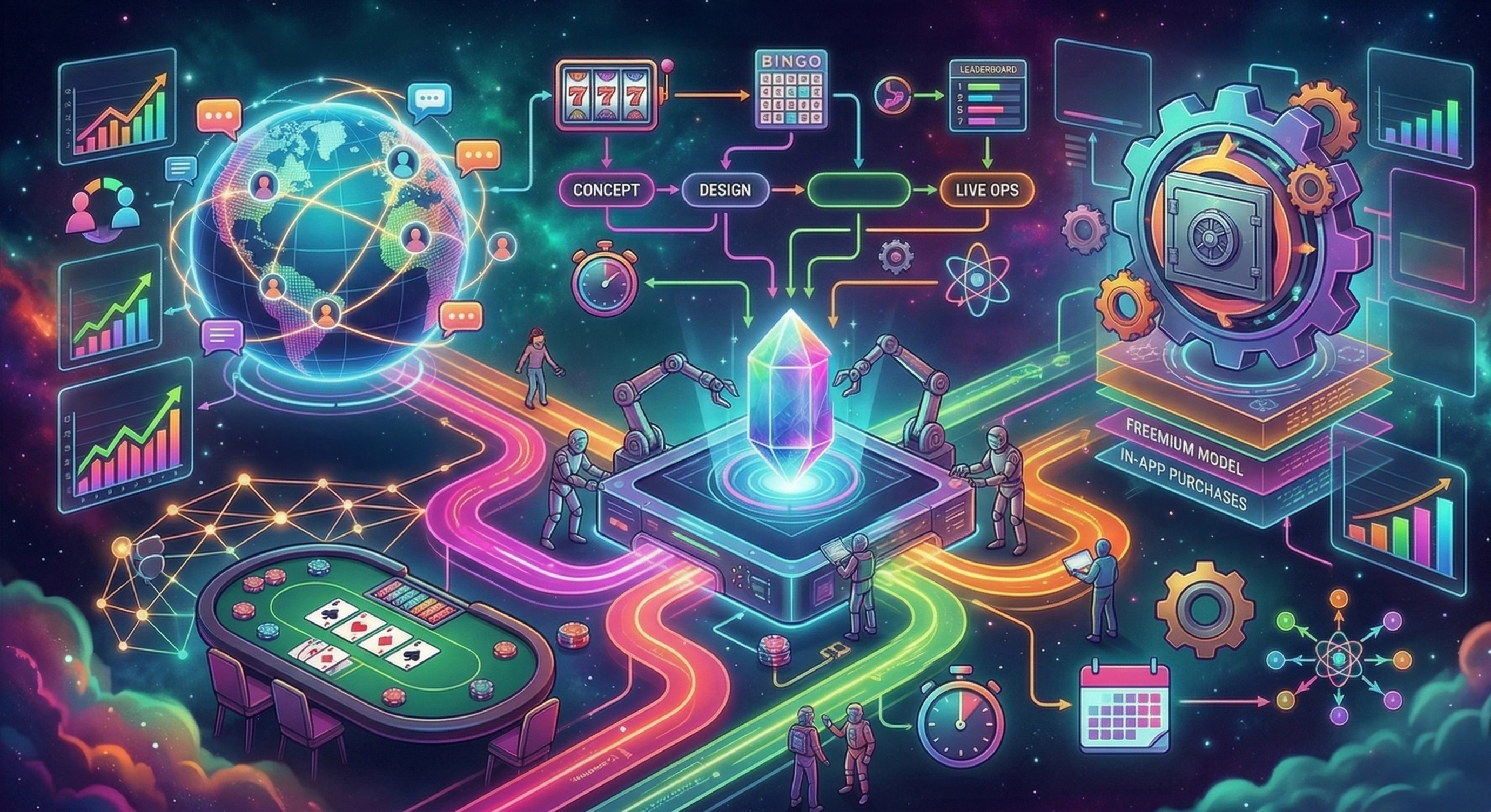
Social Casino Game Development: How It Works and Why It’s Growing
Social casino games have become one of the most profitable and scalable segments within the mobile gaming industry. Unlike traditional real-money gambling platforms, social casino games simulate casino experiences such as slots, poker, blackjack, and roulette without offering direct cash payouts. Instead, they rely on virtual economies, in-app purchases, and engagement-driven design to generate revenue.
In 2026, this category continues to grow rapidly due to its accessibility, strong retention mechanics, and highly optimized monetization systems. For companies exploring game development opportunities, social casino games represent a unique intersection of entertainment, psychology, and scalable business models.
This guide explains how social casino game development works, what makes these games successful, and why they continue to expand globally.
What Is Social Casino Game Development?
Social casino game development refers to the process of designing and building games that replicate casino-style mechanics in a free-to-play environment. These games are typically available on mobile devices, web platforms, and social networks.
Players use virtual currency instead of real money, but they can purchase additional chips, spins, or in-game items to continue playing or enhance their experience.
Common types of social casino games include:
-
Slot games
-
Poker (Texas Hold’em, tournaments)
-
Blackjack
-
Roulette
-
Bingo and casual casino hybrids
The key difference from traditional gambling is that players are not withdrawing real winnings, which simplifies regulatory requirements in many markets while still allowing strong monetization.
Why Social Casino Games Are Growing
The growth of social casino games is driven by several factors.
First, accessibility. These games are easy to understand and require minimal onboarding, making them attractive to a wide demographic, including non-traditional gamers.
Second, retention mechanics. Social casino games are designed around continuous play loops, rewards, and progression systems that encourage daily engagement.
Third, monetization efficiency. The combination of virtual economies and behavioral design leads to high lifetime value (LTV) per user.
Finally, scalability. These games can operate globally with relatively low content complexity compared to other game genres.
Core Mechanics Behind Social Casino Games
Successful companies that build social casino games rely on a set of core mechanics that drive engagement and retention.
1. Reward Loops and Progression
Players are constantly rewarded through spins, wins, bonuses, and achievements. Even when outcomes are randomized, the perception of progress is maintained through:
-
Daily rewards
-
Bonus rounds
-
Level progression
-
Unlockable features
These systems create a sense of momentum that keeps players returning.
2. Virtual Economy Systems
The virtual economy is the backbone of social casino games. Players earn and spend virtual currency, which can be replenished through gameplay or purchased via in-app purchases.
A well-balanced economy ensures that:
-
Players do not churn too quickly
-
Spending feels optional but valuable
-
Progression remains achievable
3. Psychological Engagement Design
Social casino games are heavily influenced by behavioral psychology. Elements such as anticipation, near wins, and variable rewards are used to increase engagement.
Key techniques include:
-
Variable reward schedules
-
Visual and audio feedback
-
Streak systems
-
Limited-time offers
These features create emotional engagement without requiring complex gameplay.
4. LiveOps and Content Updates
LiveOps plays a major role in social casino success. Social casino game development companies focus on making regular updates keep the experience fresh and encourage continued spending.
Common LiveOps strategies include:
-
Seasonal themes
-
New slot machines or game modes
-
Limited-time events
-
Special promotions and bonuses
Games that actively use LiveOps outperform static titles in both retention and revenue.
Monetization Strategies in Social Casino Games
Social casino games are among the highest-performing monetization models in mobile gaming.
In-App Purchases
The primary revenue source is the sale of virtual currency or bundles. These often include:
-
Coin packs
-
Booster bundles
-
VIP memberships
-
Limited-time offers
Ads Integration
While less dominant than IAP, ads are still used, especially rewarded ads that offer players additional currency.
VIP and Loyalty Systems
High-value players are often segmented into VIP tiers with exclusive rewards, personalized offers, and faster progression.
Time-Limited Promotions
Urgency-driven offers significantly increase conversion rates and average revenue per user (ARPU).
Technology Behind Social Casino Development
Modern social casino games require scalable and reliable infrastructure.
Typical tech stack includes:
-
Unity or custom game engines
-
Cloud-based backend systems
-
Real-time data analytics
-
Payment integrations
-
LiveOps management tools
Performance and scalability are critical, as these games often support large global audiences. According to GamesIndustry.biz, social casino remains one of the top-grossing categories on both iOS and Android.
The Role of Data and Optimization
Data plays a central role in social casino game development. The global social casino market is expected to surpass $9 billion in 2026, according to Newzoo. Developers continuously analyze player behavior to optimize:
-
Retention rates
-
Conversion rates
-
Session duration
-
Monetization funnels
A/B testing is commonly used to refine pricing, rewards, and gameplay mechanics.
Challenges in Social Casino Game Development
Despite its success, this segment presents challenges.
-
Balancing monetization without harming user experience
-
Avoiding player fatigue
-
Maintaining long-term engagement
-
Managing virtual economy inflation
Studios that rely on data-driven decisions and modular systems are better equipped to address these challenges.
The Importance of Scalable Architecture
Social casino games must be built for long-term growth. Modular development allows studios to:
-
Add new games quickly
-
Update content without full rebuilds
-
Test monetization strategies
-
Scale infrastructure as users grow
At Galaxy4Games, we design social casino systems using modular frameworks that support LiveOps, monetization flexibility, and global scalability.
Final Thoughts
Social casino game development represents one of the most scalable and profitable opportunities in the gaming industry today. By combining simple mechanics, strong psychological engagement, and advanced monetization systems, these games achieve high retention and long-term revenue growth.
At Galaxy4Games, we build social casino experiences with scalable architecture, data-driven optimization, and LiveOps-ready systems. If you’re looking to enter this high-growth segment, our team can help you design and launch a product built for performance and expansion.