

Entry Points into Gaming for First-Time Founders in 2026: How to Make It Right
Every week, thousands of new games hit the app stores. AI-assisted development has compressed timelines that used to take months down to weeks, and the volume of new releases is only accelerating. Most first-time founders look at that stat and feel a knot in their stomach.
We look at it and see a wide-open door.
Here is the thing most people get wrong about the AI wave in gaming: they frame it as a competitive threat when it is actually the best market condition for a first-time founder in years. The cost of testing a game idea has dropped dramatically. The time between "concept" and "real player feedback" has shrunk. And the studios that have spent years building the technological infrastructure that AI pipelines run on top of? They can now move faster than ever before, with more precision, at a fraction of the previous cost.
The real question is not whether to enter the gaming market. It is how to enter it without burning your budget on infrastructure that already exists.
If you are a first-time founder looking at gaming in 2026, this is what you actually need to understand before you make your first move.
Everyone Sees the Flood. Few See What It Actually Means.
Yes, more games are being published than ever before. AI tools have made it faster to generate assets, write dialogue, prototype mechanics, and even generate code scaffolding. The barrier to getting something on the screen has never been lower.
But here is what that actually creates for a smart founder: a market full of noise, and a massive premium on signal.
Players are not going to stop playing games because there are more of them. The global gaming market is projected to surpass $300 billion by 2027, driven by mobile growth, new markets, and deeper monetization in live games. More games entering the market does not shrink that pie. It just means the games with better retention, better monetization, and better LiveOps will capture a disproportionate share of it.
What the AI flood actually filters out
The games that AI tools produce quickly, without a real foundation underneath them, tend to share a few characteristics:
-
Thin mechanics with no long-term retention loop
-
No LiveOps infrastructure, so there is nothing to update after launch
-
Poor analytics integration, meaning the developer cannot tell what is working
-
Generic feel, because they were built on the same templates everyone else is using
This is not your competition. This is the noise that makes your signal clearer.
A well-built game, built on proven infrastructure, with real retention mechanics and a LiveOps-ready architecture, stands out more today than it did five years ago. Not less.
The Real Advantage AI Gives First-Time Founders
Here is the part of the AI story that actually matters for you as a first-time founder: AI has dramatically reduced the cost of being wrong.
In the old model, testing a game idea meant committing months of development and significant budget before you had any real signal from players. By the time you discovered that your core mechanic did not work, or that your target audience was not responding, you had already spent most of your runway.
AI-assisted development changes that math. Prototypes that used to take 3-4 months can now be built in weeks. Concept validation is cheaper. Iteration cycles are faster. You can test multiple ideas in the time it used to take to build one, and make decisions based on real data instead of assumptions.
What this means for your strategy
For a first-time founder, this is a genuine strategic advantage. You can:
-
Validate before you commit - test core mechanics with a lightweight prototype before investing in full production
-
Fail fast and cheaply - learn what is not working before it costs you six months and $200K
-
Run parallel experiments - explore two or three concept directions at a fraction of the historical cost
-
Enter the market sooner - compress the time between idea and first real player feedback
The cost of a bad bet has dropped significantly. That is not just good news for your budget. It changes the entire risk profile of entering gaming as a first-time founder.
But here is the catch that almost no one talks about.
AI Is a Tool. Infrastructure Is the Foundation.
AI tools are powerful. But they are tools. They accelerate work. They do not replace the foundation that work needs to run on.
A developer who picks up an AI coding assistant today can generate game code faster. But if they are building on a blank slate, without a battle-tested architecture, without proven monetization modules, without a LiveOps framework already in place, they are still starting from zero. The AI just helps them get to zero faster.
This is the distinction that matters most when you are evaluating a game development partner.
What 15 Years of Building Actually Produced — and Why It Cannot Be Replicated Overnight
The infrastructure that makes a game a business, not just a product, takes years to build and refine. It is not something you can generate with a prompt. Galaxy4Games In-House Technology includes:
|
Component |
What it does |
|---|---|
|
Core architecture, platform integrations, and store compliance already built and tested |
|
|
Ready to use game features: game mechanics from match3 to rpg systems, UI systems, event engines, monetization modules, progression frameworks |
|
|
Architecture that supports continuous updates, in-game events, and long-term player retention from day one with admin site panel, analytics backend |
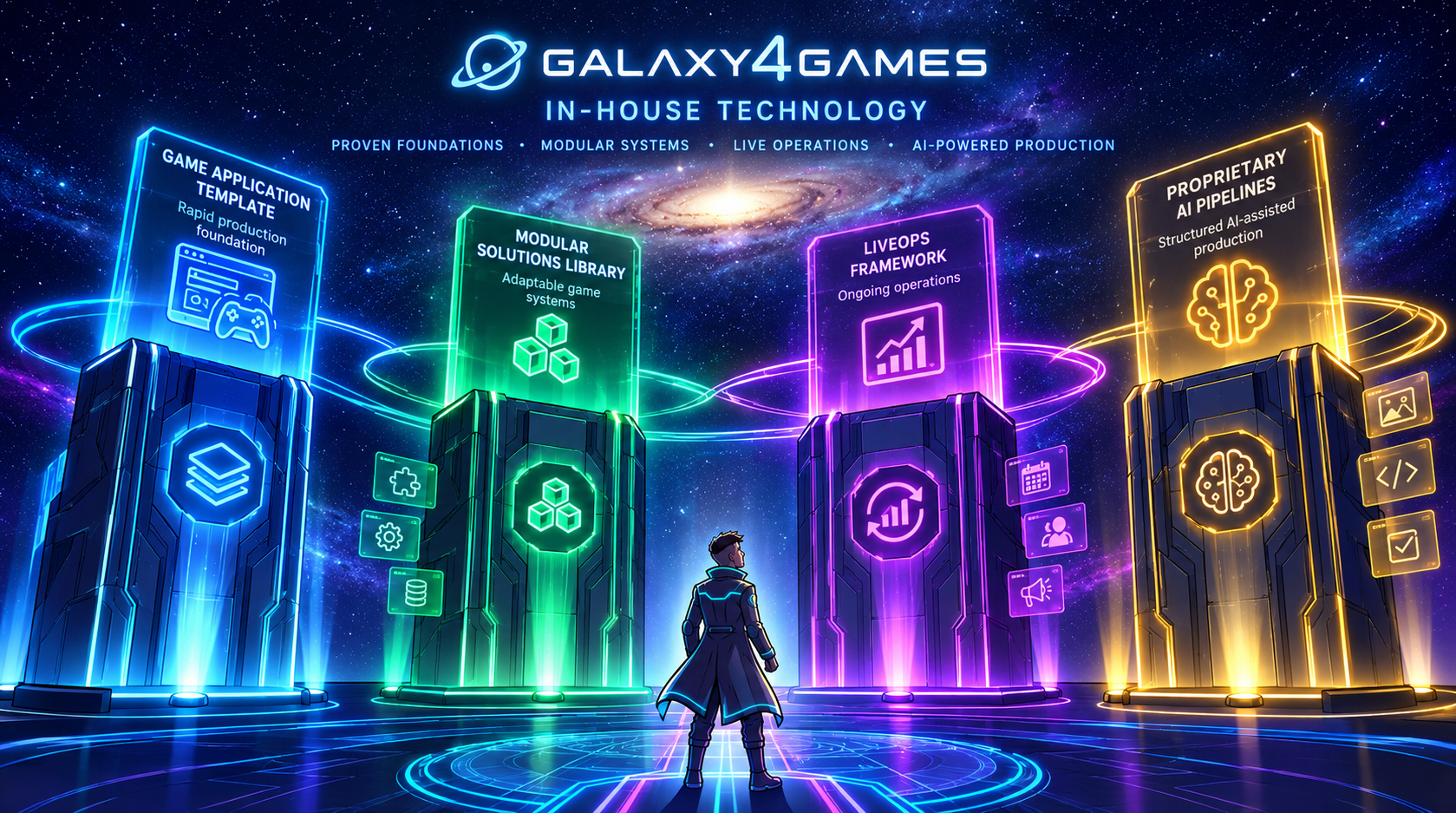
At Galaxy4Games, we spent 15+ years building and operating live games on the App Store and Google Play to arrive at this foundation. That experience is encoded in every component. Our AI pipelines run on top of this infrastructure, which means we are not using AI to compensate for a weak foundation. We are using it to move faster on top of a strong one.
That combination is what compresses development time and costs by 30-50% compared to building from scratch, without trading away quality.
This is also why the studios that never built anything of their own are struggling right now. Game outsourcing companies that only delivered client work, without ever launching, operating, or scaling a live title, do not have this foundation to draw from. AI tools do not fill that gap. They accelerate whatever is already there. If what is already there is thin, AI just helps you build something thin, faster.
Where AI-Shrunk Timelines Should Not Be Overestimated
AI has genuinely compressed certain parts of game development. But there is a version of the AI pitch that first-time founders should be careful about, because it sets expectations that the market will correct quickly and expensively.
A prototype is not a product
If your game was not built on a modular, production-ready, scalable foundation from day one, the prototype you ship is likely the ceiling, not the floor. LiveOps is not a feature you add later. Managing a game in production is not a one-time task. Analytics integration is not a launch-week tweak. These are ongoing, operational disciplines that have to be architected into the game from the beginning. If they are not, you are not looking at a product you can grow. You are looking at something you will eventually throw away and rebuild.
This is the part of the AI story that tends to get skipped: the tools that help you build faster do not automatically produce something that survives contact with a live player base.
AI pipelines do not shrink the team to one developer
If a studio is promising you a full game from a single developer powered by AI, be prepared to be disappointed. One developer can absolutely vibe-code a prototype. What they cannot do is deliver the technological foundation that provides quality, cuts timelines, controls costs, and produces a scalable product, because that foundation is built by a professional senior team over years, not generated by a prompt.
Beyond the build itself, a game that is meant to run long-term still needs:
-
QA - thorough, systematic, not a single pass before submission
-
Art and animation polishing - AI-generated assets are a starting point, not a finish line
-
LiveOps expertise - planning, executing, and iterating on in-game events and content updates
-
Analytics interpretation - knowing what the data is telling you and acting on it continuously
None of these collapse to one person with an AI subscription. If you are in this for the long run, the team behind your game matters as much as the tools they use.
The right question is not "how fast can we build this?" It is "what does this need to look like six months after launch?" Build backwards from that answer.
How to Choose a Game Development Partner in the AI Era
The market is full of studios that now claim AI-powered development. That claim is easy to make. The right questions cut through the noise quickly.
Ask about their own games, not just their clients' games
There is a meaningful difference between a studio that builds games for clients and a studio that also builds, launches, and operates its own live titles. The second type has skin in the game. They know what post-launch actually demands, because they live it. They have made the real decisions around retention, monetization, LiveOps event strategy, and store compliance, not as a vendor delivering a project, but as an operator who needs the game to perform.
Ask any potential partner: do you have your own games live in the App Store or Google Play right now? The answer tells you a lot.
Ask what their AI actually runs on top of
Any studio can say they use AI in their pipeline. The question is what that pipeline is built on. Probe for specifics:
-
What is your core development architecture?
-
How long has your modular component library been in production?
-
How do you handle LiveOps after launch?
-
Can you show me a game you built and still operate today?
A studio that cannot answer these questions concretely is using AI as a marketing claim, not an operational advantage.
Watch for the red flags
-
No live games of their own (client portfolio only, no own titles)
-
Vague timelines with no explanation of how they achieve them
-
No mention of analytics, retention, or post-launch support
-
"We use AI" without any explanation of what that means technically
The right partner does not just build your game. They help you launch it, operate it, and grow it, from a foundation that was already proven before your project began.
Choosing well here is the highest-leverage decision you will make as a first-time founder in gaming.
Now Is the Time. Enter Smart.
The AI wave is not a reason to wait. It is a reason to move, with the right partner, right now.
The cost of testing a game idea is lower than it has ever been. The market is bigger than it has ever been. And the gap between a game built on a proven foundation and a game generated on a thin one is more visible than it has ever been, because players have more choices and less patience for games that do not hold their attention past day three.
First-time founders who move now, with a partner who brings real infrastructure, real operator experience, and real AI integration, are not entering a crowded market. They are entering a market where the noise is louder than ever, and the signal is worth more because of it.
The flood is not the threat. Building on the wrong foundation is.
Ready to test your game idea without burning your runway? Let's talk about what it actually takes to build and launch your first game.