





Market State and Best Mobile Game Outsourcing Companies for US Studios (2026)
The US mobile game market in 2026 is not a growth story built on volume. Downloads are declining, attention is harder to win, and IAP revenue from non-game apps surpassed games for the first time in 2025. The titles generating sustained revenue are not the ones with the biggest launch spikes - they are the ones built to retain, monetize, and operate over time.
That shift changes what an outsourcing partner needs to be. A studio that ships and steps back is not enough. US founders and producers need external partners that understand LTV-driven development, IAP architecture, soft launch analytics, and LiveOps operations from day one - partners that think in the same metrics you do.
This guide covers the strongest external game development outsourcing partners for US studios in 2026, evaluated on mobile capability, LiveOps readiness, monetization depth, and fit for studios at different production stages.
The State of the US Game Market
Market Size and Scale
The US is the single largest national mobile game market on the planet. According to Sensor Tower's State of Gaming 2026 report, 2025 marked a third consecutive year of revenue growth across the App Store and Google Play. Global consumers spent approximately $85 billion in apps in 2025, a striking 21% year-on-year increase and 2.8x the amount spent five years earlier. The US ranked second globally by mobile game IAP revenue, sitting above every European market and behind only China Mainland.
The deal flow reflects that maturity. Scopely paid $3.5 billion for Niantic in 2025, adding Pokémon Go's LiveOps infrastructure to a portfolio that already included Marvel Strike Force and Stumble Guys. Magic: The Gathering Arena generated $56 million in 2025 on a title that launched in 2021, proof that well-operated live games compound in value long after launch.
The Monetization Shift
2025 was a year of divergence, and the US numbers tell the story clearly. According to Sensor Tower's State of Gaming 2026, downloads fell while time spent in the US actually rebounded after 2024 declines. Revenue held up. The market is not shrinking; it is consolidating around titles that retain and monetize well over time.
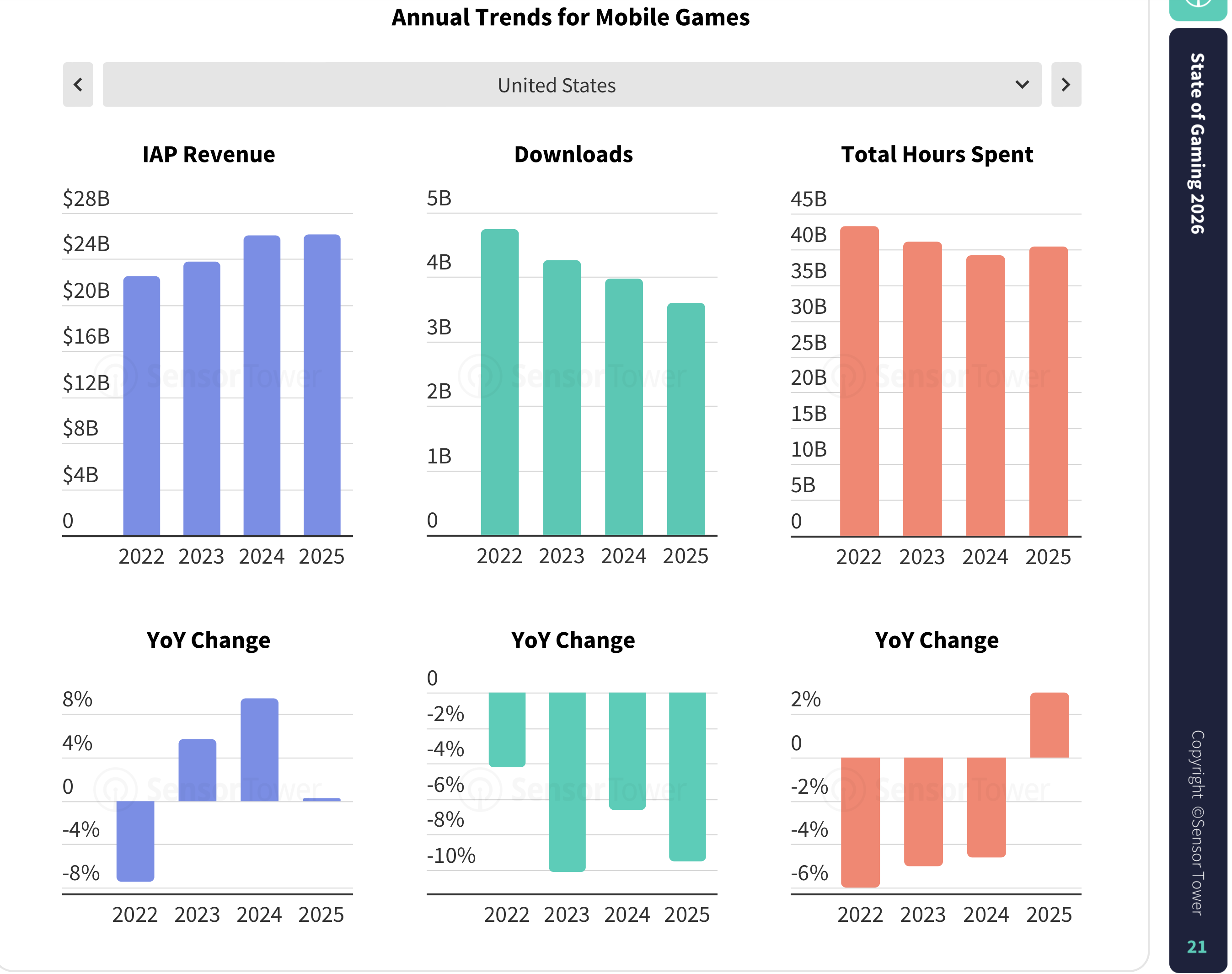
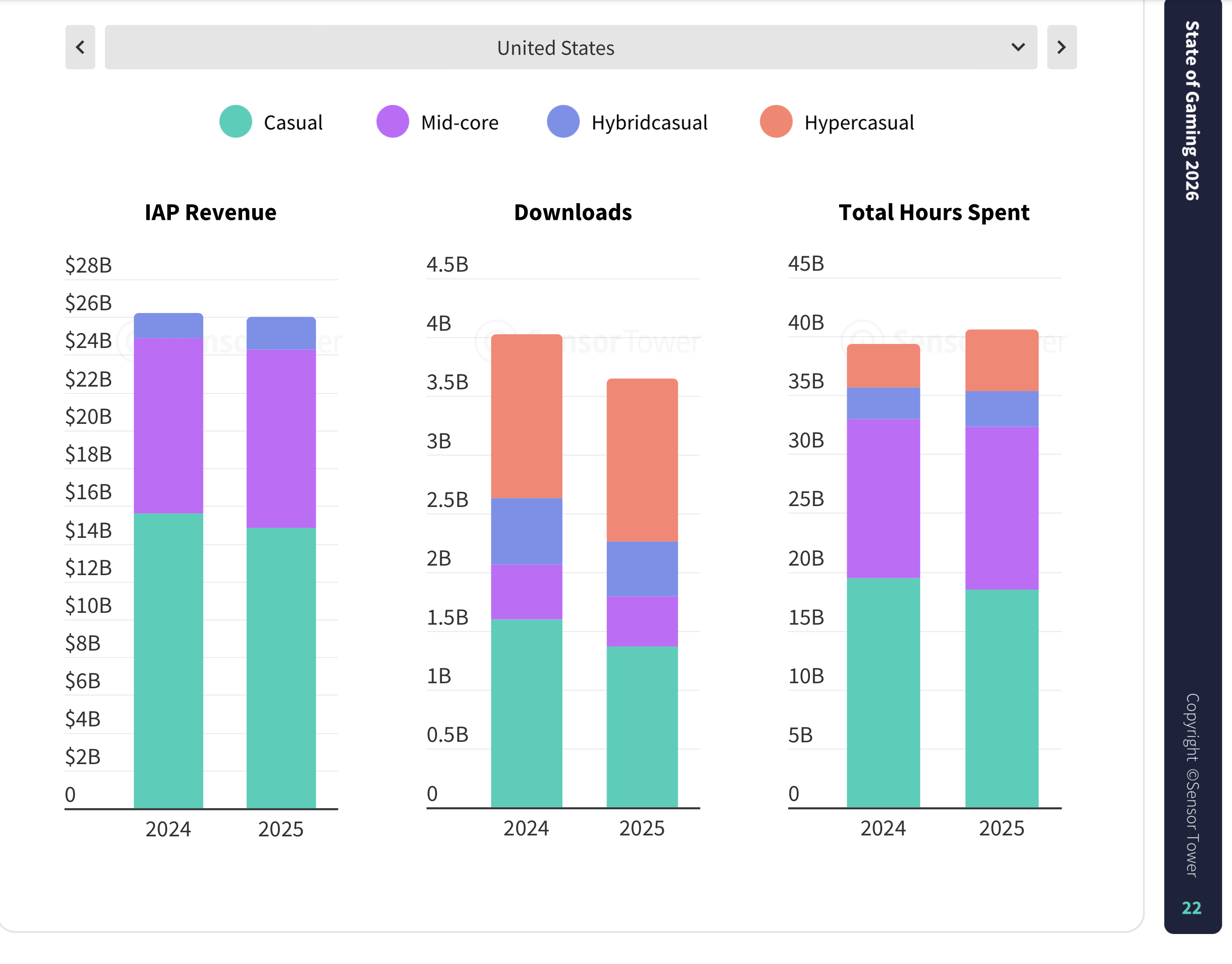
The genre-level picture sharpens that signal further:
-
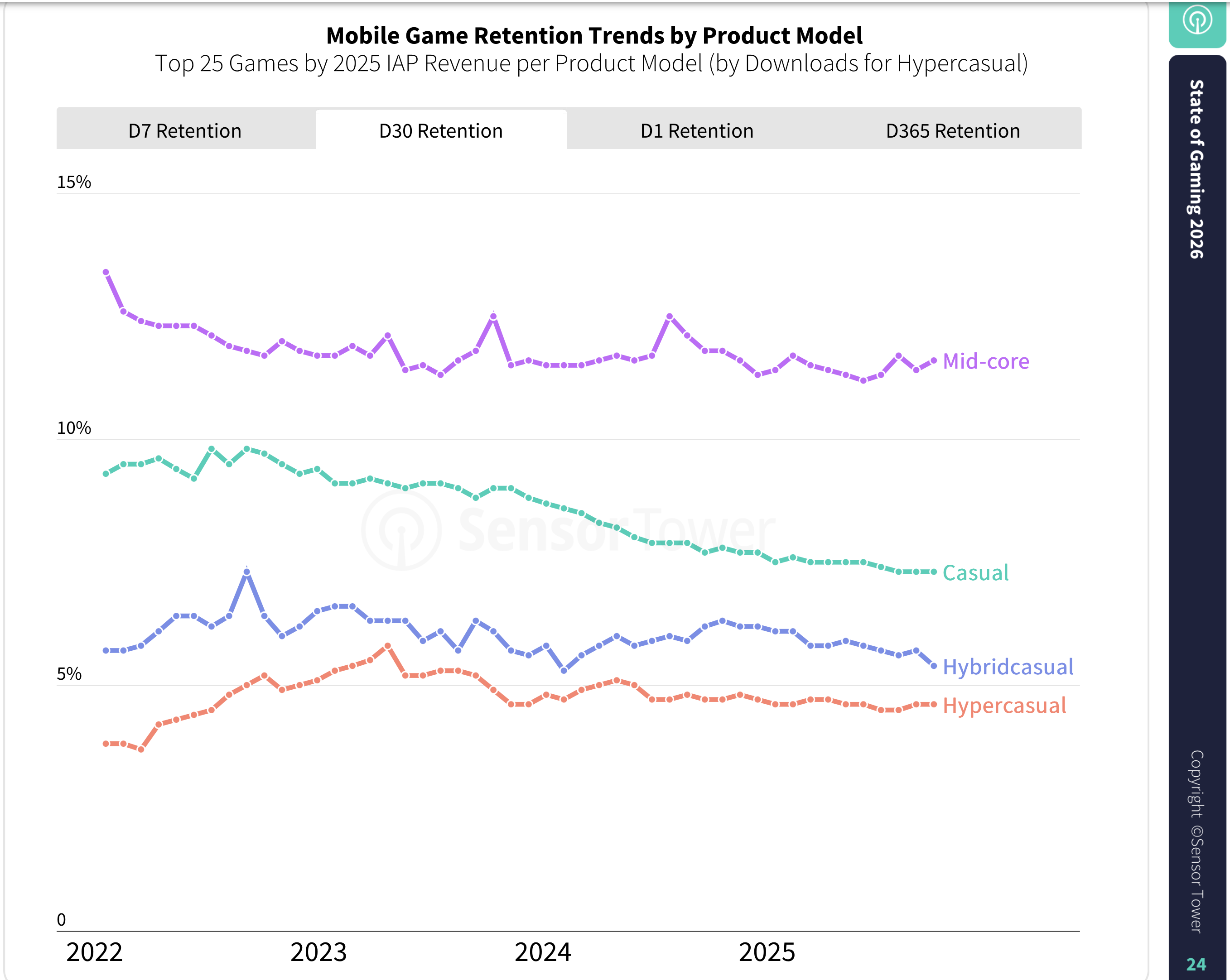
Hybridcasual was the standout monetization gainer in 2025, with revenue up sharply while Casual and Mid-core were essentially flat.
-
Hypercasual was the only model to post download growth, but engagement surged across major markets including the US, Japan, and Western Europe.
-
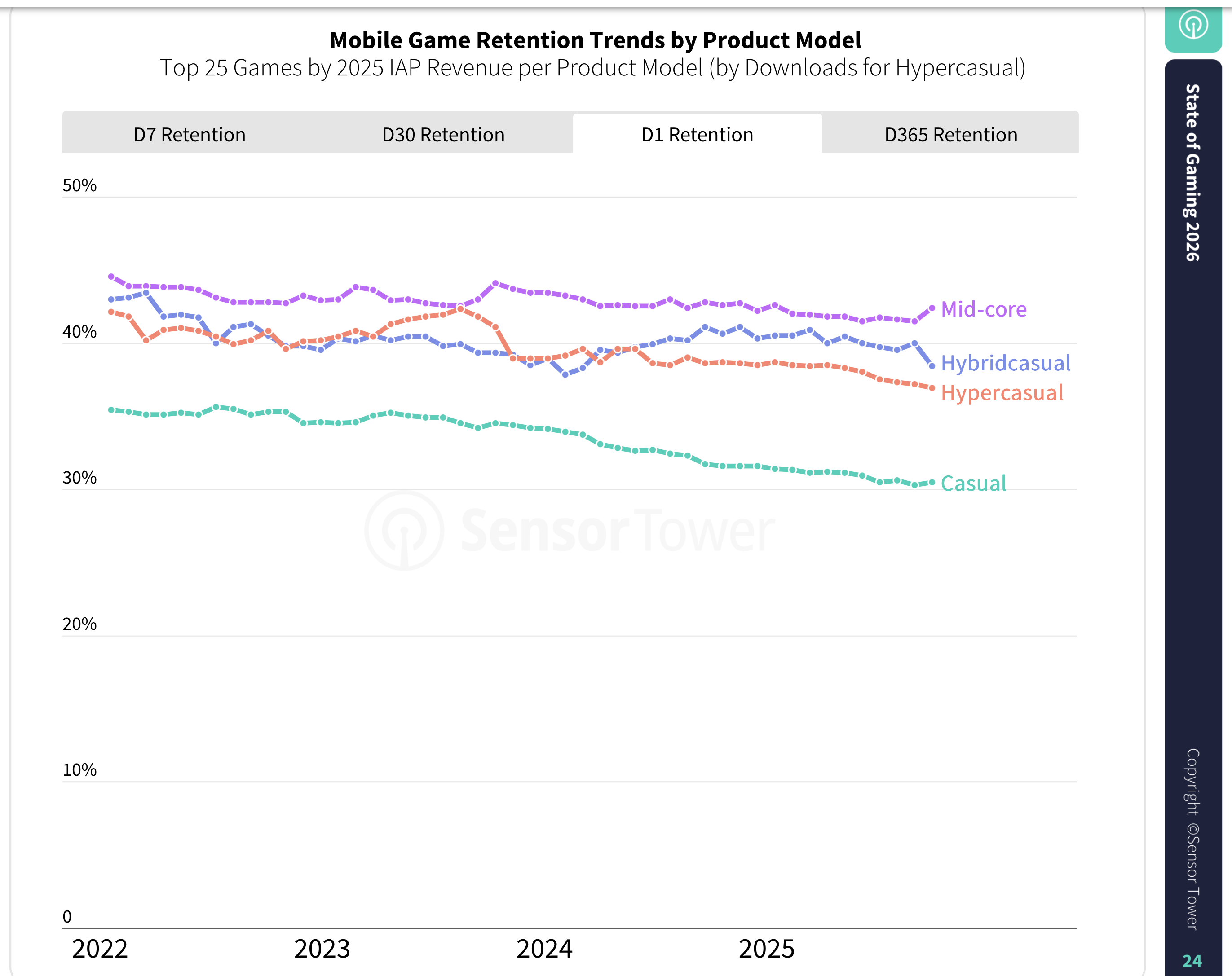
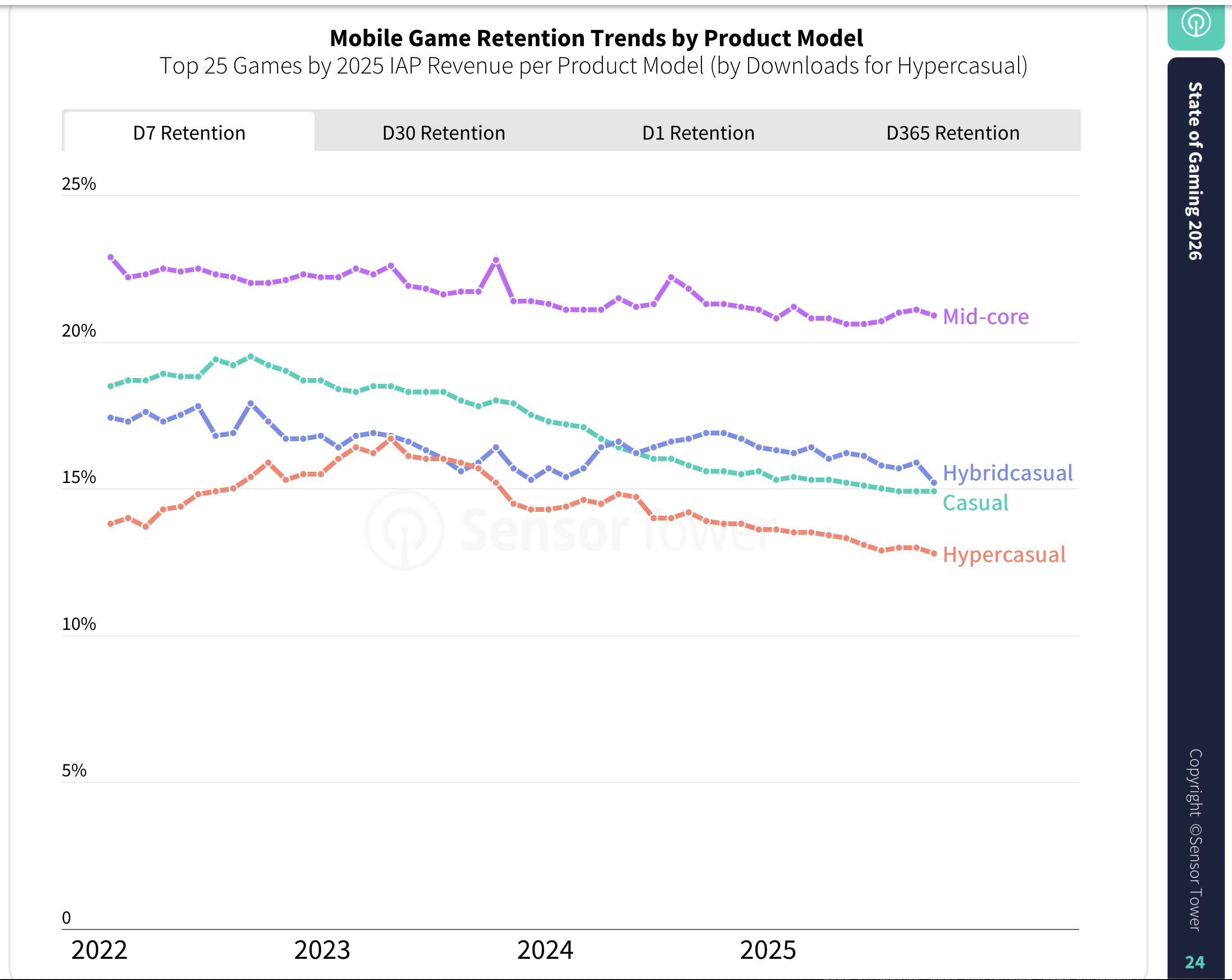
Casual D7 retention declined steadily from early 2022 through late 2025, a model-specific stickiness headwind that makes LiveOps event systems increasingly critical for casual publishers.
-
Top casual and mid-core titles remain the IAP revenue leaders. For publishers outside that tier, hybridcasual is the most direct way to ride the monetization trend, but its 2025 gains also raise the bar on monetization per hour.
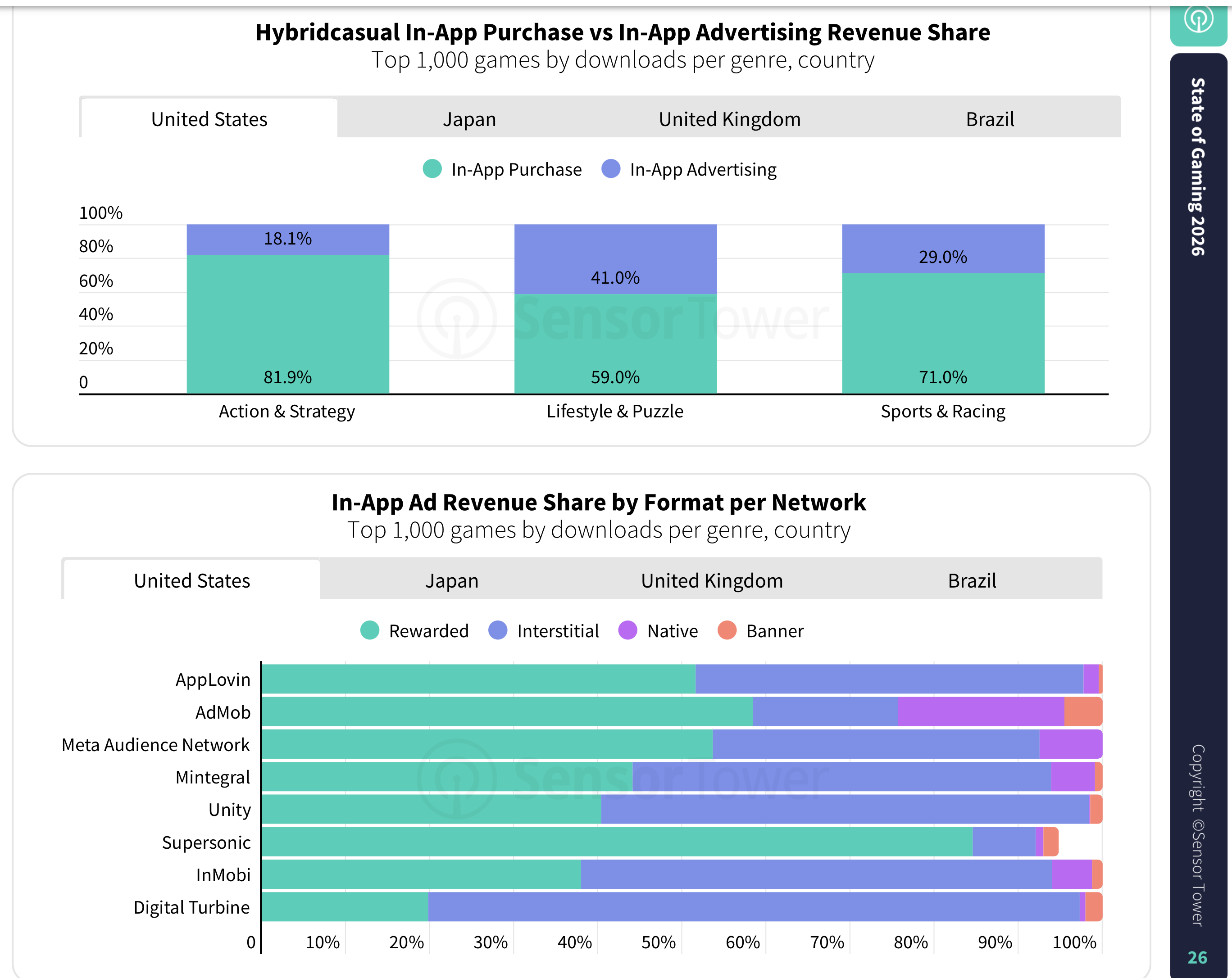
The US market generated $26.12 billion in mobile gaming revenue in 2025, according to Business of Apps. IAP revenue from non-game apps surpassed games for the first time in 2025, a signal that competition for consumer wallet share is now cross-category, not just cross-genre.
The core implication: with installs down and attention harder to win, each install must generate more value. Growth depends less on adding users and more on expanding lifetime value from the existing base.
Why This Creates Demand for LiveOps-Ready Partners
Sensor Tower's 2026 data is direct on this point: live ops is increasingly central, and high-quality execution is shifting from differentiation to table stakes. In 2025, LiveOps shifted toward retention and repeat play, with event menus proving the most consistent feature associated with revenue lift. 83.4% of events tagged "Events menu" were accompanied by a revenue lift, according to Playliner data cited in the Sensor Tower report. Long-term LiveOps success does not come from a single standout event; it comes from interlocking systems that align with player motivations.
The features driving the most consistent results combine progression with monetization: expeditions, multi-tier season passes, collection albums, and milestone-reward events. These are not features that can be bolted on after launch. They require architectural decisions made early in production.
For indie and mid-size studio founders, this creates a specific and concrete challenge. Building that full stack of expertise in-house is expensive and slow to develop. Many studios, across every stage of growth, use outsourcing partners to access that expertise, scale production efficiently, and keep their internal teams focused on the decisions only they can make.
The global game outsourcing market is projected to reach $17.4 billion by 2032, growing at 10.5% annually, driven largely by demand from mobile-first markets where live operations and post-launch support have become non-negotiable. The real challenge for US studios is not finding an outsourcing partner; it is finding one that understands the US market specifically. Not just one that lists "mobile" in its services menu, but one that thinks in LTV, retention curves, and LiveOps depth from day one.
What US Studios Should Demand from an Outsourcing Partner
The US market has specific requirements that not every outsourcing studio is equipped to meet:
-
IAP and monetization architecture: US players are the highest-spending cohort globally. A partner that cannot design and implement robust IAP systems, progression gating, and monetization flows is not ready for this market.
-
LiveOps from day one: The titles generating sustained US revenue are live-operated games, not one-and-done launches. Your outsourcing partner needs to architect for continuous updates, events, and A/B testing before a single line of code is written.
-
Soft launch and analytics integration: US studios typically soft launch in secondary markets before a global rollout. A partner experienced in soft launch pipelines, analytics hooks, and iteration cycles based on real data is worth significantly more than one that ships and steps back.
-
iOS and Android compliance: Apple's App Store review standards and Google Play's policy framework are both demanding. A partner that has shipped titles on both stores, repeatedly, reduces compliance risk substantially.
-
Time zone and communication fit: Most strong outsourcing partners operate from Eastern Europe or Asia. For US studios, that means asynchronous-first workflows with structured daily handoffs. The best partners have English-fluent production leads and US-compatible communication setups.
Top Game Development Outsourcing Companies for US Studios: Comparison Table
|
Studio |
HQ |
Service Area |
Core Services |
Platforms |
Best For |
|---|---|---|---|---|---|
|
Galaxy4Games |
Tallinn, Estonia |
Worldwide |
Full-cycle, LiveOps, mobile art |
iOS, Android, Web, cross-platform |
US studios needing a mobile-first full-cycle outsourcing partner with hands-on live game experience, IAP-ready architecture, and LiveOps post-launch support |
|
iLogos Game Studios |
Ukraine |
Worldwide |
Full-cycle, porting, QA |
Mobile, PC, Console |
Studios needing reliable multi-platform delivery with integrated QA |
|
Moonmana |
Ukraine |
Worldwide |
Full-cycle development |
Mobile, PC, Console |
Studios needing a full-cycle partner with a verified published portfolio across casual, MMORPG, and RPG genres |
|
Kevuru Games |
Ukraine |
Worldwide |
Art production, full-cycle |
Mobile, 3D |
Art-heavy mobile projects where visual quality is a core competitive differentiator |
|
Virtuos |
Singapore |
Global (EU, Asia, NA offices) |
AAA co-dev, remasters, full-cycle |
Console, PC, Mobile |
Enterprise-scale US studios with AAA production requirements and publisher relationships |
|
Room 8 Studio |
Ukraine |
Global (EU and NA teams) |
Game art, co-development, trailers |
Multi-platform |
Studios needing high-volume art production or co-development with existing internal engineering |
|
Pingle Studio |
Ukraine |
Worldwide |
Porting, art, co-development |
Multi-platform |
Studios porting existing titles to mobile or scaling art pipelines for a live game |
|
Sperasoft |
Serbia |
Global (EU, NA presence) |
Co-development, art, QA |
Multi-platform |
Studios needing a co-development partner with a strong US publisher track record |
|
Lemon Sky Studios |
Malaysia |
Worldwide |
Game art, animation |
Multi-platform |
US studios requiring high-volume, high-quality 2D and 3D art production at competitive rates |
Studio Profiles
1. Galaxy4Games
HQ: Tallinn, Estonia | Offices, representatives, and team members across the USA, UK, and most European countries Services: Full-cycle mobile game development, LiveOps, game art Platforms: iOS, Android, Web, and cross-platform Best for: US studios needing a mobile-first outsourcing partner with hands-on live game experience, IAP-ready architecture, and post-launch operations support
Galaxy4Games is a boutique full-cycle game development studio that combines 15+ years of hands-on game-building experience for clients with launching and operating their own live titles on the App Store and Google Play - including Animal Sort! and Bingo: Love in Montana, both live on Google Play and the App Store - using a proprietary Game Application Template, modular solutions library, and LiveOps-ready framework to help ROI-focused entrepreneurs, startups, and publishers build, launch, and scale games faster, starting from a proven, production-ready foundation.
That operational knowledge is encoded into three proprietary systems every client project benefits from. The Game Application Template provides a structured development foundation with core architecture, platform integrations, store compliance, and analytics hooks already built and tested, eliminating the setup work that typically consumes the first weeks of production. The modular solutions library is a set of battle-tested, plug-and-play components, including UI systems, event engines, monetization modules, progression frameworks, and LiveOps event tools, each proven in Galaxy4Games' own live products before touching a client build. The LiveOps-ready framework means games are architected from day one to support continuous updates, in-game events, analytics integration, and long-term player retention.
For US studio founders operating in a market where LTV and retention metrics determine survival, this translates to a partner that thinks in the same terms you do: one that will help you launch, operate, and grow your game from a foundation that was already proven before your project began. Together, these systems compress development time and costs by 30-50% compared to building from a blank slate.
Key strengths for US studios:
-
Boutique team of 40 senior specialists with direct communication and no factory-model overhead
-
Operator credibility: live games on the App Store and Google Play inform every client decision
-
IAP-ready architecture and monetization modules built and battle-tested in live products
-
LiveOps-ready framework built in from day one, not bolted on at launch
-
Full-cycle scope: concept, production, client/server development, DevOps, store compliance, and post-launch operations
-
Soft launch analytics support and real data-driven iteration from studios that run their own live titles
-
Recognised externally: Top 100 iOS App Developers (Techreviewer), Top Game Development Company (GoodFirms)
Learn more about Galaxy4Games' mobile development services
2. iLogos Game Studios
HQ: Ukraine (remote-first) | Service Area: Worldwide Services: Full-cycle development, porting, QA, game art Platforms: Mobile, PC, Console, Instant Games Best for: Studios needing reliable multi-platform delivery with integrated QA and mobile as the primary target
Founded in 2007, iLogos has built its reputation on production efficiency and consistent cross-platform delivery. For US studios that want a mobile-first build with potential PC or console extensions, iLogos provides a stable production partner with a long track record and integrated QA that reduces post-production defect rates.
Key strengths for US studios:
-
Proven cross-platform delivery with mobile as a first-class target
-
Integrated QA reduces revision cycles on both iOS and Android
-
Long studio history with a stable, experienced senior team
3. Moonmana
HQ: Ukraine | Service Area: Worldwide Services: Full-cycle game development Platforms: Mobile, PC, Console Best for: Studios needing a full-cycle partner with a verified published portfolio spanning casual, strategy, MMORPG, and RPG genres
Moonmana has been building and publishing its own games since 2008. Their portfolio spans a wide genre range: Ultimate Pirates is an MMORPG/strategy title published across Steam, Xbox, PS5, iOS, Android, and web, alongside RPG, action-adventure, and simulation projects. Client work includes projects for WB, Glu Mobile, and Azerion, providing US studios with verifiable evidence of delivery across different genre complexities and major publisher relationships.
Key strengths for US studios:
-
Verified published portfolio across casual, MMORPG, strategy, and RPG genres
-
Cross-platform delivery including iOS, Android, PC, and console
-
Long-term partner track record with major US and global publishers
4. Kevuru Games
HQ: Ukraine | Service Area: Worldwide Services: Digital art production, full-cycle game development Platforms:Mobile, 3D experiences Best for: Art-heavy mobile projects where visual quality is a core competitive differentiator in the US market
Kevuru sits at the intersection of art production and full-cycle development. For US studios building mobile titles where character design, environment art, and animation quality are central to product-market fit and UA creative performance, Kevuru provides a level of visual polish that pure-dev studios rarely match.
Key strengths for US studios:
-
High-end art production alongside full development capability
-
Strong track record in 3D and character-driven mobile projects
-
Single-partner solution for studios that need art and dev without managing two vendors
5. Virtuos
HQ: Singapore | Service Area: Global (studios across EU, Asia, North America) Services: AAA co-development, remasters, full-cycle development Platforms: Console, PC, Mobile Best for: Enterprise-scale US studios with AAA production requirements and established publisher relationships
Virtuos operates at the top end of the outsourcing market. With studios across multiple continents and a client list that includes the world's largest publishers, they are the right choice when project scope and budget match AAA expectations. For most independent US mobile studios, Virtuos is likely oversized, but for larger publishers or studios working on premium titles with console tie-ins, their scale and infrastructure are difficult to match.
Key strengths for US studios:
-
Unmatched scale for enterprise-tier co-development
-
North American studio presence reduces time zone friction for US teams
-
Established publisher relationships that smooth co-development pipelines
6. Room 8 Studio
HQ: Ukraine | Service Area: Global (EU and NA delivery teams) Services: Game art, co-development, trailers and marketing assets Platforms: Multi-platform, with strong mobile art capability Best for: US studios needing high-volume art production or co-development alongside existing internal engineering
Room 8 has built a strong position in game art and co-development, with contributions to major global titles. Their co-development model integrates cleanly with studios that have internal engineering but need to outsource art production to hit shipping timelines. Their marketing asset capability is also relevant for US App Store and Google Play launch campaigns.
Key strengths for US studios:
-
High-volume art production with consistent quality standards
-
NA delivery teams reduce the time zone gap for US-based production leads
-
Strong marketing asset capability for store launches and UA creative
7. Pingle Studio
HQ: Ukraine | Service Area: Worldwide Services: Porting, art production, co-development Platforms: Multi-platform Best for: US studios porting existing titles to mobile or scaling art pipelines for a live game
Pingle's core strength is porting and large-scale art production. For US studios with an existing PC or console title looking to bring it to iOS and Android, Pingle's porting expertise is directly relevant. They have handled high-profile porting projects and built the operational structure to run parallel production pipelines without quality degradation.
Key strengths for US studios:
-
Specialist porting capability for studios expanding to mobile from other platforms
-
Large-scale art production for live games needing regular content updates
-
Structured for parallel workstreams, useful for LiveOps-heavy titles
8. Sperasoft
HQ: Serbia | Service Area: Global (EU and NA presence) Services: Co-development, game art, QA Platforms: Multi-platform Best for: US studios needing a co-development partner with a verified track record alongside major US publishers
Sperasoft has worked with a wide range of global publishers on co-development, art, and QA across major franchises. Their NA-aligned presence and established publisher relationships make them a credible option for US studios looking for a co-development partner that already understands the production standards major US publishers expect.
Key strengths for US studios:
-
Verified co-development track record with major global publishers
-
NA-aligned teams reduce coordination friction for US studios
-
Strong QA capability for studios shipping to both iOS and Android simultaneously
9. Lemon Sky Studios
HQ: Malaysia | Service Area: Worldwide Services: Game art, 2D and 3D animation Platforms: Multi-platform Best for: US studios requiring high-volume, high-quality 2D and 3D art production at competitive rates
Lemon Sky has established a strong reputation for art production quality across a wide range of titles and platforms. For US studios managing tight production budgets while maintaining high visual standards, particularly for mobile titles where art quality directly impacts UA creative performance and store conversion, Lemon Sky offers a reliable, high-output option.
Key strengths for US studios:
-
High-volume 2D and 3D art production with a consistent quality track record
-
Competitive rates relative to equivalent EU or US-based art studios
-
Broad platform experience including mobile-specific asset formats and specifications
How to Choose the Right Partner for Your US Mobile Project
The profiles above give you the full picture on each studio. The right choice depends on where your project sits right now and what you actually need the partner to do.
Match the Partner to Your Production Need
Each studio on this list has a distinct core strength. Galaxy4Games is the right fit when you need a full-cycle partner that will stay with you through launch, soft launch iteration, and LiveOps operations. iLogos and Moonmana are strong full-cycle options with verified published portfolios. Kevuru and Lemon Sky are the right call when art quality is the primary variable. Room 8 and Pingle are built for studios with internal engineering that need to outsource specific workstreams at scale. Sperasoft and Virtuos serve the upper end of the market, where co-development with major publisher standards is the requirement.
The LTV Question
The single biggest differentiator between outsourcing partners for US studios is how they think about post-launch. The US market rewards games that retain and monetize well over time, not titles that launch strongly and decay. A partner that has no experience operating live games will not understand why your Day 30 retention curve matters more than your Day 1 install count.
The question to ask every candidate: "Walk me through how you approach soft launch analytics and LiveOps architecture." The answer will tell you everything about whether they are a build-and-ship vendor or a long-term production partner.
Working Hours and Communication
Most studios on this list operate from Eastern Europe or Asia. For US teams, that typically means a 7-10 hour time difference with Eastern European partners and a 12-14 hour gap with Asian studios. The best partners structure production around asynchronous workflows with daily written handoffs, dedicated English-speaking production leads, and scheduled overlap windows for live calls.
Key questions to ask during vetting:
-
Who is your primary production contact, and what are their working hours?
-
How do you structure daily handoffs for asynchronous teams?
-
What project management tools do you use, and can we integrate with our existing stack?
Budget Signals
Eastern European studios typically operate at 30-60% of the cost of equivalent US-based development capacity. For a US indie studio managing seed or Series A budgets, that differential is significant. The studios on this list are not budget shops; they are professional production partners that happen to offer competitive rates relative to the US market.
Key takeaway: The right outsourcing partner for a US mobile studio is not the cheapest or the largest. It is the one whose production model, LiveOps thinking, and monetization experience most closely matches where your game needs to go.
Further Reading
Further Reading
-
The Real Cost of Launching a Mobile Game: Why ROI Thinking Must Start on Day One - development cost benchmarks, UA budgets, soft launch strategy, and LiveOps economics for mobile studios
-
Top 10 Game Development Companies in Europe - a broader look at the European studios shaping mobile, PC, and cross-platform game production
-
Top LiveOps Providers Known for Innovative Game Solutions in 2026 - a guide to the studios and platforms leading the LiveOps space in 2026
-
Game Development Outsourcing: How Studios Reduce Costs and Scale Production in 2026 - a practical breakdown of how outsourcing works, where it saves money, and how to structure it for scale
-
Monetization Strategies for Mobile Games and Apps That Actually Work - IAP design, ad monetization, and hybrid models grounded in real mobile market data