

How Galaxy4Games Took Over a Failed Game and Improved It With Modular Solutions Without Starting Over
"My previous game studio failed to deliver my game."
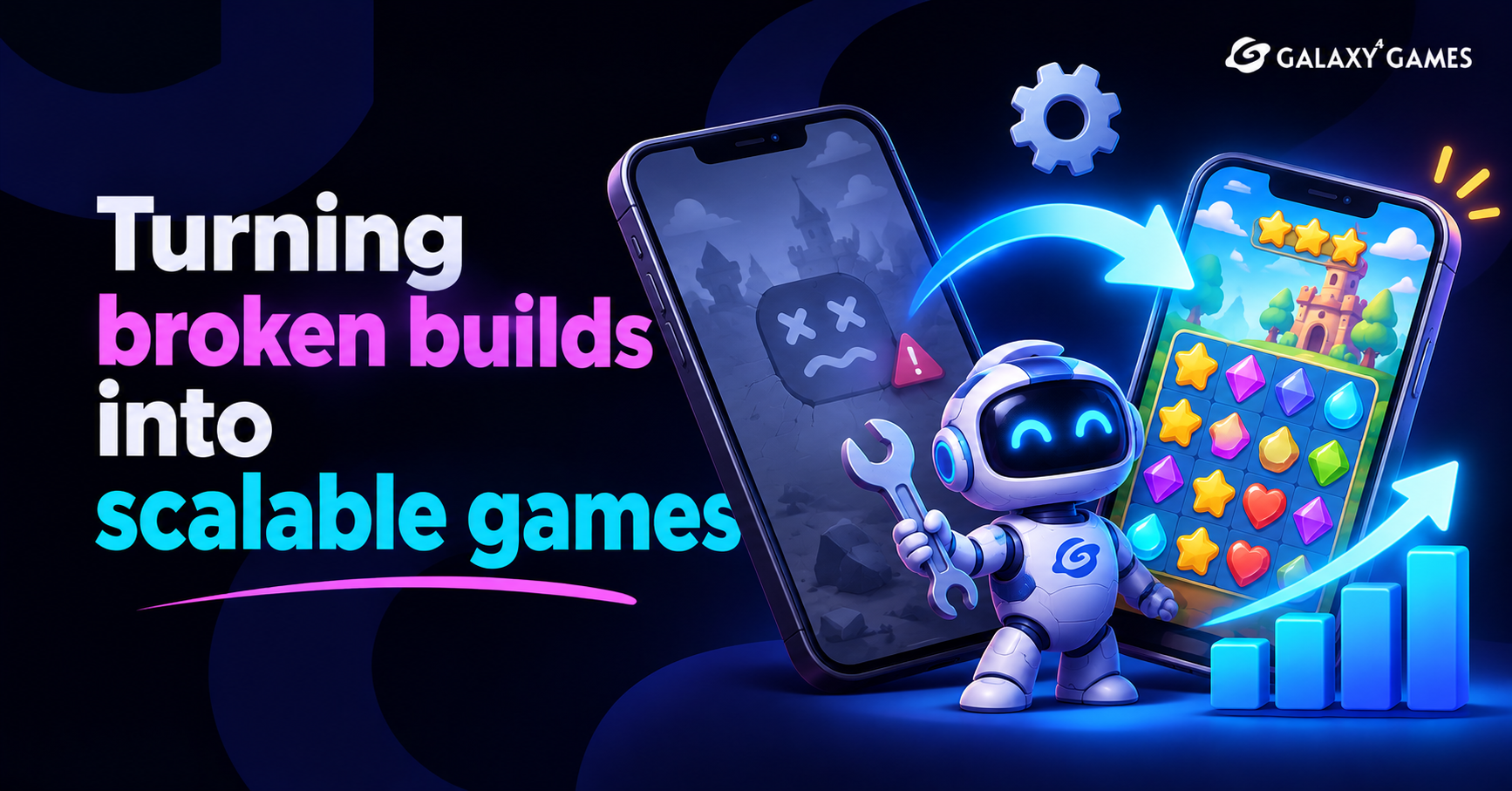
The client had invested months and significant budget into a mobile game they believed in. A Brawl Stars-style multiplayer experience with real commercial potential. And the studio they trusted to build it had delivered something that couldn't even pass App Store review.
Missed deadlines. Repeated submission failures. A codebase the team couldn't explain, couldn't build reliably, and couldn't ship. When the client finally reached out to Galaxy4Games, they weren't just looking for a new development partner. They were trying to figure out whether anything they'd paid for was salvageable.
That question, "is it worth saving?", is the one every founder in this situation is really asking. Not "can someone fix the bugs?" but "did I waste everything?"
The short answer: probably not. The longer answer is what this article is about.
This is the story of how a real client, with a real failed project, went from stuck and demoralized to a game in production on Android and iOS, a shipped seasonal event, measurable retention improvements, and new features that now take weeks instead of months - without throwing away existing work or paying to rebuild from scratch.
If you've been burned by a previous game development studio and you're trying to decide whether to rescue the project or start over, this case study was written for you.
What Went Wrong: The Anatomy of a Failed Game Development Engagement
The client's situation wasn't unusual. It's a pattern that plays out more often than most outsourcing studios will admit.
She had hired a team to build a competitive multiplayer mobile game in the Brawl Stars genre: real-time battles, character progression, seasonal content. The concept was solid. The market opportunity was real. But over the course of the engagement, every major commitment had been broken.
The Warning Signs That Were Already There
By the time she contacted Galaxy4Games, the project had accumulated a full set of failure indicators:
-
Deadlines missed repeatedly, with explanations that changed each time
-
Store submission failures on both Google Play and the App Store, with no clear path to resolution
-
No working build that ran reliably across devices
-
Code delivered without documentation, making it impossible to understand or hand off
-
Communication that had gone dark, with the team increasingly difficult to reach
The store submission failures were particularly damaging. Getting a mobile game approved by Apple and Google requires technical compliance with platform guidelines, proper signing certificates, correct API usage, and stable builds. Repeated failures on this front aren't just a delay; they signal deeper structural problems in how the codebase was built.
What this means for the client: Every week stuck in submission limbo is a week of marketing budget, momentum, and opportunity cost bleeding out. For a game targeting a competitive genre, timing matters.
The Fear Nobody Talks About
Beyond the practical failures, there was an emotional layer that shaped everything that followed. The client was afraid.
Not just frustrated, not just annoyed. Genuinely afraid that the code they'd paid for was so badly built that any new studio would say the same thing: "This is unfixable. We need to start over."
That fear is rational. "Start over" is the most common recommendation a new development team gives when they inherit a failed project. It's also, in many cases, the most expensive and least necessary one.
The First Step: A Consultation Before Any Commitment
The client didn't come to Galaxy4Games asking to hire a new studio. They came asking for a consultation.
That distinction matters. When you've already been burned once, signing another development contract without understanding what you actually have is exactly the kind of decision that gets you burned again. She wanted answers before she committed to anything.
The consultation covered three things:
-
What her current situation actually looked like from a technical and commercial standpoint
-
What realistic options existed for moving forward (not just "rebuild everything")
-
What the next steps should be regardless of whether she chose Galaxy4Games or not
This is the right way to approach any studio after a failed engagement. A team that gives you honest options before you sign anything is a team that has less incentive to oversell you on unnecessary work.
Key insight: The first question to ask any new studio isn't "can you build my game?" It's "what do you actually recommend after reviewing what I already have?" If the answer is always "start over," that's a red flag, not a guarantee of quality.
The Painful Middle: Getting the Code Out
After the consultation, the client faced the hardest part of switching development partners: getting the assets back.
The previous team had the source code, the art assets, the project files, and the store credentials. Extracting all of it required persistent, documented requests and a difficult period of back-and-forth. This is one of the most underestimated risks in mobile game outsourcing and it's worth addressing before any engagement ends, not after.
What needed to be recovered included:
|
Asset Type |
Why It Matters |
|---|---|
|
Full source code repository (with history) |
Without version history, the new team inherits a snapshot, not a project |
|
Raw art and audio source files |
Compiled assets in a build can't be edited or extended |
|
Store console access (owner-level) |
Required to submit updates; developer-level access is not enough |
|
Signing keys and certificates |
Without these, the app cannot be published to the existing store listing |
|
Third-party SDK accounts and licenses |
Analytics, ads, and crash reporting break without these |
The process was slow and frustrating. But she got what she needed. And that made everything that followed possible.
The Code Audit: What We Actually Found
Once the project files were transferred, Galaxy4Games conducted a thorough code audit. The client expected the worst - the reality was more nuanced.
The code was genuinely poor quality. Inconsistent architecture, missing documentation, technical debt across multiple systems, and a build pipeline that explained the persistent store submission failures. None of that was a surprise.
But "poor quality" and "unsalvageable" are not the same thing.
The Three-Path Framework
When a new studio inherits a troubled codebase, there are typically three routes forward:
|
Route |
What It Means |
Choose When |
|---|---|---|
|
Incremental improvement |
Fix critical issues, replace weak systems with proven modules, build on what works |
Source is complete, core game loop is sound, design is valid |
|
Partial rebuild |
Keep assets and design; rewrite specific systems that are unmaintainable |
Specific subsystems are broken beyond repair but the majority is recoverable |
|
Full rebuild |
Start from scratch with new code |
Source is missing, core architecture is fundamentally broken, or the game design itself needs to change |
The Galaxy4Games audit found that the game's core concept and assets were intact. The design was sound. The problems were in implementation quality, not in the vision.
The recommendation was incremental improvement, not a full rebuild.
This is not the recommendation most studios give. A full rebuild generates a larger contract, a longer timeline, and more billable hours. It also carries the implicit message that the previous team's work was completely worthless, which is rarely true and almost always an oversimplification.
The real risk of a full rebuild: You spend 6-12 months and significant budget recreating what you already have, while your market window narrows. Incremental improvement, done methodically, gets you to a shippable product faster and at lower cost.
Why Modular Solutions Change the Equation
Galaxy4Games operates with a proprietary modular solutions library: production-ready game systems that have been built, tested in live titles, and refined into components that can replace weak implementations in an inherited codebase.
Instead of rebuilding the entire game, the plan was to progressively swap out the lowest-quality systems with battle-tested modules. This approach compresses the risk: at every stage, the game is in a more stable state than it was before, and the client can see and evaluate progress in real increments rather than waiting months for a complete rebuild to materialize.
A concrete example: the Window System. A prototype typically has screens written one at a time, each with its own way of opening, closing, animating, and reacting to the rest of the game. That is fast on day one and expensive forever after - every new screen is a new set of potential bugs. The first structural change, made in the second week, was to move all existing popups onto the Galaxy4Games window module. From then on, every screen in the game (settings, login, level-up, Daily Bonus rewards, the no-connection popup, the match result) is built the same way: a layout, the logic behind it, and one shared system that opens, closes, animates, and orders them. Ordering is handled once. Look and logic are separate. Transitions are shared. A new screen became routine work with predictable risk, not a source of regressions.
The migration followed the order of risk: foundation first (core architecture, screens, audio), then money and identity (purchasing, authentication), then onboarding (tutorials), then growth (analytics, attribution, localization). After each step the game still built, still ran, and was in better shape than before. The full picture across 18 modules:
|
Area |
Module |
What it delivered |
|---|---|---|
|
Architecture |
Core architecture modules |
Core systems untangled in week 2; features no longer depend on hidden connections |
|
Screens |
Window system |
Every popup converted to a window in week 2; used for all new screens since |
|
Audio |
Audio system |
Audio replaced early and extended as the game grew |
|
Identity |
Authentication module + account backend |
Device, Google Play Games and Apple sign-in; account deletion |
|
Payments |
Purchasing module |
Purchases made reliable and server-checked (weeks 2-3) |
|
Onboarding |
Tutorial module |
Tutorials rebuilt on the module around week 7, including first-launch guidance |
|
Rewards |
Rewards module |
Daily Bonus rewards, experience and currency flying to the HUD, celebratory reward effects |
|
Flow control |
Tasks and state machine |
Lobby flows (level-up, Daily Bonus, tutorials) run in a defined order |
|
Content delivery |
Asset manager |
Lighter start-up (week 6); extra character skins downloaded on demand |
|
Languages |
Localization module |
English, German and Spanish |
|
Data |
Analytics module |
Analytics from week 7; ad attribution in week 8 |
|
Delivery |
Auto-build pipeline |
Builds and store test deliveries run without manual steps |
Two things are worth noticing. First, none of this required the game design to change: players still get the Brawl Stars-style battles the client wanted. Second, each module arrived with its own tested behavior, so the team spent its time on the game rather than rebuilding login, purchases, or tutorials from scratch.
The migration is not finished, and that is stated plainly. It is a running list, worked down in order of risk, which is exactly why the game could keep shipping while it happened.
The next sections show what that looked like in practice, using the real history of this project.
From Inherited Badly Written Prototype to Production Game: The Week-by-Week Reality
Weeks, Not Months: What the Modular Foundation Buys You
A prototype can show an idea. A product has to keep adding to it: new modes, new events, new reasons to come back. In a typical prototype codebase, each of those is a project of its own, measured in months, because every addition fights the code underneath it.
Once the game was on the modular foundation, the same kind of work shrank to weeks, and in some cases days. Three examples, all from the project history:
|
Feature |
Time to players |
What it reused |
|---|---|---|
|
Halloween update |
About four weeks after the takeover, during the rescue itself |
Window system, shared UI components, the modular approach |
|
Daily Bonus |
About four days |
Windows, rewards and fly-to-HUD effects, analytics |
|
Analytics and ad attribution |
About a week |
Analytics module, build pipeline |
Why It Moves This Fast
None of these needed a new login, a new reward flow, or a new screen framework. Three things explain the pace:
-
New features plug into existing systems. Screens, rewards, tutorials, analytics, and localization already exist, so a feature is mostly its own content and rules.
-
One automated delivery pipeline. Every feature reaches testers the same way, without manual steps.
-
Ideas are checked early. Design documents and quick prototypes validate a feature before it is built in the engine.
The Halloween update followed the same logic earlier in the project: it ran on top of a stabilized core, instead of waiting for a perfect one, and gave the client their first real player data.
With the audit complete, Galaxy4Games proposed a phased recovery roadmap. The goal wasn't to build the perfect game on day one. It was to reach a meaningful, shippable MVP as quickly as possible, validate it through user acquisition testing, and then iterate based on real data.
In the first week, the inherited game moved into Galaxy4Games' own repository. By week six, the game server was in production and the first production builds were out. Ten weeks in, the project had a backend of its own, a five-person team working in one workflow, and new features reaching players in weeks, not months.
That is the practical meaning of "incremental improvement": the game was in a better, shippable state at every step, and every step is visible in the history.
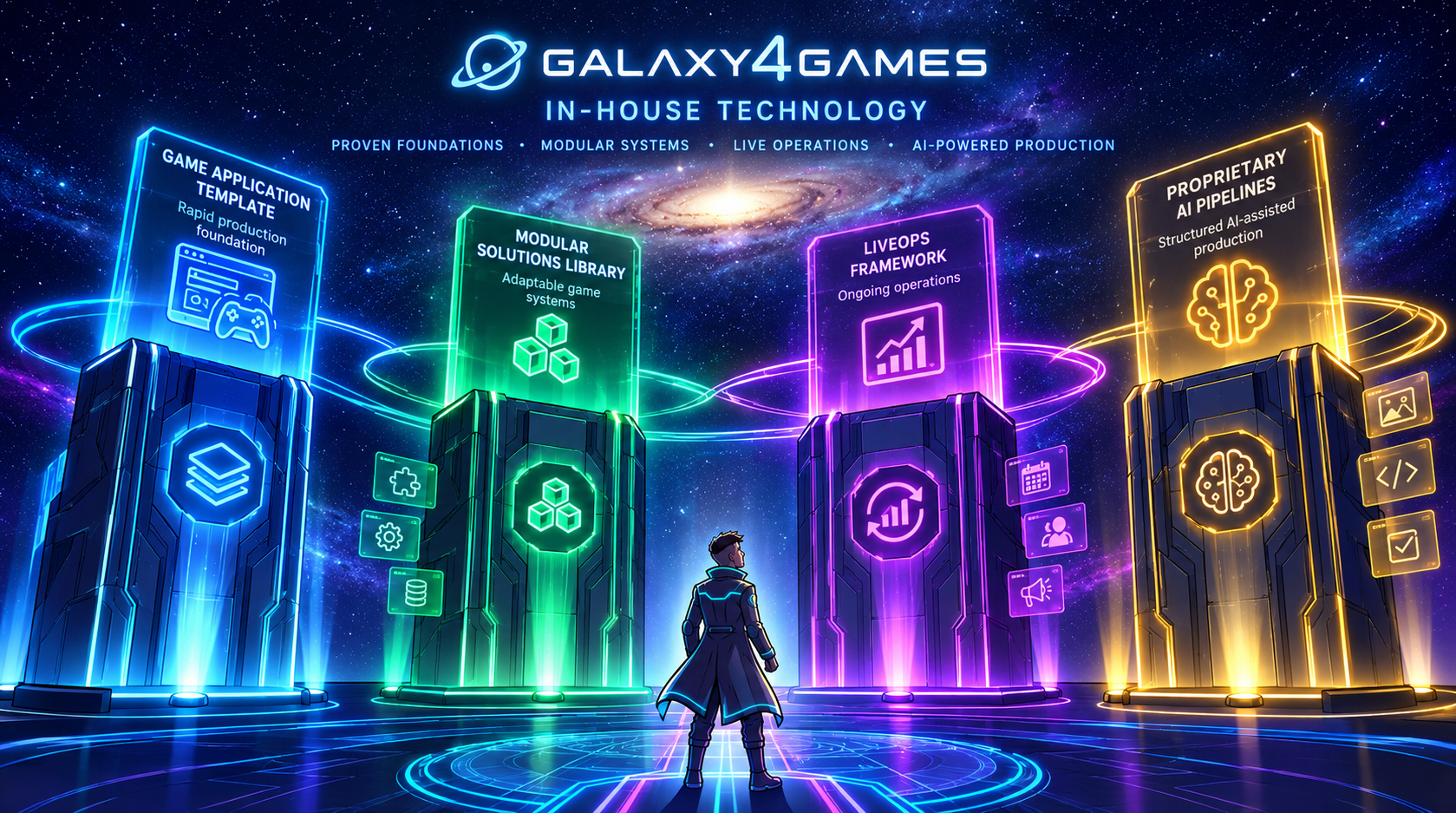
|
When |
What changed |
|---|---|
|
Week 1 |
Inherited game moved into a clean, traceable repository |
|
Weeks 2-3 |
Weakest core systems replaced with proven modules; purchases made reliable; every task tracked as a ticket |
|
Weeks 3-5 |
New sign-in and account system; automated delivery to the stores' test channels; Halloween update |
|
Week 6 |
Game server and first builds in production; account deletion flow; faster, lighter start-up |
|
Weeks 6-8 |
Daily Bonus, rebuilt tutorials, analytics, localization and ad attribution |
|
Weeks 9-10 |
New content and modes prepared on the same foundation |
Three things stand out from this history.
Store compliance became routine, not a crisis. Signing, automated delivery to the stores' test channels, crash reporting, and an in-app account deletion flow (which both Apple and Google require) are now part of the build pipeline. The issues that kept the previous studio's game out of the stores were fixed once, at the root, and stayed fixed.
Work became traceable. From the third week onward, tasks are tracked as numbered tickets and the commit history follows them. The client can see what was done, when, and why - which directly answers the "code without documentation" problem that started this whole story.
A backend was built to carry growth. The backend has its own repository, developed from the first weeks. It covers sign-in and accounts, player profiles and progress, account deletion, and game settings served from Galaxy4Games' own servers - with monitoring built in, so when something breaks at scale, the team sees it immediately.
Phase 1: Critical Bug Fixes, Module Integration, and the Halloween Event
The first iteration had three priorities running in parallel:
1. Critical bug fixing. The store submission failures were traced to specific technical compliance issues in the build pipeline. Fixing these was non-negotiable; nothing else could ship until the game could actually pass review. In practice, this meant a working Android build within the first two weeks, automated delivery to the stores' test channels by week five, and production builds by week six.
2. Switching to Galaxy4Games modules. The weakest systems in the inherited codebase were identified and replaced with production-ready modules from Galaxy4Games' proprietary library: core architecture, screens, and audio first, then purchasing, authentication, and tutorials. This wasn't cosmetic cleanup; it addressed the architectural issues that had caused the most instability and made future development significantly faster.
3. Adding a Halloween seasonal event. This might seem like an unusual priority for a rescue project, but the reasoning was deliberate. A seasonal LiveOps event, built using Galaxy4Games' modular approach, served two purposes: it gave the game a compelling reason for players to engage immediately after launch, and it provided real retention data from real players. The Halloween update was delivered on schedule, about four weeks after the takeover.
The retention data it generated was the first genuine signal the client had about how the game actually performed with real users.
The result: measurably improved retention compared to the pre-rescue baseline.
Why Starting with a Seasonal Event Was the Right Call
Most rescue projects focus exclusively on stabilization before adding any new content. That's the cautious approach. It's also the approach that keeps a game in development limbo for months before anyone outside the team ever plays it.
The modular event system made it possible to add a high-quality seasonal event without requiring the underlying codebase to be perfect first. The event ran on top of the stabilized core, delivered a real player experience, and generated the UA test data needed to inform every subsequent decision.
This is what "LiveOps-ready architecture" actually means in practice: not a marketing phrase, but a technical reality where new content can be added and tested without a full development cycle for each update.
Phase 2: Ongoing Module Migration and LiveOps Expansion
The work continues, and the first part of Phase 2 has already shipped:
-
Continued migration to Galaxy4Games modules across the remaining systems, progressively eliminating technical debt and raising code quality to production standard. Game settings, for example, moved to Galaxy4Games' own backend in week ten.
-
Analytics and attribution in place. devtodev and Firebase analytics from week seven, Meta attribution and test-campaign creatives from week eight - so every build now produces data the client can act on.
-
New modes and content on the same foundation. New modes and events are being prepared without re-architecting the game, so new content is mostly content work, not engineering work.
-
A LiveOps event calendar built on the insights from UA testing, adding content that the data shows players actually want.
-
Balance in documented passes. Hero and weapon balance is documented and tuned in written design passes, so changes can be made deliberately and verified in-game.
This is the structure of a game that operates as a live product, not a one-time launch. The difference between a game that earns revenue for months and one that spikes and dies is almost always in the quality and consistency of post-launch operations.
What This Means If You're in the Same Situation
If you're reading this because you've had a similar experience with a previous game development partner, here's what this case study actually tells you.
Your investment is probably not lost
The instinct after a failed engagement is to assume the worst: that the code is garbage, the assets are unusable, and the only way forward is to pay twice to rebuild everything. That's the narrative most studios will confirm, because it leads to a larger contract for them.
The reality is that most troubled codebases have salvageable value. The game's core concept, its art assets, its design decisions, and often large portions of its code can be preserved and improved. What usually needs to change is the quality of specific systems, not the entire foundation. The project in this case study is the proof: the same game, the same design, on a foundation that now ships new features in weeks.
According to industry data, most inherited mobile game projects can be upgraded for 20 to 40 percent of their original build cost when the source files are complete and the core design is sound. A full rebuild only becomes the rational choice when source files are missing, the architecture is fundamentally broken, or the game design itself requires material change.
What to do right now
If you're currently stuck with a failed development engagement, take these steps before contacting any new studio:
-
Secure your accounts. Make sure you have owner-level access to your Google Play Console and App Store Connect. Developer-level access is not enough. Do this before the relationship with the previous team deteriorates further.
-
Request everything in writing. Source code repository with full history, raw art and audio source files, signing keys and certificates, SDK accounts and licenses. Document every request.
-
Don't sign a new development contract before an audit. Any studio that gives you a firm quote on rescue work without reading the code is guessing. The quote will move. Insist on a code audit as the first step.
-
Ask specifically about the incremental option. When you speak to a new studio, ask: "What would an incremental improvement approach look like?" If they can't articulate one, they're defaulting to rebuild.
-
Ask how new features will be built after the rescue. A rescue that only fixes bugs leaves you with a stable game and the same slow, expensive roadmap. Ask for the studio's reusable systems (screens, tutorials, rewards, analytics, events) and for examples of how fast a new mode or event has been delivered on them.
-
Start with a consultation, not a contract. A team that helps you understand your options before asking you to sign anything is demonstrating the kind of client-first thinking you need after a bad experience.
The question worth asking any prospective studio
"If you reviewed my existing code and found it was poor quality but not unsalvageable, would you recommend incremental improvement or a full rebuild? Walk me through how you'd make that decision."
The answer will tell you a great deal about whether that studio is optimizing for your outcome or their billing.
Why Galaxy4Games Approaches Rescue Projects Differently
Galaxy4Games is a boutique mobile game development studio with one operational advantage that changes the calculus on rescue projects: the team builds and operates its own live games on the App Store and Google Play.
That distinction matters more than it might appear. A studio that has shipped and operated its own titles has direct experience with exactly the problems that sink outsourced projects: store compliance, build stability, retention mechanics, LiveOps event execution, and the post-launch decisions that determine whether a game grows or stalls.
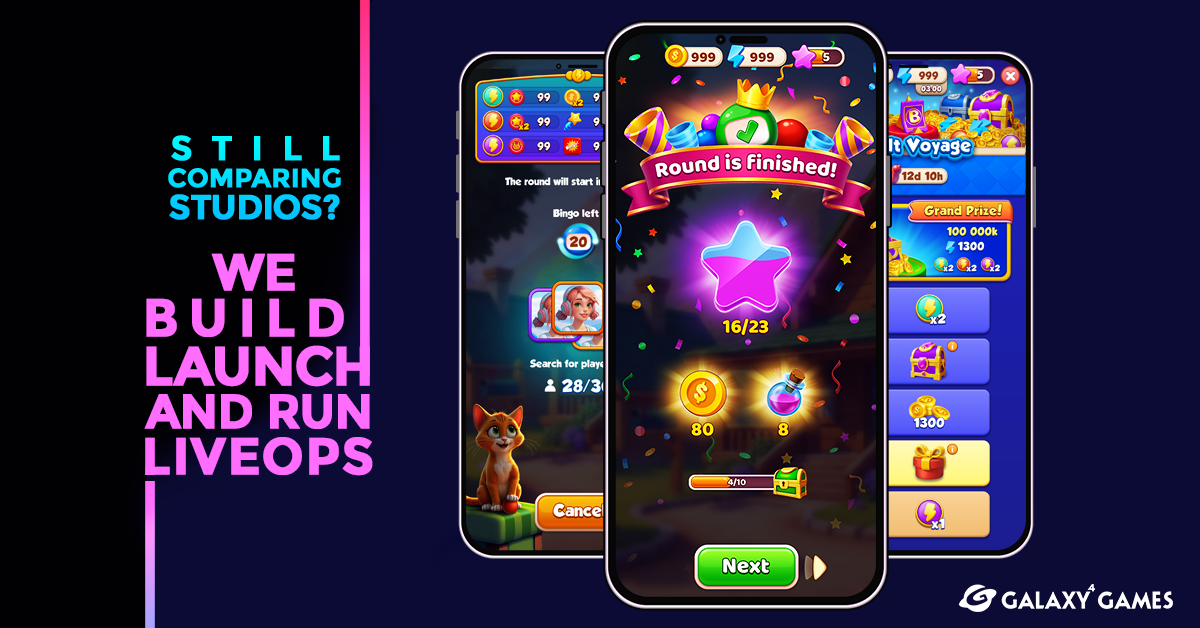
What the Modular Approach Delivers in Practice
The proprietary modular solutions library isn't a portfolio of theoretical components. Each module has been battle-tested in Galaxy4Games' own live products before being deployed in client work. When a module replaces a weak system in an inherited codebase, the client isn't getting an experiment; they're getting something that already works in a live environment.
For rescue projects specifically, this matters because:
-
Speed: Replacing a broken system with a proven module is faster than rebuilding it from scratch. The project went from import to production builds in five weeks.
-
Reliability: A module that runs in a live game has already encountered and resolved the edge cases that a fresh implementation hasn't.
-
Predictability: The client can see what the module does in a live product before it's integrated into theirs.
-
Scalability: Screens, tutorials, rewards, analytics, localization, and a monitored backend are in place from the start, so growth means adding content rather than re-architecting.
-
Delivery speed after the rescue: New features and modes take weeks, not months. The Daily Bonus went from start to a playable build in about four days.
The delivery speed after the rescue makes this concrete:
|
Feature |
Time to players |
What it reused |
|---|---|---|
|
Halloween update |
About 4 weeks after takeover, during the rescue itself |
Window system, shared UI components, modular approach |
|
Daily Bonus |
About 4 days |
Windows, rewards and fly-to-HUD effects, analytics |
|
Analytics and ad attribution |
About 1 week |
Analytics module, build pipeline |
None of these needed a new login system, a new reward flow, or a new screen framework. New features plug into existing systems, so a feature is mostly its own content and rules - not a ground-up engineering project.
The LiveOps Framework as a Foundation, Not an Add-On
Most studios treat LiveOps as a feature to be added after launch. Galaxy4Games builds it into the architecture from the start, which is why it was possible to deliver a full seasonal event (the Halloween update) during the rescue phase itself, not after months of additional development.
For a competitive multiplayer game in the Brawl Stars genre, LiveOps is not optional. The games that retain players and generate sustainable revenue are the ones that give players reasons to return on a weekly and monthly basis. Building that capability into the foundation, rather than retrofitting it later, is one of the most consequential decisions in mobile game development.
The client's project now has that foundation. And the ongoing work, adding new events based on UA test results, is the operational model of a game built to grow.

Ready to Talk About Your Project?
If your previous game development partner failed to deliver, the first step isn't signing a new contract. It's understanding what you actually have and what it would take to get it to market.
Galaxy4Games offers an initial consultation for founders and publishers in exactly this situation. The conversation covers your current state, what realistic recovery options look like, and what a step-by-step path to launch could involve, with no obligation to proceed.
The client in this case study started with a consultation. They left with a plan, a realistic timeline, and for the first time since the project began, a team they could trust. Ten weeks later, they had a game in production and a roadmap of new content.
Contact Galaxy4Games to book your consultation and get an honest assessment of where your project stands.